







Question: Hello, I have a case study that i am working on, it was completed and submitted for a grade. However, the professor gave me until
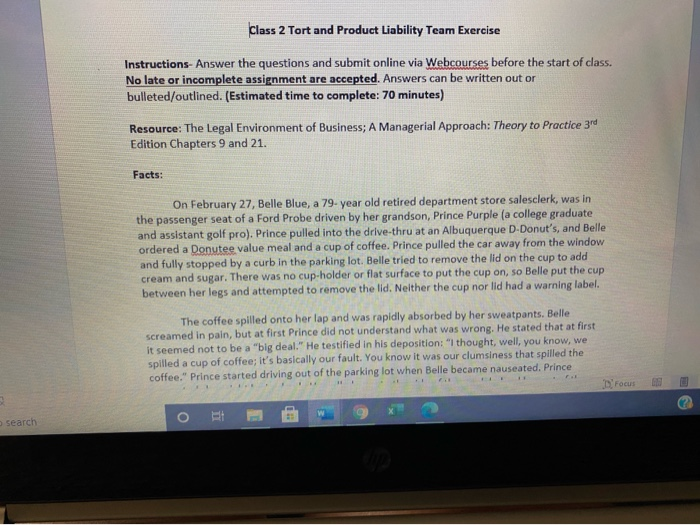
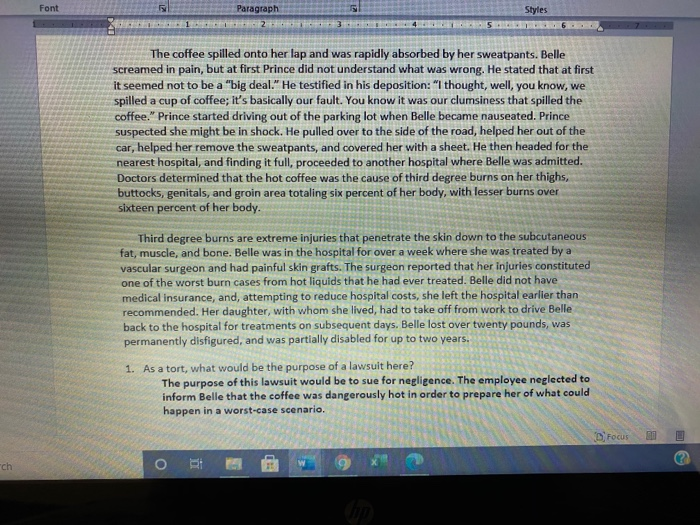
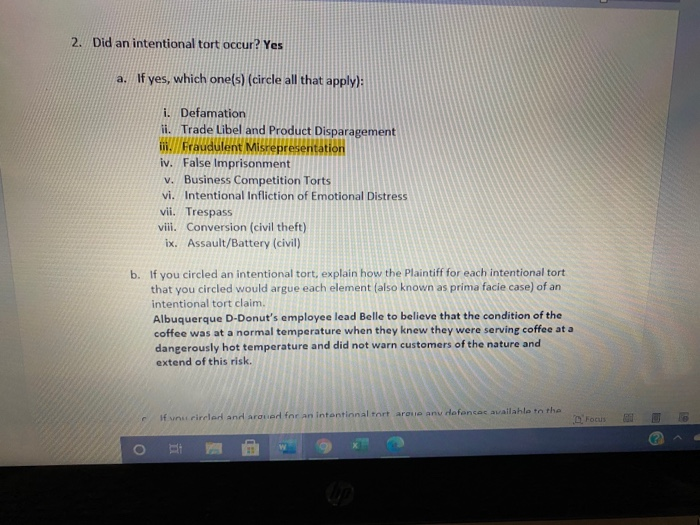
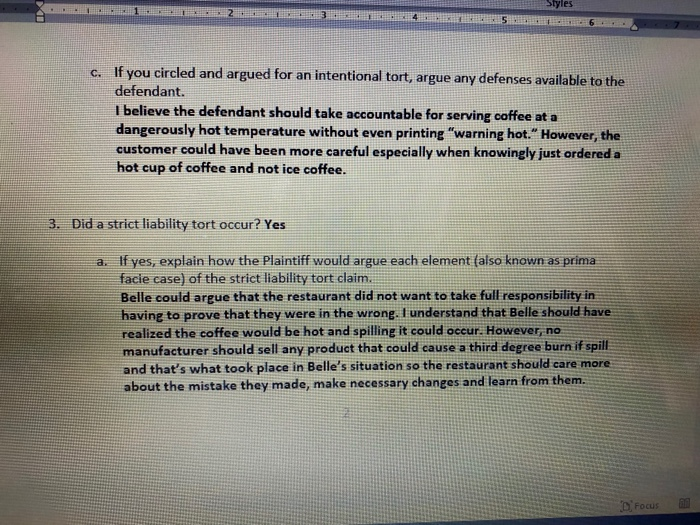
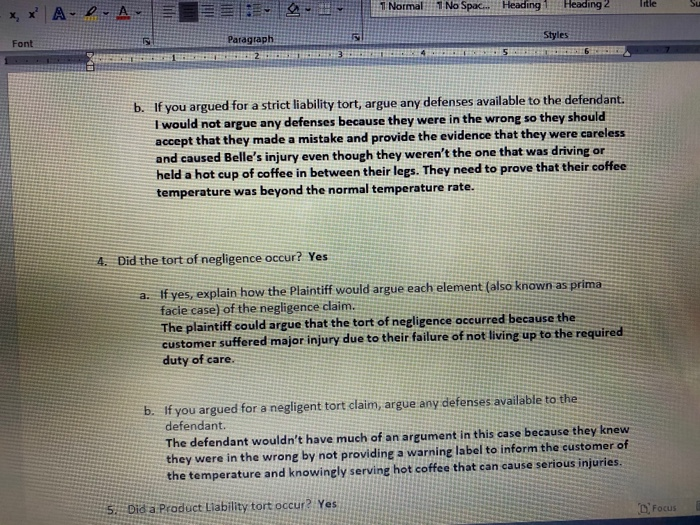
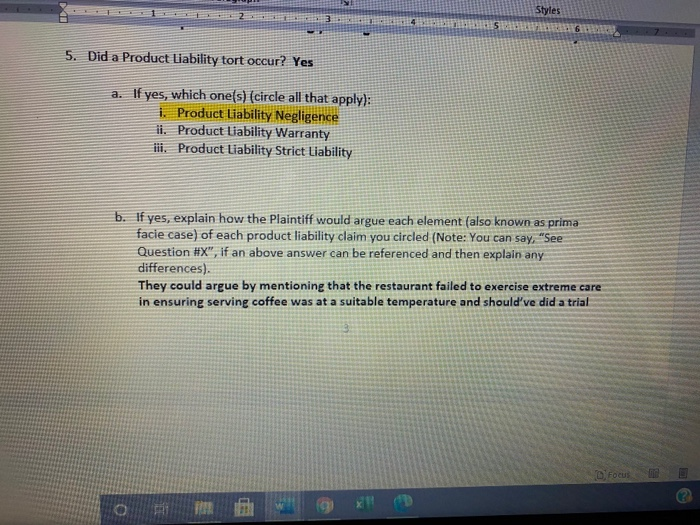
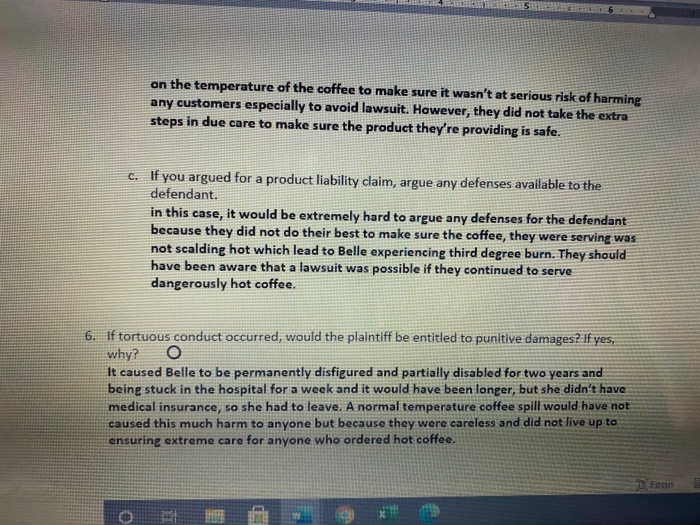
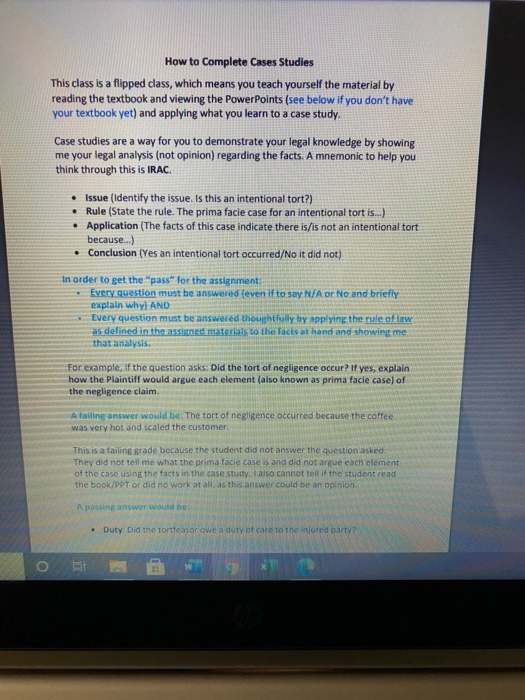
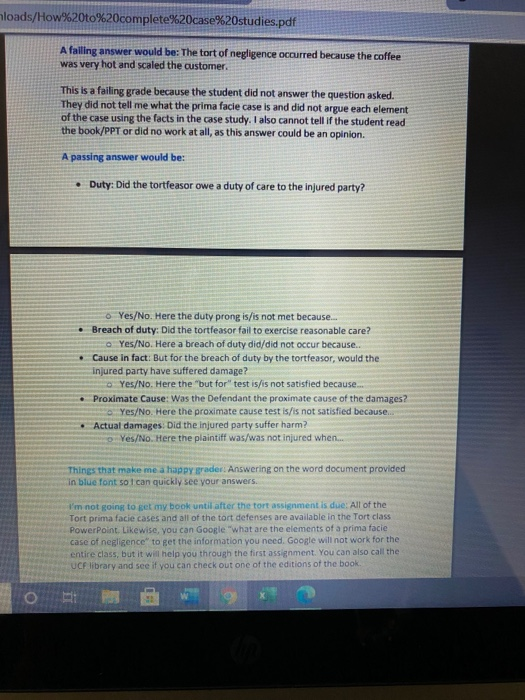
Class 2 Tort and Product Liability Team Exercise Instructions- Answer the questions and submit online via Webcourses before the start of class. No late or incomplete assignment are accepted. Answers can be written out or bulleted/outlined. (Estimated time to complete: 70 minutes) Resource: The Legal Environment of Business; A Managerial Approach: Theory to Practice 3rd Edition Chapters 9 and 21. Facts: On February 27, Belle Blue, a 79-year old retired department store salesclerk, was in the passenger seat of a Ford Probe driven by her grandson, Prince Purple (a college graduate and assistant golf pro). Prince pulled into the drive-thru at an Albuquerque D-Donut's, and Belle ordered a Donutee value meal and a cup of coffee Prince pulled the car away from the window and fully stopped by a curb in the parking lot. Belle tried to remove the lid on the cup to add cream and sugar. There was no cup holder or flat surface to put the cup on, so Belle put the cup between her legs and attempted to remove the lid. Neither the cup nor lid had a warning label. The coffee spilled onto her lap and was rapidly absorbed by her sweatpants. Belle screamed in pain, but at first Prince did not understand what was wrong. He stated that at first it seemed not to be a "big deal." He testified in his deposition: "I thought, well, you know, we spilled a cup of coffee; it's basically our fault. You know it was our clumsiness that spilled the coffee." Prince started driving out of the parking lot when Belle became nauseated. Prince Focus 11 search Font Paragraph Styles The coffee spilled onto her lap and was rapidly absorbed by her sweatpants. Belle screamed in pain, but at first Prince did not understand what was wrong. He stated that at first it seemed not to be a "big deal." He testified in his deposition: "I thought, well, you know, we spilled a cup of coffee; it's basically our fault. You know it was our clumsiness that spilled the coffee." Prince started driving out of the parking lot when Belle became nauseated. Prince suspected she might be in shock. He pulled over to the side of the road, helped her out of the car, helped her remove the sweatpants, and covered her with a sheet. He then headed for the nearest hospital, and finding it full, proceeded to another hospital where Belle was admitted. Doctors determined that the hot coffee was the cause of third degree burns on her thighs, buttocks, genitals, and groin area totaling six percent of her body, with lesser burns over sixteen percent of her body. Third degree burns are extreme injuries that penetrate the skin down to the subcutaneous fat, muscle, and bone. Belle was in the hospital for over a week where she was treated by a vascular Surgeon and had painful skin grafts. The surgeon reported that her injuries constituted one of the worst burn cases from hot liquids that he had ever treated. Belle did not have medical insurance, and, attempting to reduce hospital costs, she left the hospital earlier than recommended. Her daughter, with whom she lived, had to take off from work to drive Belle back to the hospital for treatments on subsequent days. Belle lost over twenty pounds, was permanently disfigured, and was partially disabled for up to two years. 1. As a tort, what would be the purpose of a lawsuit here? The purpose of this lawsuit would be to sue for negligence. The employee neglected to inform Belle that the coffee was dangerously hot in order to prepare her of what could happen in a worst-case scenario. Focus ch O 2. Did an intentional tort occur? Yes a. If yes, which one(s) (circle all that apply): i. Defamation ii. Trade Libel and Product Disparagement Fraudulent Misrepresentation iv. False Imprisonment v. Business Competition Torts vi. Intentional Infliction of Emotional Distress vii. Trespass viii. Conversion (civil theft) ix. Assault/Battery (civil) b. If you circled an intentional tort, explain how the plaintiff for each intentional tort that you circled would argue each element (also known as prima facie case) of an intentional tort claim Albuquerque D-Donut's employee lead Belle to believe that the condition of the coffee was at a normal temperature when they knew they were serving coffee at a dangerously hot temperature and did not warn customers of the nature and extend of this risk. If unu circles and aroued for an intentional tort aroue anu defence available to the O Focus 1 3 c. If you circled and argued for an intentional tort, argue any defenses available to the defendant. I believe the defendant should take accountable for serving coffee at a dangerously hot temperature without even printing "warning hot." However, the customer could have been more careful especially when knowingly just ordered a hot cup of coffee and not ice coffee. 3. Did a strict liability tort occur? Yes a. If yes, explain how the Plaintiff would argue each element (also known as prima facie case) of the strict liability tort claim. Belle could argue that the restaurant did not want to take full responsibility in having to prove that they were in the wrong. I understand that Belle should have realized the coffee would be hot and spilling it could occur. However, no manufacturer should sell any product that could cause a third degree burn if spill and that's what took place in Belle's situation so the restaurant should care more about the mistake they made, make necessary changes and learn from them. Focus 1 Normal No Spac... Heading 1 Heading 2 Title ** A-DA Font Paragraph Styles 3 1 40 b. If you argued for a strict liability tort, argue any defenses available to the defendant. I would not argue any defenses because they were in the wrong so they should accept that they made a mistake and provide the evidence that they were careless and caused Belle's injury even though they weren't the one that was driving or held a hot cup of coffee in between their legs. They need to prove that their coffee temperature was beyond the normal temperature rate. 4. Did the tort of negligence occur? Yes a. If yes, explain how the plaintiff would argue each element (also known as prima facie case) of the negligence claim. The plaintiff could argue that the tort of negligence occurred because the customer suffered major injury due to their failure of not living up to the required duty of care. b. If you argued for a negligent tort claim, argue any defenses available to the defendant. The defendant wouldn't have much of an argument in this case because they knew they were in the wrong by not providing a warning label to inform the customer of the temperature and knowingly serving hot coffee that can cause serious injuries. 5. Did a Product Liability tort occur? Yes D Focus Styles SA 6 5. Did a Product Liability tort occur? Yes a. If yes, which one(s) (circle all that apply): 1. Product Liability Negligence ii. Product Liability Warranty iii. Product Liability Strict Liability b. If yes, explain how the plaintiff would argue each element (also known as prima facie case) of each product liability claim you circled (Note: You can say, "See Question #X", if an above answer can be referenced and then explain any differences). They could argue by mentioning that the restaurant failed to exercise extreme care in ensuring serving coffee was at a suitable temperature and should've did a trial D. Focus o on the temperature of the coffee to make sure it wasn't at serious risk of harming any customers especially to avoid lawsuit. However, they did not take the extra steps in due care to make sure the product they're providing is safe. C. If you argued for a product liability claim, argue any defenses available to the defendant. in this case, it would be extremely hard to argue any defenses for the defendant because they did not do their best to make sure the coffee, they were serving was not scalding hot which lead to Belle experiencing third degree burn. They should have been aware that a lawsuit was possible if they continued to serve dangerously hot coffee. 6. If tortuous conduct occurred, would the plaintiff be entitled to punitive damages? If yes, why? o It caused Belle to be permanently disfigured and partially disabled for two years and being stuck in the hospital for a week and it would have been longer, but she didn't have medical insurance, so she had to leave. A normal temperature coffee spill would have not caused this much harm to anyone but because they were careless and did not live up to ensuring extreme care for anyone who ordered hot coffee. D Focus How to Complete Cases Studies This class is a flipped class, which means you teach yourself the material by reading the textbook and viewing the Power Points (see below if you don't have your textbook yet) and applying what you learn to a case study. Case studies are a way for you to demonstrate your legal knowledge by showing me your legal analysis (not opinion) regarding the facts. A mnemonic to help you think through this is IRAC. Issue (Identify the issue. Is this an intentional tort?) Rule (State the rule. The prima facie case for an intentional tort is...) Application (The facts of this case indicate there is/is not an intentional tort because...) Conclusion (Yes an intentional tort occurred/No it did not) In order to get the "pass" for the assignment: Every question must be answered (even if to say N/A or No and briefly explain why) AND Every question must be answered thoughtfully by applying the rule of law as defined in the assigned materials to the facts at hand and showing me that analysis. For example, if the question asks: Did the tort of negligence occur? If yes, explain how the plaintiff would argue each element (also known as prima facie case) of the negligence claim A talling answer would be: The tort of negligence occurred because the coffee was very hot and scaled the customer This is a failing grade because the student did not answer the question asked They did not tell me what the prima facie case is and did not argue each element of the case using the facts in the case study. I also cannot tell if the student read the book/PPT or did no work at all, as this answer could be an opinion A passing answer would be Duty Did the tortfeasor owe a duty of care to the injured party? [ O loads/How%20to%20complete%20case%20studies.pdf A falling answer would be: The tort of negligence occurred because the coffee was very hot and scaled the customer. This is a failing grade because the student did not answer the question asked. They did not tell me what the prima facie case is and did not argue each element of the case using the facts in the case study. I also cannot tell if the student read the book/PPT or did no work at all, as this answer could be an opinion. A passing answer would be: Duty: Did the tortfeasor owe a duty of care to the injured party? Yes/No. Here the duty prong is/is not met because... Breach of duty: Did the tortfeasor fail to exercise reasonable care? Yes/No. Here a breach of duty did/did not occur because.. Cause in fact: But for the breach of duty by the tortfeasor, would the injured party have suffered damage? Yes/No. Here the "but for" test is/is not satisfied because ... Proximate Cause: Was the Defendant the proximate cause of the damages? Yes/No. Here the proximate cause test is/is not satisfied because Actual damages: Did the injured party suffer harm? Yes/No. Here the plaintiff was/was not injured when. Things that make me a happy grader. Answering on the word document provided in blue font so I can quickly see your answers. I'm not going to get my book until after the tort assignment is due: All of the Tort prima facie cases and all of the tort defenses are available in the Tort class PowerPoint. Likewise, you can Google "what are the elements of a prima facie case of negligence to get the information you need. Google will not work for the entire class, but it will help you through the first assignment. You can also call the UCF library and see if you can check out one of the editions of the book. O Class 2 Tort and Product Liability Team Exercise Instructions- Answer the questions and submit online via Webcourses before the start of class. No late or incomplete assignment are accepted. Answers can be written out or bulleted/outlined. (Estimated time to complete: 70 minutes) Resource: The Legal Environment of Business; A Managerial Approach: Theory to Practice 3rd Edition Chapters 9 and 21. Facts: On February 27, Belle Blue, a 79-year old retired department store salesclerk, was in the passenger seat of a Ford Probe driven by her grandson, Prince Purple (a college graduate and assistant golf pro). Prince pulled into the drive-thru at an Albuquerque D-Donut's, and Belle ordered a Donutee value meal and a cup of coffee Prince pulled the car away from the window and fully stopped by a curb in the parking lot. Belle tried to remove the lid on the cup to add cream and sugar. There was no cup holder or flat surface to put the cup on, so Belle put the cup between her legs and attempted to remove the lid. Neither the cup nor lid had a warning label. The coffee spilled onto her lap and was rapidly absorbed by her sweatpants. Belle screamed in pain, but at first Prince did not understand what was wrong. He stated that at first it seemed not to be a "big deal." He testified in his deposition: "I thought, well, you know, we spilled a cup of coffee; it's basically our fault. You know it was our clumsiness that spilled the coffee." Prince started driving out of the parking lot when Belle became nauseated. Prince Focus 11 search Font Paragraph Styles The coffee spilled onto her lap and was rapidly absorbed by her sweatpants. Belle screamed in pain, but at first Prince did not understand what was wrong. He stated that at first it seemed not to be a "big deal." He testified in his deposition: "I thought, well, you know, we spilled a cup of coffee; it's basically our fault. You know it was our clumsiness that spilled the coffee." Prince started driving out of the parking lot when Belle became nauseated. Prince suspected she might be in shock. He pulled over to the side of the road, helped her out of the car, helped her remove the sweatpants, and covered her with a sheet. He then headed for the nearest hospital, and finding it full, proceeded to another hospital where Belle was admitted. Doctors determined that the hot coffee was the cause of third degree burns on her thighs, buttocks, genitals, and groin area totaling six percent of her body, with lesser burns over sixteen percent of her body. Third degree burns are extreme injuries that penetrate the skin down to the subcutaneous fat, muscle, and bone. Belle was in the hospital for over a week where she was treated by a vascular Surgeon and had painful skin grafts. The surgeon reported that her injuries constituted one of the worst burn cases from hot liquids that he had ever treated. Belle did not have medical insurance, and, attempting to reduce hospital costs, she left the hospital earlier than recommended. Her daughter, with whom she lived, had to take off from work to drive Belle back to the hospital for treatments on subsequent days. Belle lost over twenty pounds, was permanently disfigured, and was partially disabled for up to two years. 1. As a tort, what would be the purpose of a lawsuit here? The purpose of this lawsuit would be to sue for negligence. The employee neglected to inform Belle that the coffee was dangerously hot in order to prepare her of what could happen in a worst-case scenario. Focus ch O 2. Did an intentional tort occur? Yes a. If yes, which one(s) (circle all that apply): i. Defamation ii. Trade Libel and Product Disparagement Fraudulent Misrepresentation iv. False Imprisonment v. Business Competition Torts vi. Intentional Infliction of Emotional Distress vii. Trespass viii. Conversion (civil theft) ix. Assault/Battery (civil) b. If you circled an intentional tort, explain how the plaintiff for each intentional tort that you circled would argue each element (also known as prima facie case) of an intentional tort claim Albuquerque D-Donut's employee lead Belle to believe that the condition of the coffee was at a normal temperature when they knew they were serving coffee at a dangerously hot temperature and did not warn customers of the nature and extend of this risk. If unu circles and aroued for an intentional tort aroue anu defence available to the O Focus 1 3 c. If you circled and argued for an intentional tort, argue any defenses available to the defendant. I believe the defendant should take accountable for serving coffee at a dangerously hot temperature without even printing "warning hot." However, the customer could have been more careful especially when knowingly just ordered a hot cup of coffee and not ice coffee. 3. Did a strict liability tort occur? Yes a. If yes, explain how the Plaintiff would argue each element (also known as prima facie case) of the strict liability tort claim. Belle could argue that the restaurant did not want to take full responsibility in having to prove that they were in the wrong. I understand that Belle should have realized the coffee would be hot and spilling it could occur. However, no manufacturer should sell any product that could cause a third degree burn if spill and that's what took place in Belle's situation so the restaurant should care more about the mistake they made, make necessary changes and learn from them. Focus 1 Normal No Spac... Heading 1 Heading 2 Title ** A-DA Font Paragraph Styles 3 1 40 b. If you argued for a strict liability tort, argue any defenses available to the defendant. I would not argue any defenses because they were in the wrong so they should accept that they made a mistake and provide the evidence that they were careless and caused Belle's injury even though they weren't the one that was driving or held a hot cup of coffee in between their legs. They need to prove that their coffee temperature was beyond the normal temperature rate. 4. Did the tort of negligence occur? Yes a. If yes, explain how the plaintiff would argue each element (also known as prima facie case) of the negligence claim. The plaintiff could argue that the tort of negligence occurred because the customer suffered major injury due to their failure of not living up to the required duty of care. b. If you argued for a negligent tort claim, argue any defenses available to the defendant. The defendant wouldn't have much of an argument in this case because they knew they were in the wrong by not providing a warning label to inform the customer of the temperature and knowingly serving hot coffee that can cause serious injuries. 5. Did a Product Liability tort occur? Yes D Focus Styles SA 6 5. Did a Product Liability tort occur? Yes a. If yes, which one(s) (circle all that apply): 1. Product Liability Negligence ii. Product Liability Warranty iii. Product Liability Strict Liability b. If yes, explain how the plaintiff would argue each element (also known as prima facie case) of each product liability claim you circled (Note: You can say, "See Question #X", if an above answer can be referenced and then explain any differences). They could argue by mentioning that the restaurant failed to exercise extreme care in ensuring serving coffee was at a suitable temperature and should've did a trial D. Focus o on the temperature of the coffee to make sure it wasn't at serious risk of harming any customers especially to avoid lawsuit. However, they did not take the extra steps in due care to make sure the product they're providing is safe. C. If you argued for a product liability claim, argue any defenses available to the defendant. in this case, it would be extremely hard to argue any defenses for the defendant because they did not do their best to make sure the coffee, they were serving was not scalding hot which lead to Belle experiencing third degree burn. They should have been aware that a lawsuit was possible if they continued to serve dangerously hot coffee. 6. If tortuous conduct occurred, would the plaintiff be entitled to punitive damages? If yes, why? o It caused Belle to be permanently disfigured and partially disabled for two years and being stuck in the hospital for a week and it would have been longer, but she didn't have medical insurance, so she had to leave. A normal temperature coffee spill would have not caused this much harm to anyone but because they were careless and did not live up to ensuring extreme care for anyone who ordered hot coffee. D Focus How to Complete Cases Studies This class is a flipped class, which means you teach yourself the material by reading the textbook and viewing the Power Points (see below if you don't have your textbook yet) and applying what you learn to a case study. Case studies are a way for you to demonstrate your legal knowledge by showing me your legal analysis (not opinion) regarding the facts. A mnemonic to help you think through this is IRAC. Issue (Identify the issue. Is this an intentional tort?) Rule (State the rule. The prima facie case for an intentional tort is...) Application (The facts of this case indicate there is/is not an intentional tort because...) Conclusion (Yes an intentional tort occurred/No it did not) In order to get the "pass" for the assignment: Every question must be answered (even if to say N/A or No and briefly explain why) AND Every question must be answered thoughtfully by applying the rule of law as defined in the assigned materials to the facts at hand and showing me that analysis. For example, if the question asks: Did the tort of negligence occur? If yes, explain how the plaintiff would argue each element (also known as prima facie case) of the negligence claim A talling answer would be: The tort of negligence occurred because the coffee was very hot and scaled the customer This is a failing grade because the student did not answer the question asked They did not tell me what the prima facie case is and did not argue each element of the case using the facts in the case study. I also cannot tell if the student read the book/PPT or did no work at all, as this answer could be an opinion A passing answer would be Duty Did the tortfeasor owe a duty of care to the injured party? [ O loads/How%20to%20complete%20case%20studies.pdf A falling answer would be: The tort of negligence occurred because the coffee was very hot and scaled the customer. This is a failing grade because the student did not answer the question asked. They did not tell me what the prima facie case is and did not argue each element of the case using the facts in the case study. I also cannot tell if the student read the book/PPT or did no work at all, as this answer could be an opinion. A passing answer would be: Duty: Did the tortfeasor owe a duty of care to the injured party? Yes/No. Here the duty prong is/is not met because... Breach of duty: Did the tortfeasor fail to exercise reasonable care? Yes/No. Here a breach of duty did/did not occur because.. Cause in fact: But for the breach of duty by the tortfeasor, would the injured party have suffered damage? Yes/No. Here the "but for" test is/is not satisfied because ... Proximate Cause: Was the Defendant the proximate cause of the damages? Yes/No. Here the proximate cause test is/is not satisfied because Actual damages: Did the injured party suffer harm? Yes/No. Here the plaintiff was/was not injured when. Things that make me a happy grader. Answering on the word document provided in blue font so I can quickly see your answers. I'm not going to get my book until after the tort assignment is due: All of the Tort prima facie cases and all of the tort defenses are available in the Tort class PowerPoint. Likewise, you can Google "what are the elements of a prima facie case of negligence to get the information you need. Google will not work for the entire class, but it will help you through the first assignment. You can also call the UCF library and see if you can check out one of the editions of the book. O
Step by Step Solution
There are 3 Steps involved in it

Get step-by-step solutions from verified subject matter experts
 Study Help