Question: Hello, I have a Maths question I cannot get my head around I have tried and tried but no joy I will learn all I
Hello, I have a Maths question I cannot get my head around I have tried and tried but no joy I will learn all I can from you please can you help
I have attached the question
Many Thanks
Question 5:
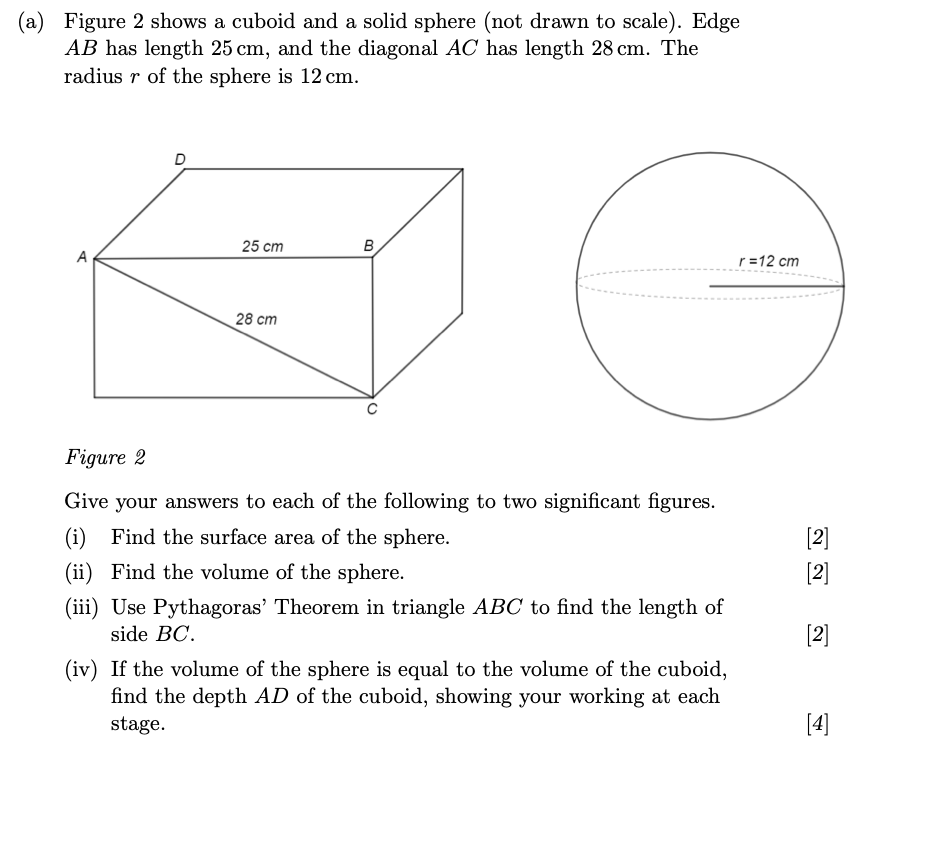
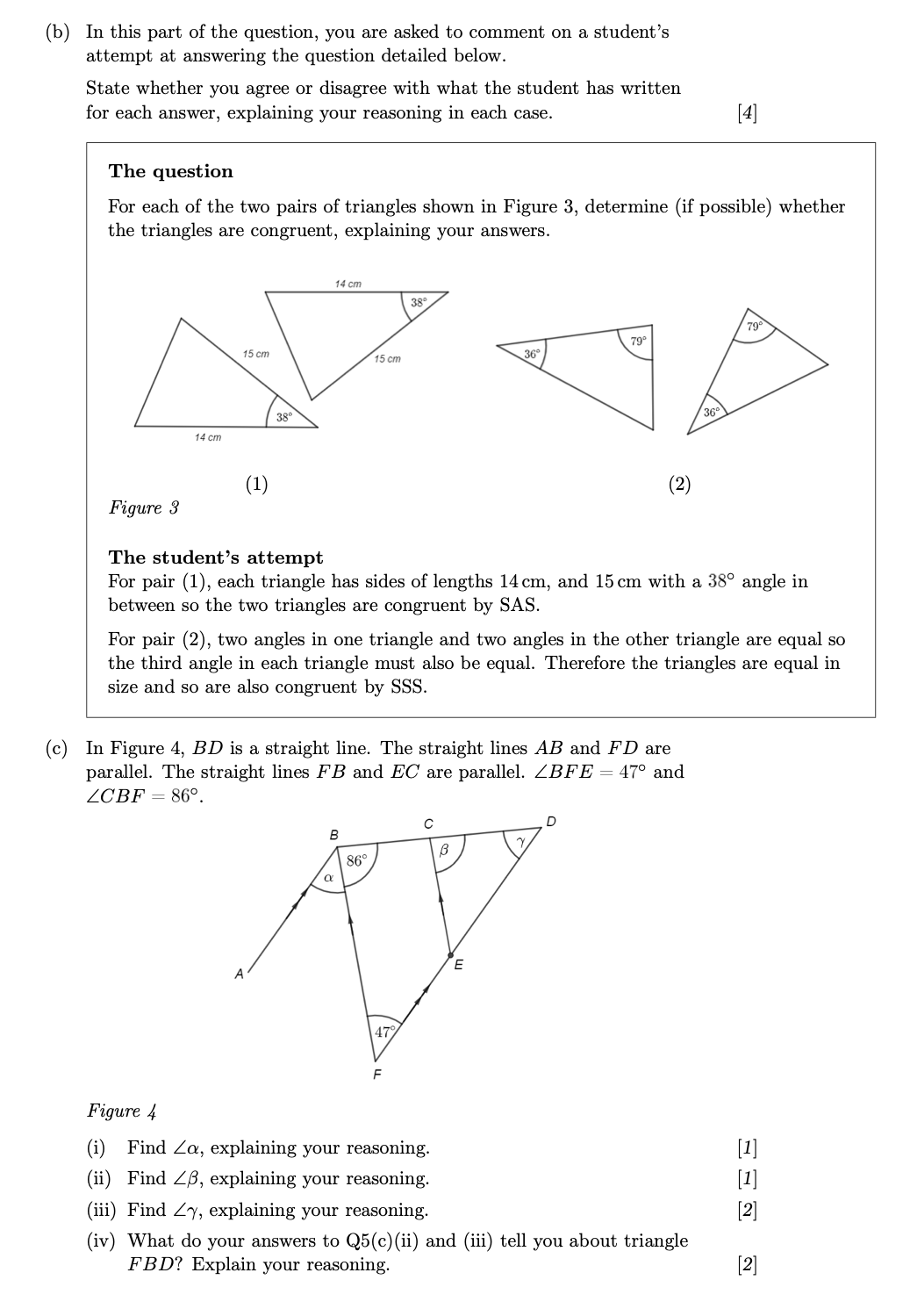
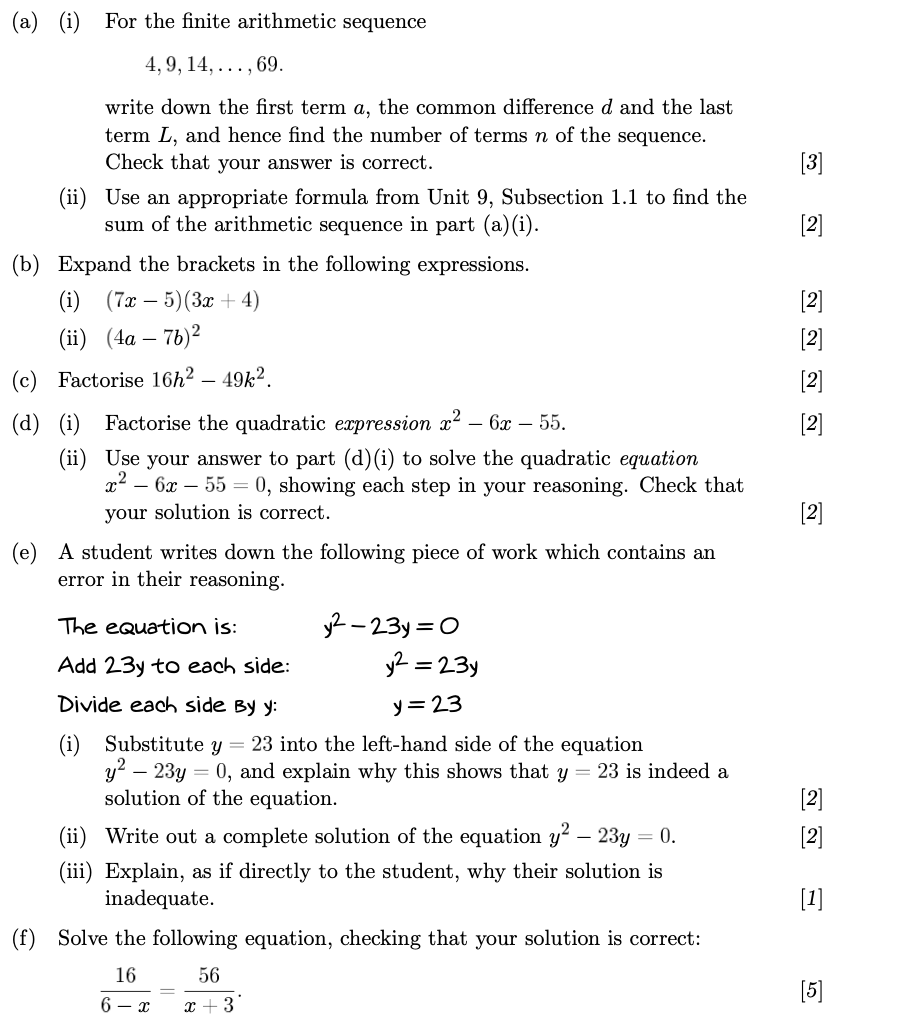
(a) Figure 2 shows a cuboid and a solid sphere (not drawn to scale). Edge AB has length 25 cm, and the diagonal AC has length 28 cm. The radius r of the sphere is 12 cm. 25 cm B A r =12 cm 28 cm Figure 2 Give your answers to each of the following to two significant figures. (i) Find the surface area of the sphere. [2] (ii) Find the volume of the sphere. [2] (iii) Use Pythagoras' Theorem in triangle ABC to find the length of side BC. [2] (iv) If the volume of the sphere is equal to the volume of the cuboid, find the depth AD of the cuboid, showing your working at each stage. [4](b) In this part of the question, you are asked to comment on a student's (C) attempt at answering the question detailed below. State whether you agree or disagree with what the student has written for each answer, explaining your reasoning in each case. [4] The question For each of the two pairs of triangles shown in Figure 3, determine (if possible) whether the triangles are congruent, explaining your answers. 14 cm (1) (2) Figure 3 The student's attempt For pair (1), each triangle has sides of lengths 14 cm, and 15 cm with a 38 angle in between so the two triangles are congruent by SAS. For pair (2), two angles in one triangle and two angles in the other triangle are equal so the third angle in each triangle must also be equal. Therefore the triangles are equal in size and so are also congruent by SSS. In Figure 4, ED is a straight line. The straight lines AB and FD are parallel. The straight lines PB and EC are parallel. ZBFE = 47 and ACBF = 86. C D 4r?" A E V F Figure 4 (i) Find Ad, explaining your reasoning. [1] (ii) Find 11,8, explaining your reasoning. [1] (iii) Find 4'7, explaining your reasoning. [2] (iv) What do your answers to Q5(c)(ii) and (iii) tell you about triangle FBD? Explain your reasoning. [2] (a) (i) For the finite arithmetic sequence 4, 9, 14, ..., 69. write down the first term a, the common difference d and the last term L, and hence find the number of terms n of the sequence. Check that your answer is correct. [3] (ii) Use an appropriate formula from Unit 9, Subsection 1.1 to find the sum of the arithmetic sequence in part (a) (i). [2] (b) Expand the brackets in the following expressions. (i) (7x - 5) (3x + 4) (ii) (4a - 76)2 (c) Factorise 16h2 - 49k2. [2] (d) (i) Factorise the quadratic expression x2 - 6x - 55. [2] (ii) Use your answer to part (d) (i) to solve the quadratic equation x2 - 6x - 55 = 0, showing each step in your reasoning. Check that your solution is correct [2] (e) A student writes down the following piece of work which contains an error in their reasoning The equation is: y2 - 23y = 0 Add 23y to each side: y2 = 23y Divide each side By y: y = 23 (i) Substitute y = 23 into the left-hand side of the equation y' - 23y = 0, and explain why this shows that y = 23 is indeed a solution of the equation. [2] (ii) Write out a complete solution of the equation y - 23y = 0. [2] (iii) Explain, as if directly to the student, why their solution is inadequate. [1] (f) Solve the following equation, checking that your solution is correct: 16 56 6- x [5] 2 +3
Step by Step Solution
There are 3 Steps involved in it
1 Expert Approved Answer
Step: 1 Unlock
Question Has Been Solved by an Expert!
Get step-by-step solutions from verified subject matter experts
Step: 2 Unlock
Step: 3 Unlock
Students Have Also Explored These Related Mathematics Questions!









 Study Help