



Question: Hello - I need assistance with this question. The question is from the example attached. Summarize the example on page 300 focusing on the central
Hello - I need assistance with this question. The question is from the example attached.
Summarize the example on page 300 focusing on the central concept.
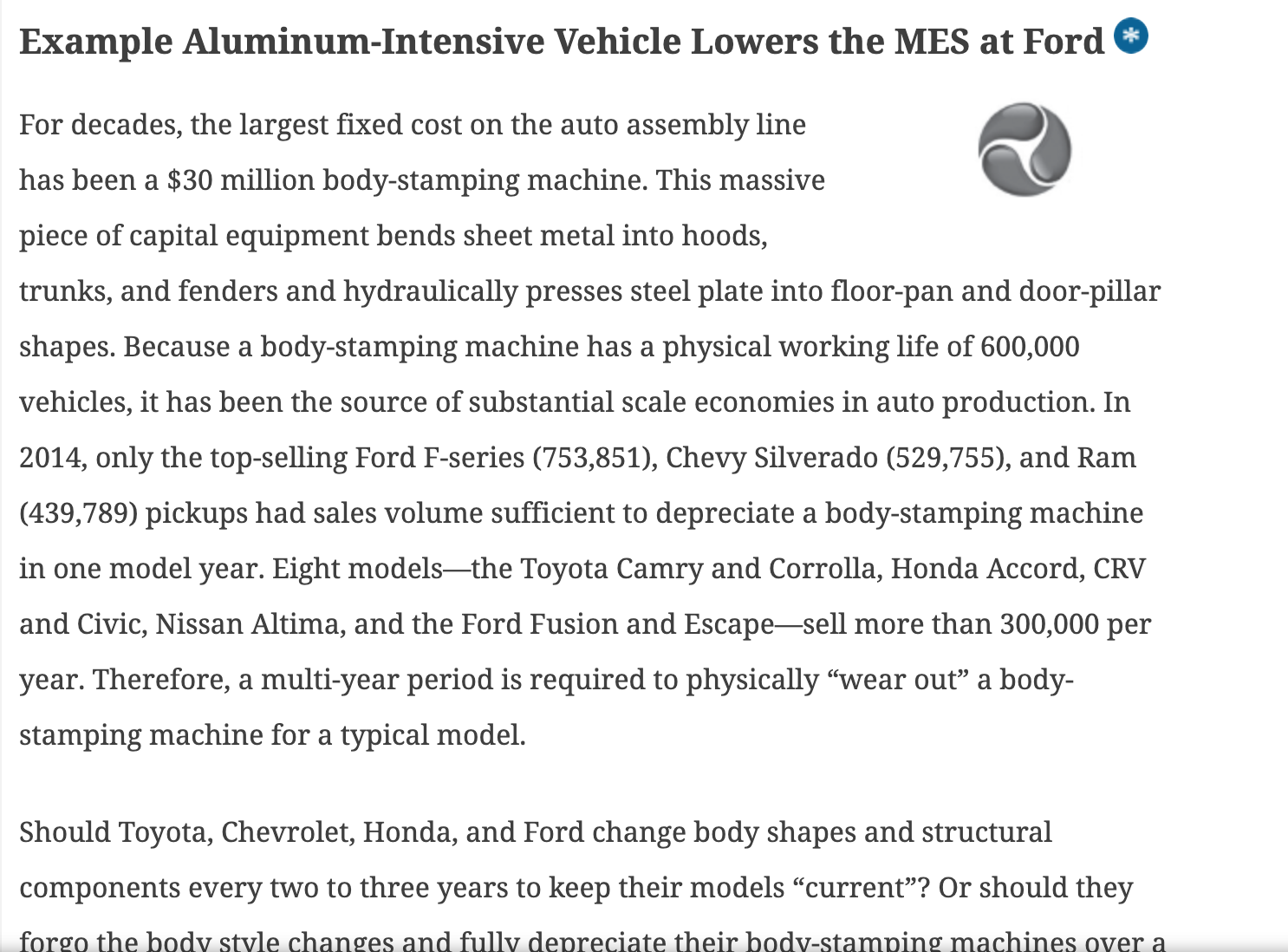
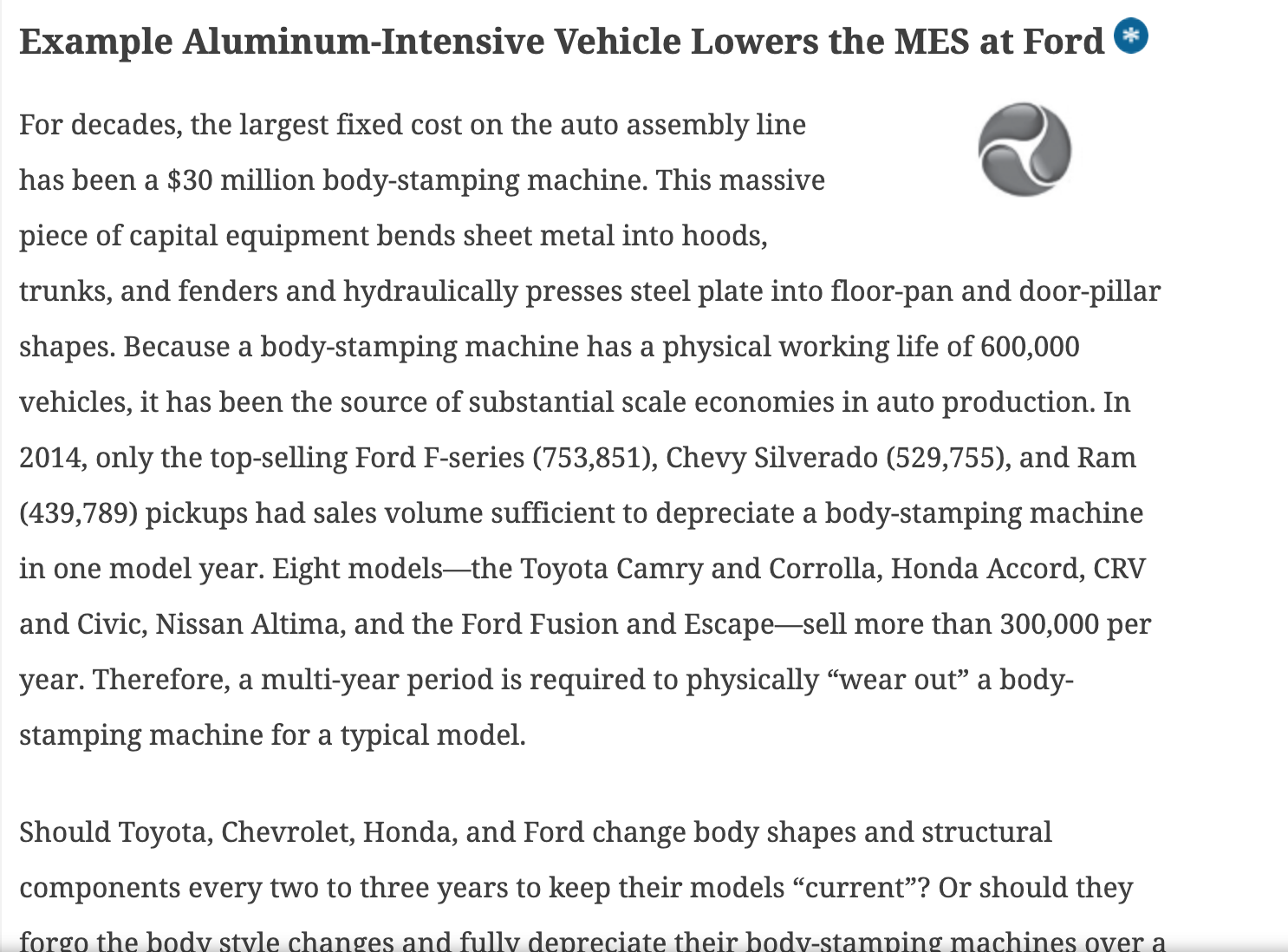
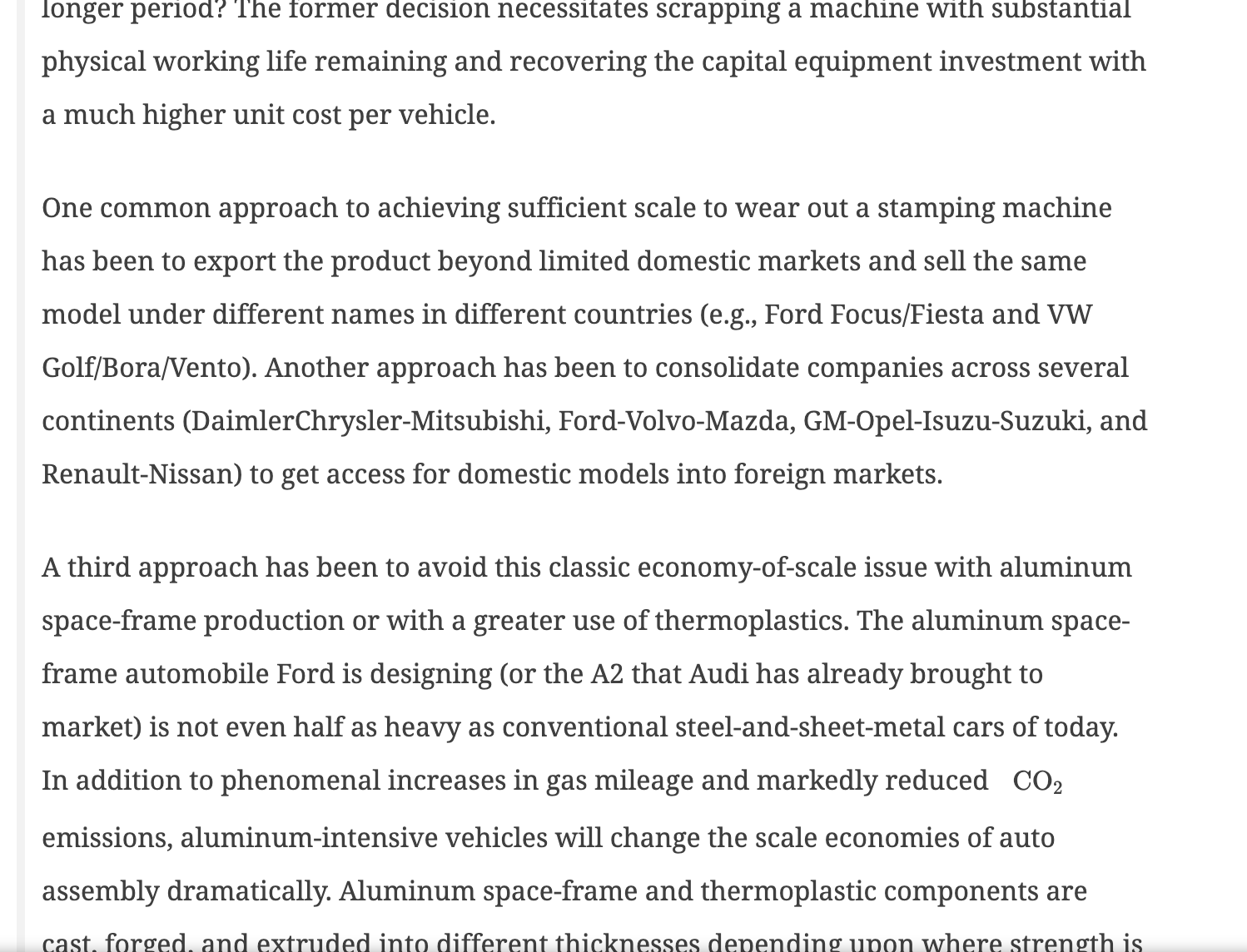
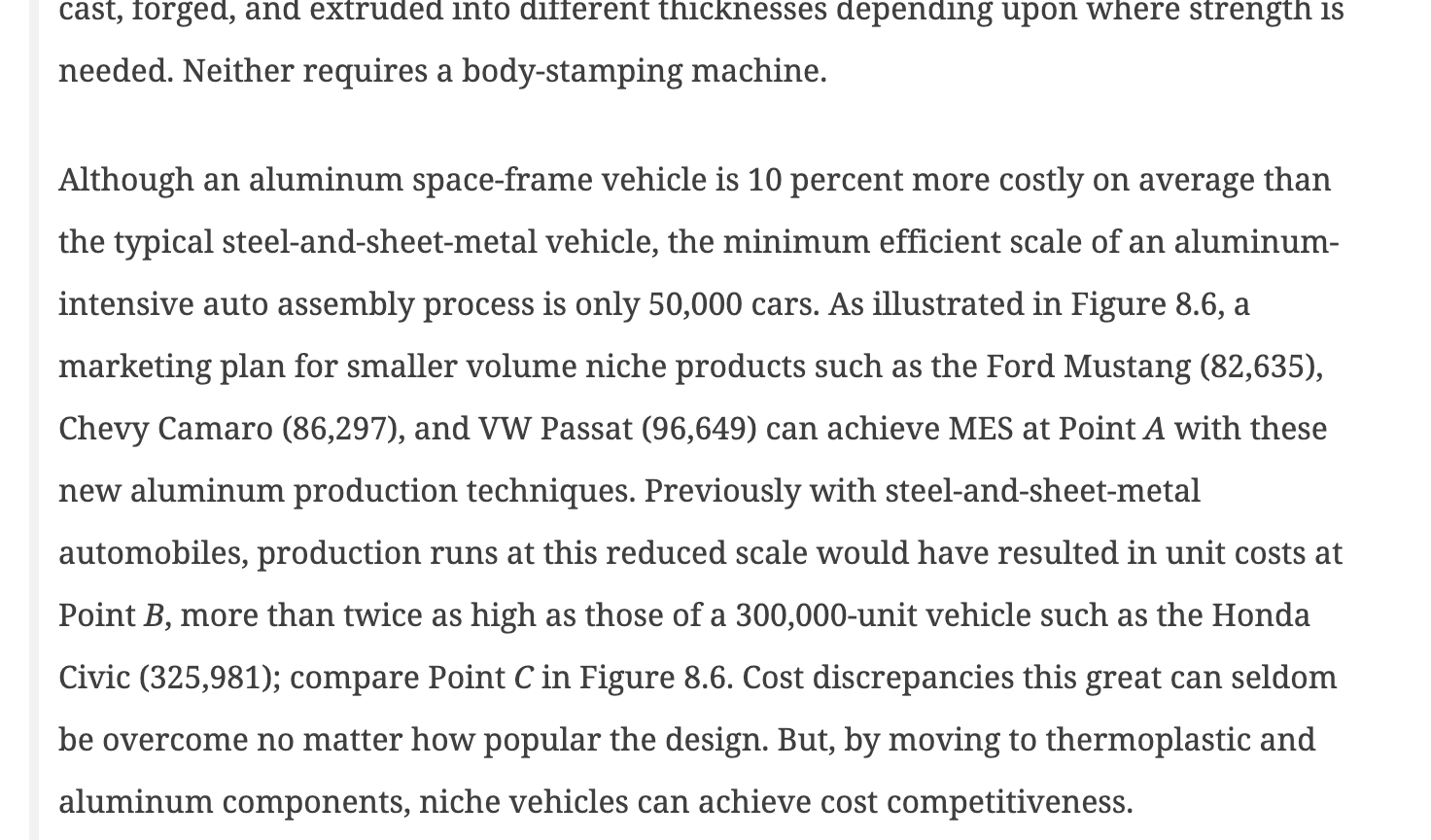
Example Aluminum-Intensive Vehicle Lowers the MES at Ford 0 For decades, the largest fixed cost on the auto assembly line pg has been a $30 million body-stamping machine. This massive piece of capital equipment bends sheet metal into hoods, trunks, and fenders and hydraulically presses steel plate into oorpan and doorpillar shapes. Because a bodystamping machine has a physical working life of 600,000 vehicles, it has been the source of substantial scale economies in auto production. In 2014, only the topselling Ford Fseries (753,851), Chevy Silverado (529,755), and Ram (439,789) pickups had sales volume sufficient to depreciate a bodystamping machine in one model year. Eight modelsthe Toyota Camry and Corrolla, Honda Accord, CRV and Civic, Nissan Altima, and the Ford Fusion and Escapesell more than 300,000 per year. Therefore, a multiyear period is required to physically \"wear out\" a body stamping machine for a typical model. Should Toyota, Chevrolet, Honda, and Ford change body shapes and structural components every two to three years to keep their models \"current\"? Or should they forgo the bodv stvle changes and fullv depreciate their bodv-stamping machines over a longer perlod? 'i'he tormer dec1slon necessitates scrapping a machine With substantial physical working life remaining and recovering the capital equipment investment with a much higher unit cost per vehicle. One common approach to achieving sufficient scale to wear out a stamping machine has been to export the product beyond limited domestic markets and sell the same model under different names in different countries (e.g., Ford Focus/Fiesta and VW Golf/Bora/Vento). Another approach has been to consolidate companies across several continents (DaimlerChryslerMitsubishi, FordVolvoMazda, GMOpelIsuzuSuzuki, and Renault-Nissan) to get access for domestic models into foreign markets. A third approach has been to avoid this classic economyofscale issue with aluminum spaceframe production or with a greater use of thermoplastics. The aluminum space frame automobile Ford is designing (or the A2 that Audi has already brought to market) is not even half as heavy as conventional steelandsheetmetal cars of today. In addition to phenomenal increases in gas mileage and markedly reduced 002 emissions, aluminumintensive vehicles will change the scale economies of auto assembly dramatically. Aluminum spaceframe and thermoplastic components are cast. forged. and extruded into different thicknesses depending unnn where strength is cast, Iorged, and BX'EI'UUE'CI 111110 ditterent tthKDEZ'SSBS depending upon Where strength 18 needed. Neither requires a bodystamping machine. Although an aluminum spaceframe vehicle is 10 percent more costly on average than the typical steelandsheetmetal vehicle, the minimum efficient scale of an aluminum intensive auto assembly process is only 50,000 cars. As illustrated in Figure 8.6, a marketing plan for smaller volume niche products such as the Ford Mustang (82,635), Chevy Camaro (86,297), and VW Passat (96,649) can achieve MES at Point A with these new aluminum production techniques. Previously with steelandsheetmetal automobiles, production runs at this reduced scale would have resulted in unit costs at Point B, more than twice as high as those of a 300,000unit vehicle such as the Honda Civic (325,981); compare Point C in Figure 8.6. Cost discrepancies this great can seldom be overcome no matter how popular the design. But, by moving to thermoplastic and aluminum components, niche vehicles can achieve cost competitiveness
Step by Step Solution
There are 3 Steps involved in it

Get step-by-step solutions from verified subject matter experts