







Question: Hello I need help on question 1,2,3 and 4 provided in the images thank you! 1. [-/1 Points] SERPSE10 9.4.0P.011. 0/6 Submissions Used ASK YOUR
Hello I need help on question 1,2,3 and 4 provided in the images thank you!

![images thank you! 1. [-/1 Points] SERPSE10 9.4.0P.011. 0/6 Submissions Used ASK](https://s3.amazonaws.com/si.experts.images/answers/2024/07/6688cb4dc278e_9736688cb4d8f648.jpg)
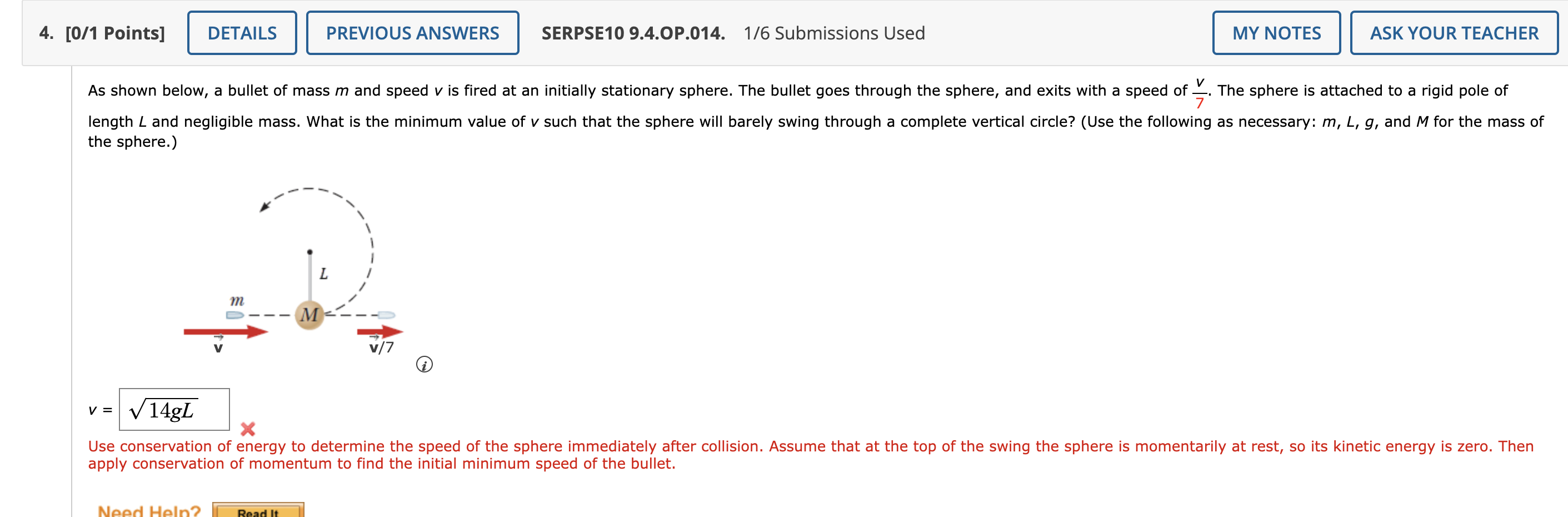
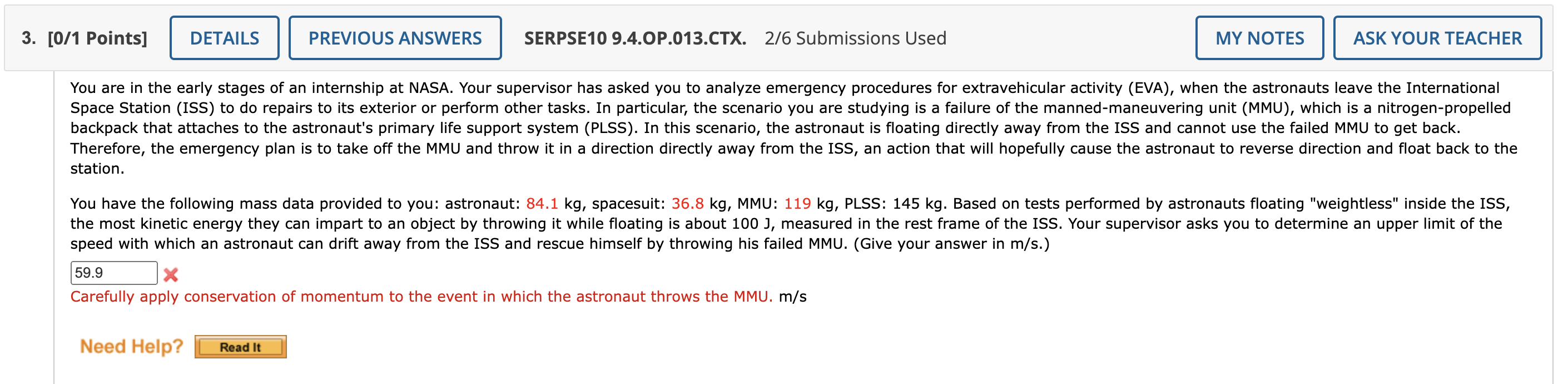
1. [-/1 Points] SERPSE10 9.4.0P.011. 0/6 Submissions Used ASK YOUR TEACHER A 9.600-9 bullet is fired into a stationary block of wood having mass m = 4.900 kg. The bullet imbeds into the block. The speed of the bullet-plus-wood combination immediately after the collision is 0.5930 m/s. What was the original speed of the bullet? (Express your answer with four signicant figures.) m/e Need Help? . [0/3 Points] DETAILS PREVIOUS ANSWERS SERPSE1O 9.4.0P.012.MI. 2/6 Submissions Used MY NOTES E A neutron in a nuclear reactor makes an elastic, head-on collision with the nucleus of a carbon atom initially at rest. (a) What fraction of the neutron's kinetic energy is transferred to the carbon nucleus? (The mass of the carbon nucleus is about 12.0 times the mass of the neutron.) 0.923 X Your response differs from the correct answer by more than 100%. (b) The initial kinetic energy of the neutron is 3.10 x 10'13 J. Find its final kinetic energy and the kinetic energy of the carbon nucleus after the collision. neutron 0.28> E> v v/7 V= v14gL X Use conservation of energy to determine the speed of the sphere immediately after collision. Assume that at the top of the swing the sphere is momentarily at rest, so its kinetic energy is zero. Then apply conservation of momentum to find the initial minimum speed of the bullet. and Hnln') l mum 3. [0/1 Points] PREVIOUS ANSWERS SERPSE10 9.4.0P.013.CTX. 2/6 Submissions Used ASK YOUR TEACHER You are in the early stages of an internship at NASA. Your supervisor has asked you to analyze emergency procedures for extravehicular activity (EVA), when the astronauts leave the International Space Station (155) to do repairs to its exterior or perform other tasks. In particular, the scenario you are studying is a failure of the manned-maneuvering unit (MMU), which is a nitrogen-propelled backpack that attaches to the astronaut's primary life support system (PLSS). In this scenario, the astronaut is oating directly away from the ISS and cannot use the failed MMU to get back. Therefore, the emergency plan is to take off the MMU and throw it in a direction directly away from the 155, an action that will hopefully cause the astronaut to reverse direction and oat back to the station. You have the following mass data provided to you: astronaut: 84.1 kg, spacesuit: 36.8 kg, MMU: 119 kg, PLSS: 145 kg. Based on tests performed by astronauts floating "weightless\" inside the 155, the most kinetic energy they can impart to an object by throwing it while oating is about 100 J, measured in the rest frame of the 155. Your supervisor asks you to determine an upper limit of the speed with which an astronaut can drift away from the ISS and rescue himself by throwing his failed MMU. (Give your answer in m/s.) _x Carefully apply conservation of momentum to the event in which the astronaut throws the MMU. m/s Need Help'? mun
Step by Step Solution
There are 3 Steps involved in it

Get step-by-step solutions from verified subject matter experts
 Study Help