







Question: Hello I need help on this question: A plastic ball attached to a spring moves in simple harmonic motion. The amplitude of the ball's motion
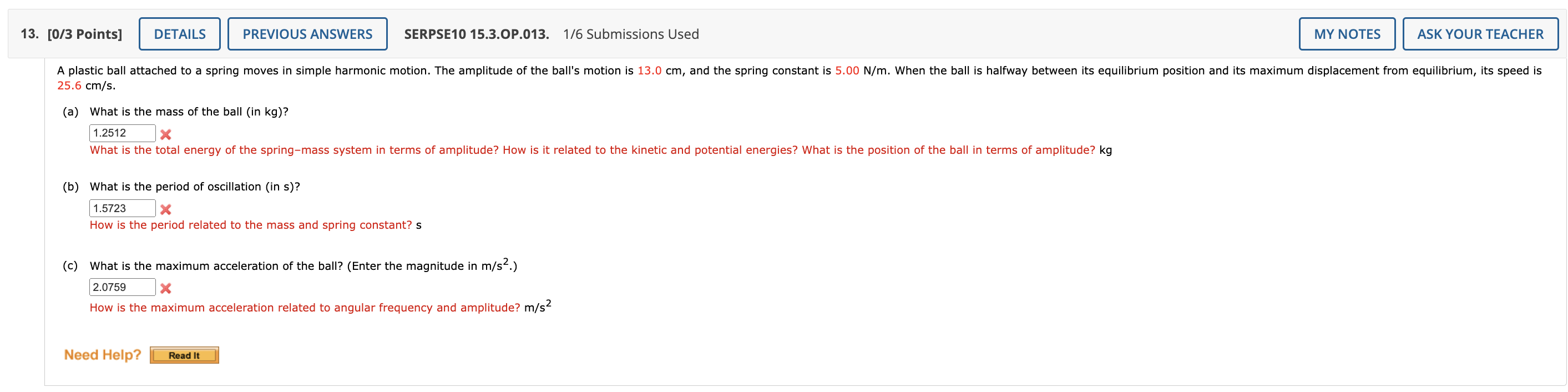
Hello I need help on this question: A plastic ball attached to a spring moves in simple harmonic motion. The amplitude of the ball's motion is 13.0 cm, and the spring constant is 5.00 N/m. When the ball is halfway between its equilibrium position and its maximum displacement from equilibrium, its speed is 25.6 cm/s.
(a)What is the mass of the ball (in kg)?
(b)What is the period of oscillation (in s)?
(c)What is the maximum acceleration of the ball? (Enter the magnitude in m/s2.)
13. [0/3 Points] DETAILS PREVIOUS ANSWERS SERPSE10 15.3.OP.013. 1/6 Submissions Used MY NOTES ASK YOUR TEACHER A plastic ball attached to a spring moves in simple harmonic motion. The amplitude of the ball's motion is 13.0 cm, and the spring constant is 5.00 N/m. When the ball is halfway between its equilibrium position and its maximum displacement from equilibrium, its speed is 25.6 cm/s. (a) What is the mass of the ball (in kg)? 1.2512 X What is the total energy of the spring-mass system in terms of amplitude? How is it related to the kinetic and potential energies? What is the position of the ball in terms of amplitude? kg (b) What is the period of oscillation (in s)? 1.5723 X How is the period related to the mass and spring constant? s (c) What is the maximum acceleration of the ball? (Enter the magnitude in m/s2.) 2.0759 X How is the maximum acceleration related to angular frequency and amplitude? m/s2 Need Help? Read It
Step by Step Solution
There are 3 Steps involved in it

Get step-by-step solutions from verified subject matter experts
 Study Help