







Question: Hello, I need help understanding these problems. Picture #1 is a reference image . - {1 Consider a binary choice version of the moonlighting game
Hello, I need help understanding these problems. Picture #1 is a reference image
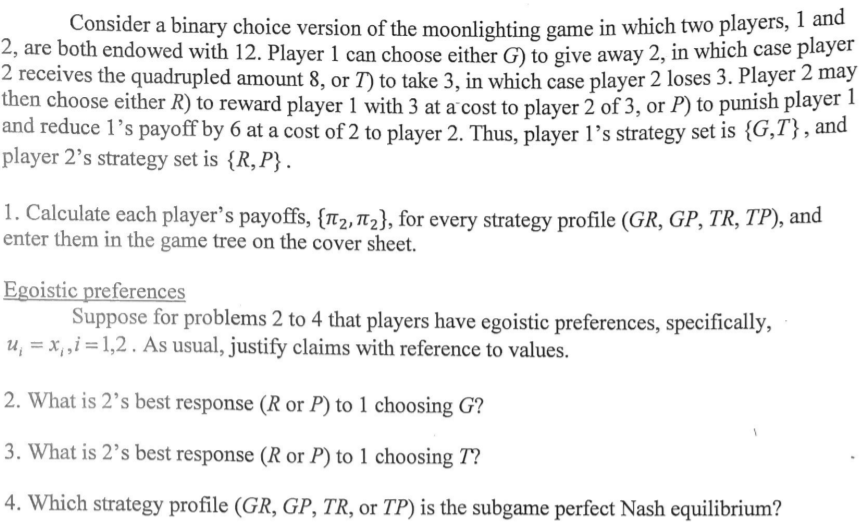
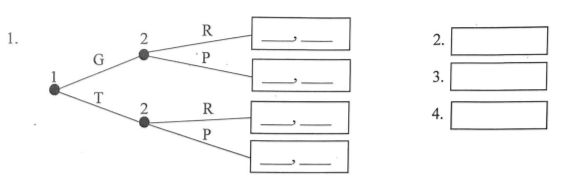
. - {1 Consider a binary choice version of the moonlighting game 1]] which two players; 1 1:: er 2, are both endowed with 12. Player 1 can choose either G) to give away 2, III WhICh \"as P2 may 2 receives the quadrupled amount 8, or I) to take 3, in which case player 2 loses 3. Mayer . ' 1 then choose either R) to reward player I with 3 at a'cost to player 2 of 3, or P) W Pun-'Sh player and reduce 1's payoff by 6 at a cost of 2 to player 2. Thus, player 1's strategy set is {6359"} s and player 2's strategy set is {R, P}. 1. Calculate each player's payoffs, [1:2, n2}, for every strategy prole (GR, GP, TR, TP): and enter them in the game tree on the cover sheet. Egoistic preferences Suppose for problems 2 to 4 that players haVe egoistic preferences, specically, at: = x, ,1\" =12 . As usual, justify claims with reference to values. 2. What is 2'5 best reSponse (R or P) to 1 choosing G? 3. What is 2's best response (R or P) to l choosing T? 4. Which strategy prole (GR, GP, TR, or TP) is the subgame perfect Nash equilibrium? R 1. 2. G P 3. T 2 R 4. P
Step by Step Solution
There are 3 Steps involved in it

Get step-by-step solutions from verified subject matter experts
 Study Help