







Question: Hello I need help with the follow question Exercise 3: Consider a two-period economy populated with consumers that have the same income and the same
Hello
I need help with the follow question
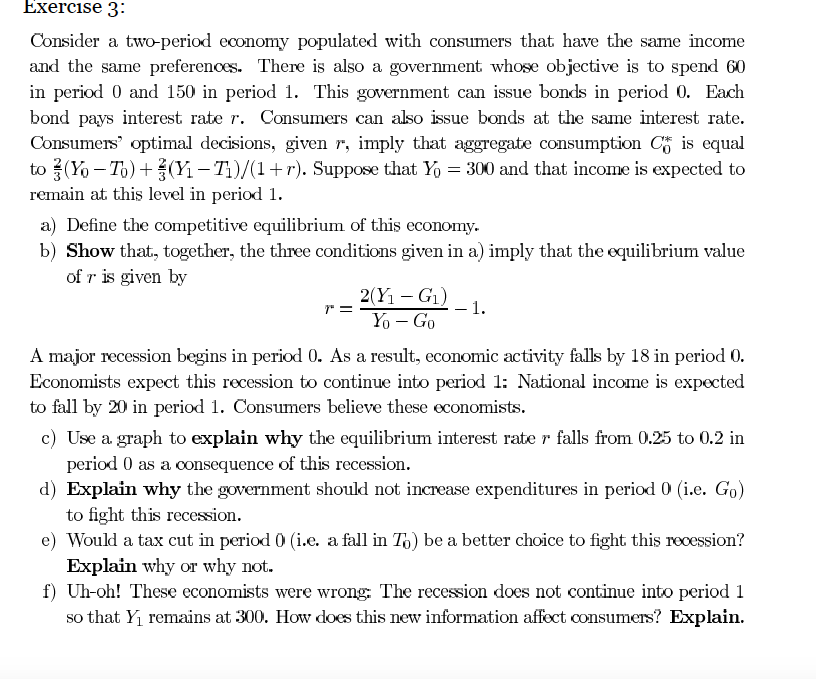
Exercise 3: Consider a two-period economy populated with consumers that have the same income and the same preferences. There is also a government whose objective is to spend 60 in period 0 and 150 in period 1. This government can issue bonds in period 0. Each bond pays interest rate r. Consumers can also issue bonds at the same interest rate. Consumers' optimal decisions, given r, imply that aggregate consumption Of is equal to }(Yo -To) + (Yi -Ti)/(1 + r). Suppose that Yo = 300 and that income is expected to remain at this level in period 1. a) Define the competitive equilibrium of this economy. b) Show that, together, the three conditions given in a) imply that the equilibrium value of r is given by r = 2(Y1 - G1) Yo - Go - 1. A major recession begins in period 0. As a result, economic activity falls by 18 in period 0. Economists expect this recession to continue into period 1: National income is expected to fall by 20 in period 1. Consumers believe these economists. c) Use a graph to explain why the equilibrium interest rate r falls from 0.25 to 0.2 in period 0 as a consequence of this recession. d) Explain why the government should not increase expenditures in period 0 (i.e. Go) to fight this recession. e) Would a tax cut in period 0 (i.e. a fall in To) be a better choice to fight this recession? Explain why or why not. f) Uh-oh! These economists were wrong. The recession does not continue into period 1 so that Y1 remains at 300. How does this new information affect consumers? Explain
Step by Step Solution
There are 3 Steps involved in it

Get step-by-step solutions from verified subject matter experts
 Study Help