







Question: Hello I need some help to build decision trees for this assignment and response to question, Optimization Production and Market Entry Part 1.1 - Setting
Hello I need some help to build decision trees for this assignment and response to question,
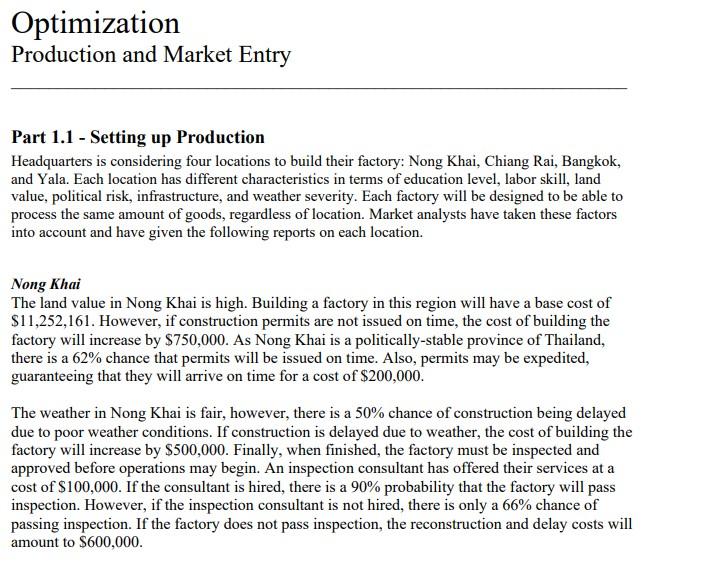
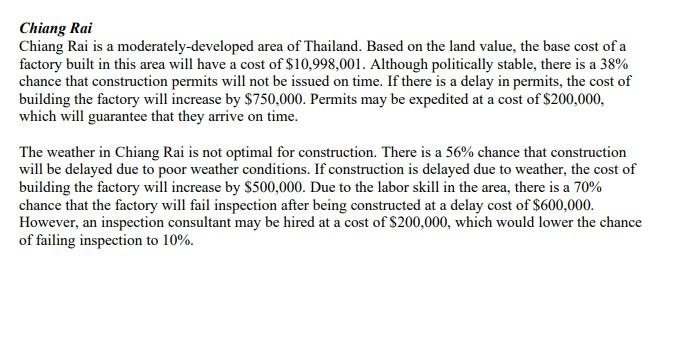
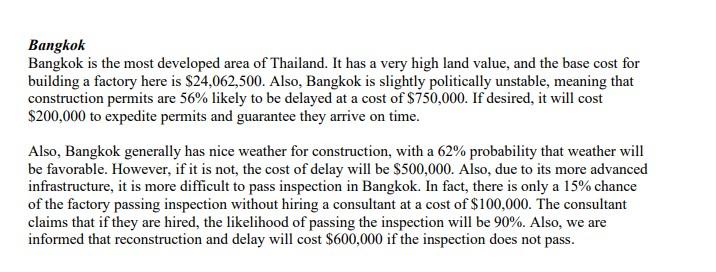
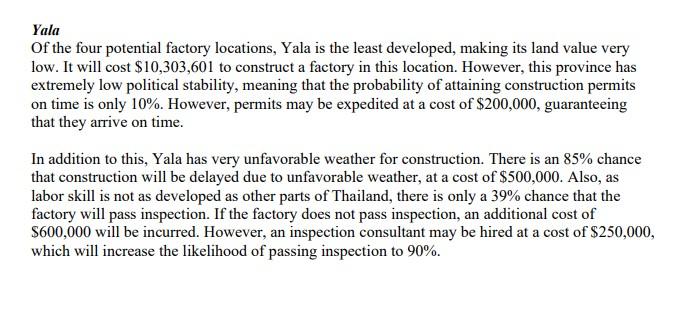
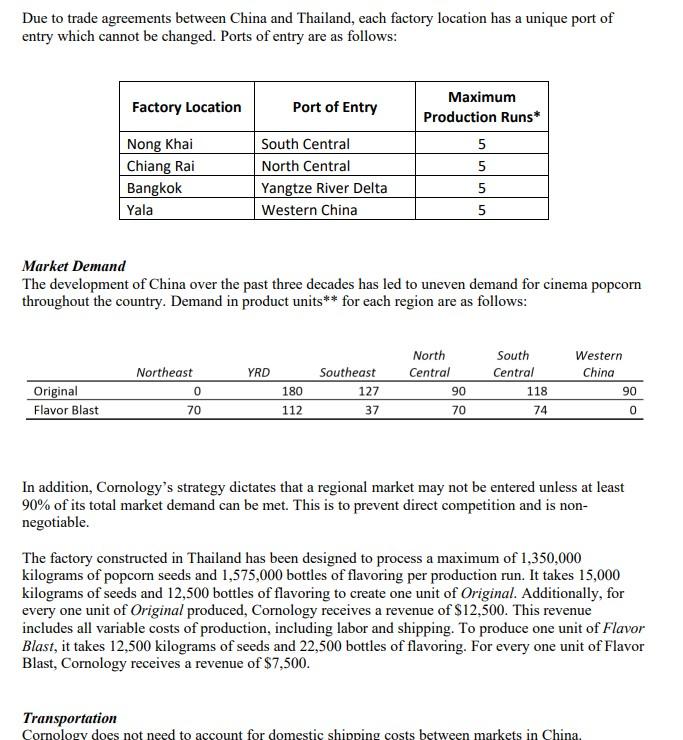
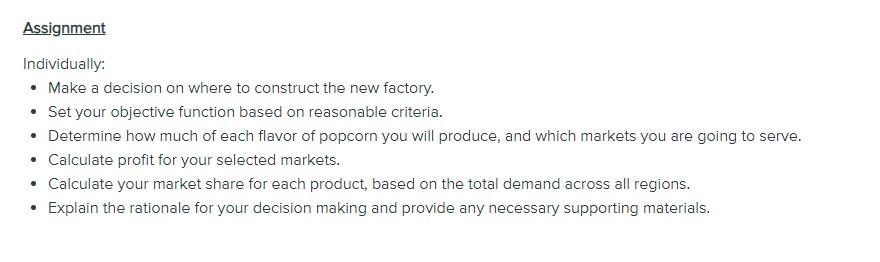
Optimization Production and Market Entry Part 1.1 - Setting up Production Headquarters is considering four locations to build their factory: Nong Khai, Chiang Rai, Bangkok, and Yala. Each location has different characteristics in terms of education level, labor skill, land value, political risk, infrastructure, and weather severity. Each factory will be designed to be able to process the same amount of goods, regardless of location. Market analysts have taken these factors into account and have given the following reports on each location. Nong Khai The land value in Nong Khai is high. Building a factory in this region will have a base cost of $11,252,161. However, if construction permits are not issued on time, the cost of building the factory will increase by $750,000. As Nong Khai is a politically-stable province of Thailand, there is a 62% chance that permits will be issued on time. Also, permits may be expedited, guaranteeing that they will arrive on time for a cost of $200,000. The weather in Nong Khai is fair, however, there is a 50% chance of construction being delayed due to poor weather conditions. If construction is delayed due to weather, the cost of building the factory will increase by $500,000. Finally, when finished, the factory must be inspected and approved before operations may begin. An inspection consultant has offered their services at a cost of $100,000. If the consultant is hired, there is a 90% probability that the factory will pass inspection. However, if the inspection consultant is not hired, there is only a 66% chance of passing inspection. If the factory does not pass inspection, the reconstruction and delay costs will amount to $600,000. Chiang Rai Chiang Rai is a moderately-developed area of Thailand. Based on the land value, the base cost of a factory built in this area will have a cost of $10,998,001. Although politically stable, there is a 38% chance that construction permits will not be issued on time. If there is a delay in permits, the cost of building the factory will increase by $750,000. Permits may be expedited at a cost of $200,000, which will guarantee that they arrive on time. The weather in Chiang Rai is not optimal for construction. There is a 56% chance that construction will be delayed due to poor weather conditions. If construction is delayed due to weather, the cost of building the factory will increase by $500,000. Due to the labor skill in the area, there is a 70% chance that the factory will fail inspection after being constructed at a delay cost of $600,000. However, an inspection consultant may be hired at a cost of $200,000, which would lower the chance of failing inspection to 10%. Bangkok Bangkok is the most developed area of Thailand. It has a very high land value, and the base cost for building a factory here is $24,062,500. Also, Bangkok is slightly politically unstable, meaning that construction permits are 56% likely to be delayed at a cost of $750,000. If desired, it will cost $200,000 to expedite permits and guarantee they arrive on time. Also, Bangkok generally has nice weather for construction, with a 62% probability that weather will be favorable. However, if it is not, the cost of delay will be $500,000. Also, due to its more advanced infrastructure, it is more difficult to pass inspection in Bangkok. In fact, there is only a 15% chance of the factory passing inspection without hiring a consultant at a cost of $100,000. The consultant claims that if they are hired, the likelihood of passing the inspection will be 90%. Also, we are informed that reconstruction and delay will cost $600,000 if the inspection does not pass. Yala Of the four potential factory locations, Yala is the least developed, making its land value very low. It will cost $10,303,601 to construct a factory in this location. However, this province has extremely low political stability, meaning that the probability of attaining construction permits on time is only 10%. However, permits may be expedited at a cost of $200,000, guaranteeing that they arrive on time. In addition to this, Yala has very unfavorable weather for construction. There is an 85% chance that construction will be delayed due to unfavorable weather, at a cost of $500,000. Also, as labor skill is not as developed as other parts of Thailand, there is only a 39% chance that the factory will pass inspection. If the factory does not pass inspection, an additional cost of $600,000 will be incurred. However, an inspection consultant may be hired at a cost of $250,000, which will increase the likelihood of passing inspection to 90%. Due to trade agreements between China and Thailand, each factory location has a unique port of entry which cannot be changed. Ports of entry are as follows: Market Demand The development of China over the past three decades has led to uneven demand for cinema popcorn throughout the country. Demand in product units** for each region are as follows: In addition, Cornology's strategy dictates that a regional market may not be entered unless at least 90% of its total market demand can be met. This is to prevent direct competition and is nonnegotiable. The factory constructed in Thailand has been designed to process a maximum of 1,350,000 kilograms of popcorn seeds and 1,575,000 bottles of flavoring per production run. It takes 15,000 kilograms of seeds and 12,500 bottles of flavoring to create one unit of Original. Additionally, for every one unit of Original produced, Cornology receives a revenue of $12,500. This revenue includes all variable costs of production, including labor and shipping. To produce one unit of Flavor Blast, it takes 12,500 kilograms of seeds and 22,500 bottles of flavoring. For every one unit of Flavor Blast, Cornology receives a revenue of $7,500. Transportation Cornology does not need to account for domestic shipving costs between markets in China. Assignment Individually: - Make a decision on where to construct the new factory. - Set your objective function based on reasonable criteria. - Determine how much of each flavor of popcorn you will produce, and which markets you are going to serve. - Calculate profit for your selected markets. - Calculate your market share for each product, based on the total demand across all regions. - Explain the rationale for your decision making and provide any necessary supporting materialsStep by Step Solution
There are 3 Steps involved in it
1 Expert Approved Answer
Step: 1 Unlock

Question Has Been Solved by an Expert!
Get step-by-step solutions from verified subject matter experts
Step: 2 Unlock
Step: 3 Unlock
 Study Help