







Question: Hello I need with the following problems please and thank you # 55,41 55, A projectile of mass 2.0 kg is fired in the air
Hello I need with the following problems please and thank you # 55,41
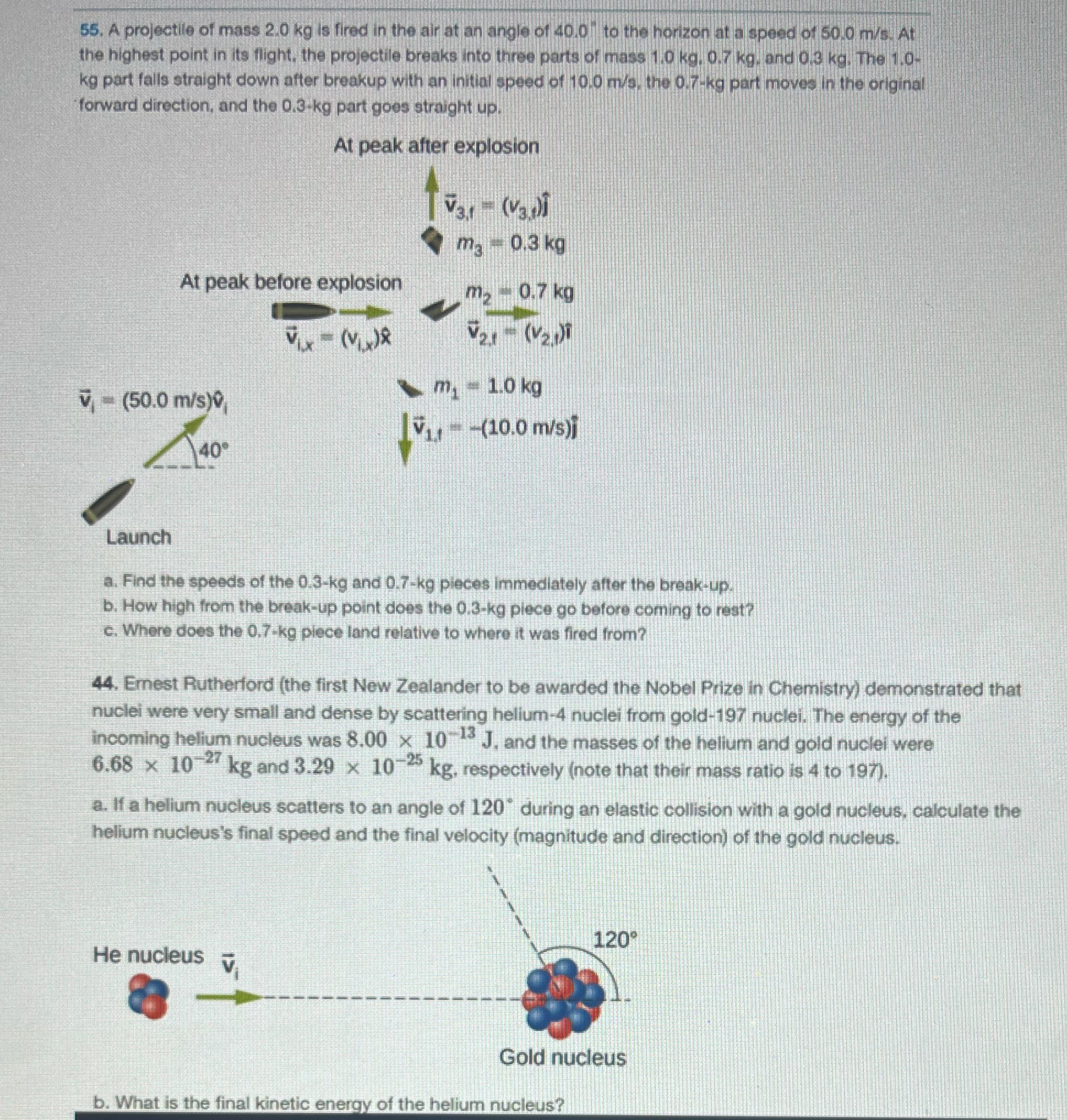
55, A projectile of mass 2.0 kg is fired in the air at an angle of 40.0 to the horizon at a speed of 50.0 m/s. At the highest point in its flight, the projectile breaks into three parts of mass 1.0 kg. 0.7 kg. and 0.3 kg. The 1.0 kg part falls straight down after breakup with an initial speed of 10.0 m/s. the 0.7-kg part moves in the original forward direction, and the 0.3-kg part goes straight up. At peak after explosion ma - 0.3 kg At peak before explosion my - 0.7 kg V21 - ( V 2 )i V - (50.0 m/s), m, - 1.0 kg IV1 - -(10.0 m/s)j Launch a. Find the speeds of the 0.3-kg and 0.7-kg pieces immediately after the break-up. b. How high from the break-up point does the 0.3-kg piece go before coming to rest? c. Where does the 0.7-kg piece land relative to where it was fired from? 44. Ernest Rutherford (the first New Zealander to be awarded the Nobel Prize in Chemistry) demonstrated that nuclei were very small and dense by scattering helium-4 nuclei from gold-197 nuclei. The energy of the incoming helium nucleus was 8.00 x 10 J. and the masses of the helium and gold nuclei were 6.68 x 10 2 kg and 3.29 x 10-" kg, respectively (note that their mass ratio is 4 to 197). a. If a helium nucleus scatters to an angle of 120" during an elastic collision with a gold nucleus, calculate the helium nucleus's final speed and the final velocity (magnitude and direction) of the gold nucleus. 120 He nucleus v Gold nucleus b. What is the final kinetic energy of the helium nucleus
Step by Step Solution
There are 3 Steps involved in it

Get step-by-step solutions from verified subject matter experts
 Study Help