







Question: Hello I was tasked with doing what is asked in the picture below this using Matlab. I finished but I just wanted someone to double
Hello I was tasked with doing what is asked in the picture below this using Matlab. I finished but I just wanted someone to double check to see if I followed the instructions given to me. I will put my Matlab code below this followed by the picture.
zeroes = 0;
poles = [-1,-1];
gain = 1;
G1 = zpk(zeroes,poles,gain);
Kp = 2;
Ki = 1.3;
Kd = 0.7;
Tf = 0.5;
G2 = pid(Kp,Ki,Kd,Tf);
numerator = 1;
denominator = [1,1];
F = tf(numerator,denominator);
numerator1 = 5;
denominator1 = [1,4];
H = tf(numerator1,denominator1);
CLTF = F * feedback(G1 * G2,H)
step(T), grid
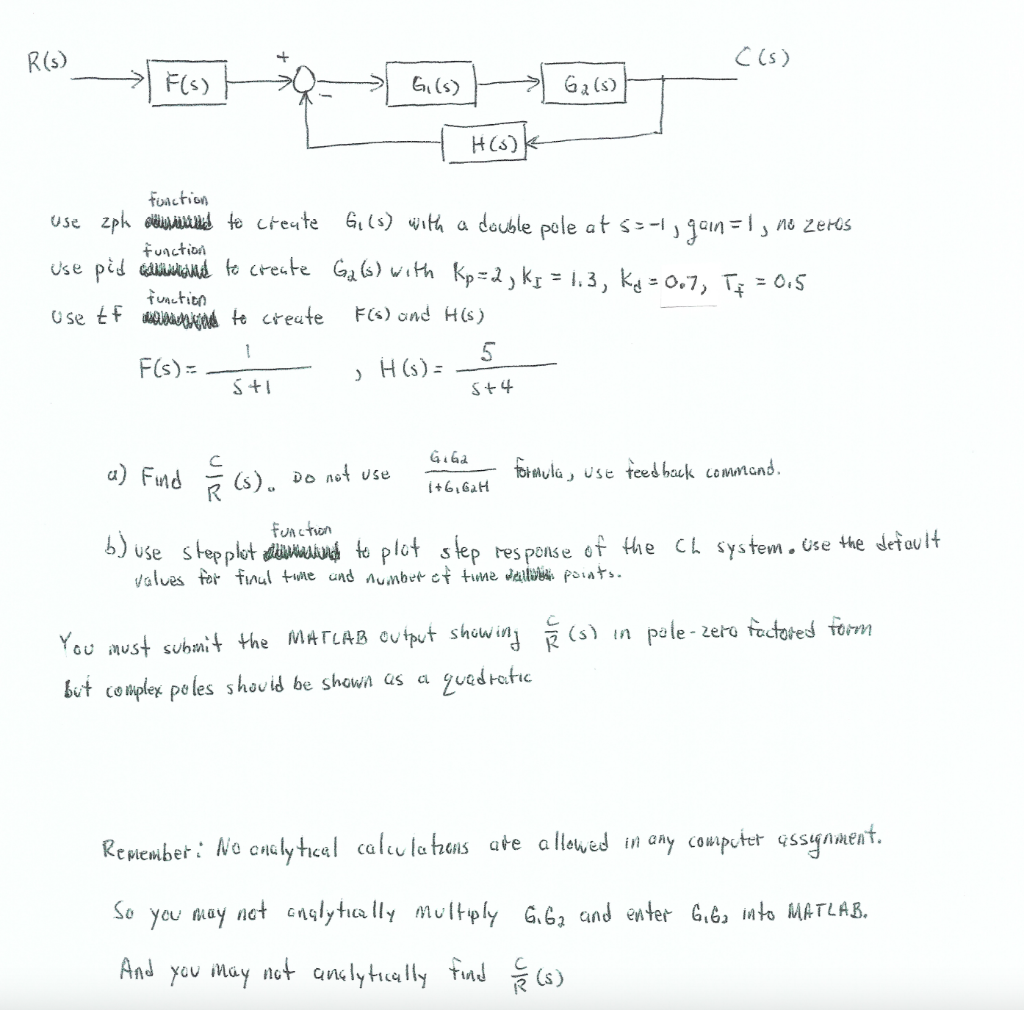
R(s) C(s) F(s) Gi(s) Ga(s) H(o) function Use zpk sdhetetled to create Gl(s) with a double pole at 53-1, gain= 1ne zeres Function Use pid curated to create Ga (6) with Kp = 2, kg = 1,3 kg = 0.7, TI = 0.5 function Use tf brands and to create FCs) and H(S) 5 F(s)- sti S+4 , H(s): & Giga u) Find 6). Do not use formula , use teed back command. i+ (+6,6aH Function b)use s tepplot etiskutimet te plot step response of the ch system. Use the default values for final twe und nuinber of time wall points. You must submit the MAECAB ou tout showing (s) (s) in pale- zero factored form but complex poles shovid be shown as a quadratic Rememberi No cnalyticel cale la tens are allowed in any computer assignment. So you may not analytically multiply G.G2 and enter Giga into MATLAB. And you may not analytically find 1/4 (5) R(s) C(s) F(s) Gi(s) Ga(s) H(o) function Use zpk sdhetetled to create Gl(s) with a double pole at 53-1, gain= 1ne zeres Function Use pid curated to create Ga (6) with Kp = 2, kg = 1,3 kg = 0.7, TI = 0.5 function Use tf brands and to create FCs) and H(S) 5 F(s)- sti S+4 , H(s): & Giga u) Find 6). Do not use formula , use teed back command. i+ (+6,6aH Function b)use s tepplot etiskutimet te plot step response of the ch system. Use the default values for final twe und nuinber of time wall points. You must submit the MAECAB ou tout showing (s) (s) in pale- zero factored form but complex poles shovid be shown as a quadratic Rememberi No cnalyticel cale la tens are allowed in any computer assignment. So you may not analytically multiply G.G2 and enter Giga into MATLAB. And you may not analytically find 1/4
Step by Step Solution
There are 3 Steps involved in it

Get step-by-step solutions from verified subject matter experts
 Study Help