







Question: Hello! May i ask for a brief/ simpler explanation worth 3-5mins of presentation for Articles 1411 & 1412? It would be better if there's a
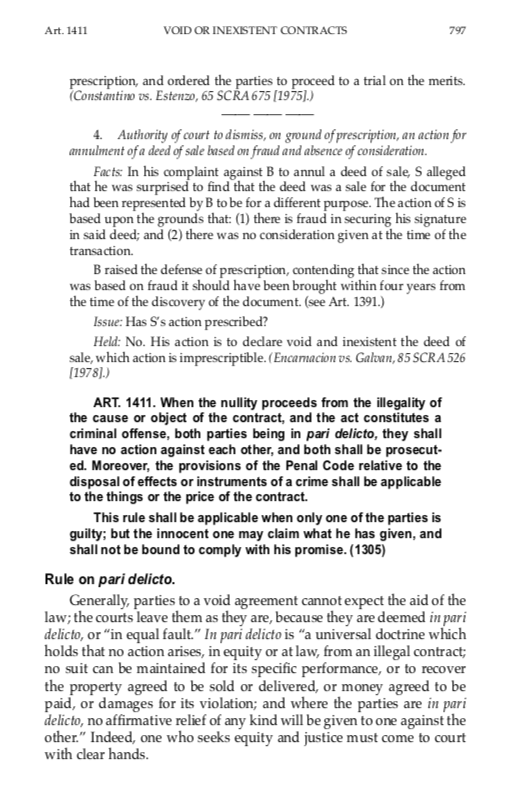
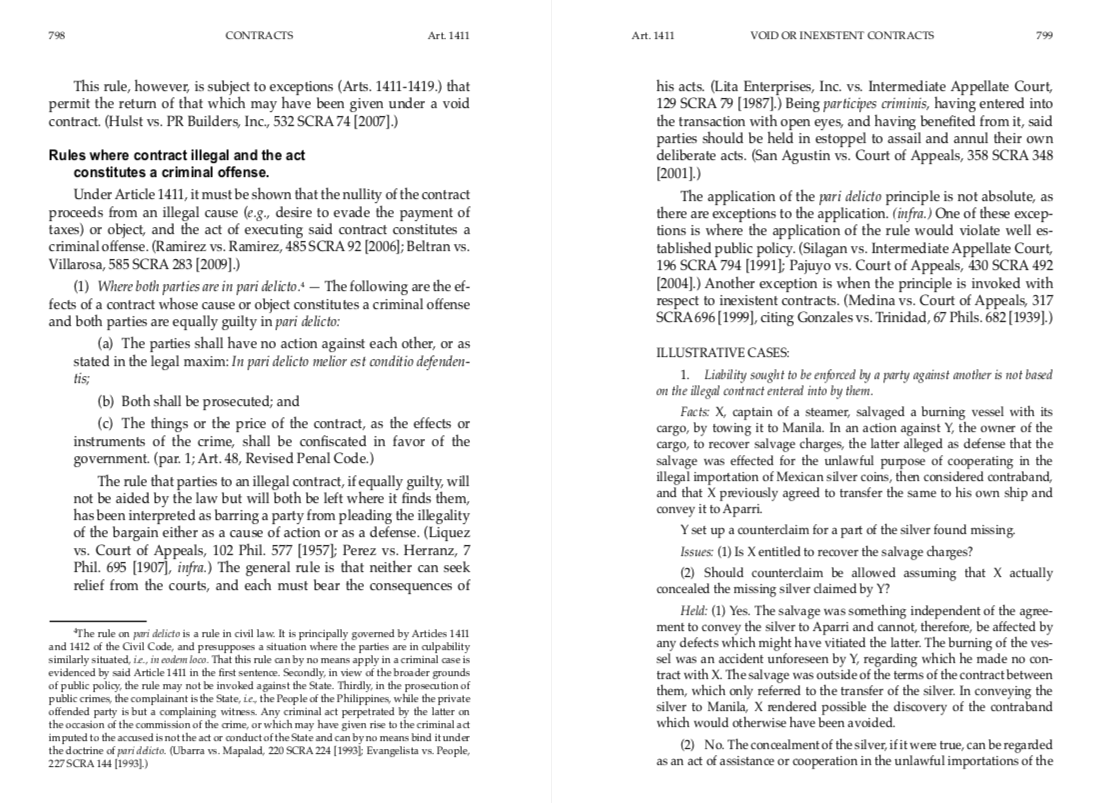
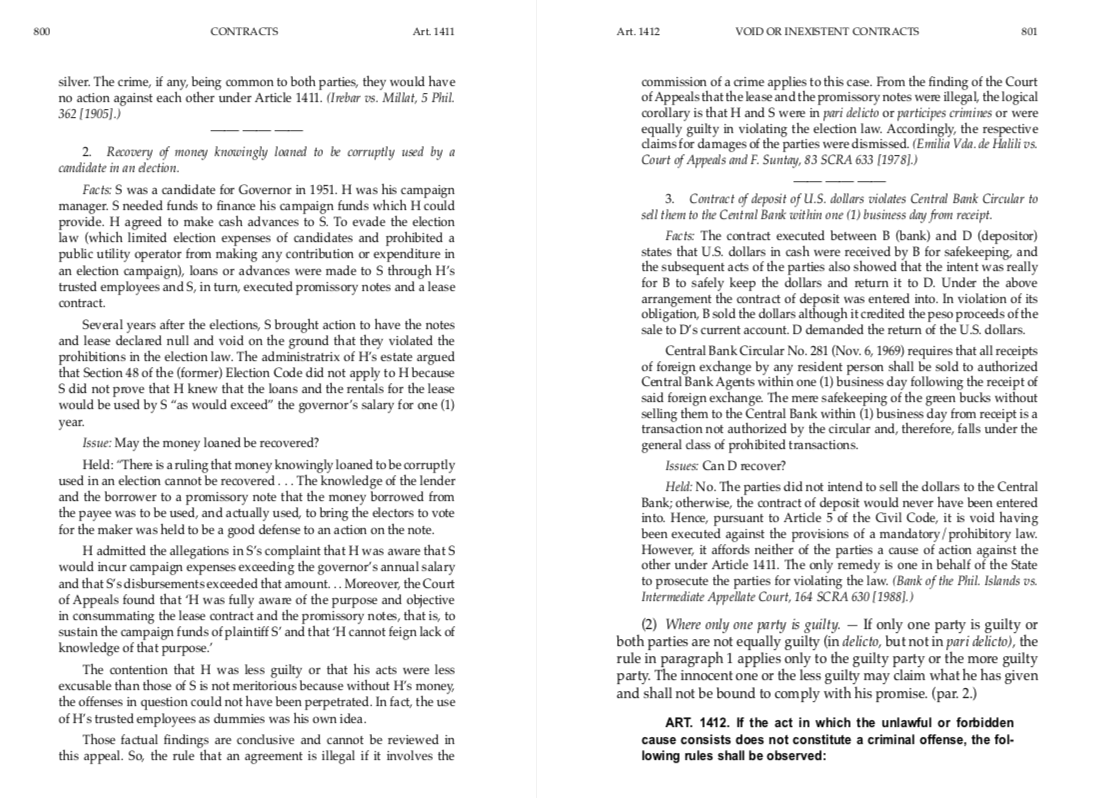
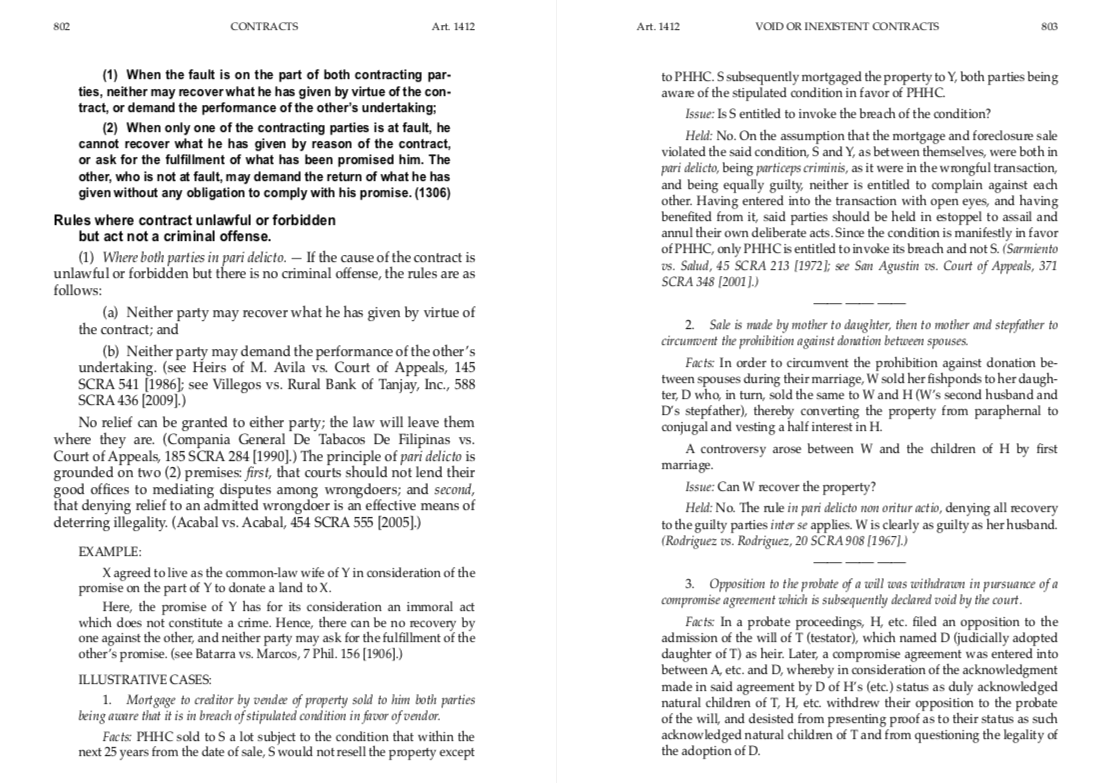
![merits. (Constantino vs. Estenzo, 65 SCRA 675 [1975].) 4. Authority of court](https://s3.amazonaws.com/si.experts.images/answers/2024/06/666b943f3e8ba_335666b943f28717.jpg)
Hello! May i ask for a brief/ simpler explanation worth 3-5mins of presentation for Articles 1411 & 1412? It would be better if there's a simple case or something applicable in the real world for each article. Here are resources:
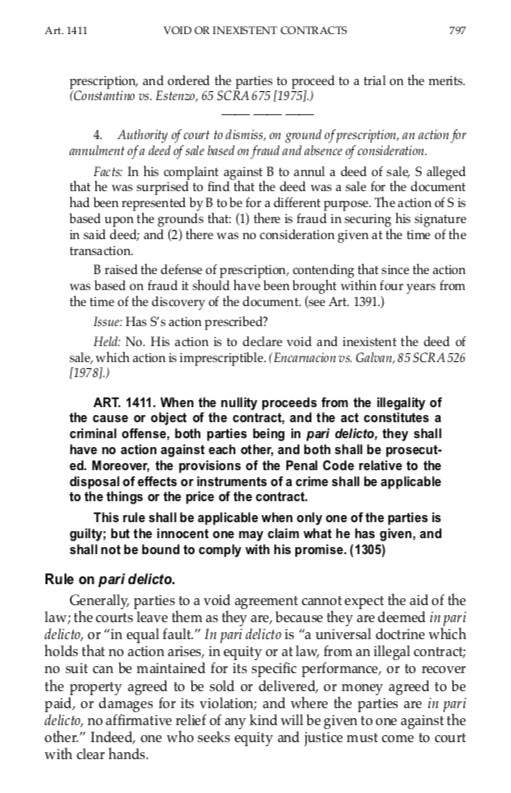
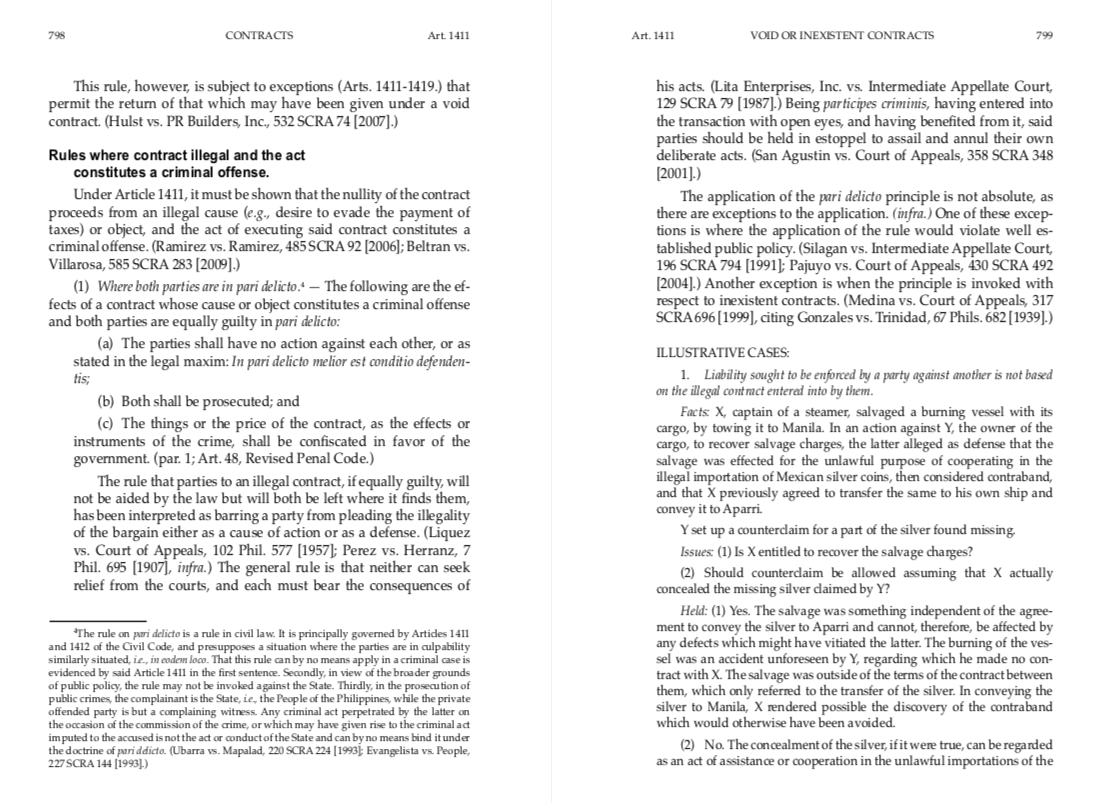
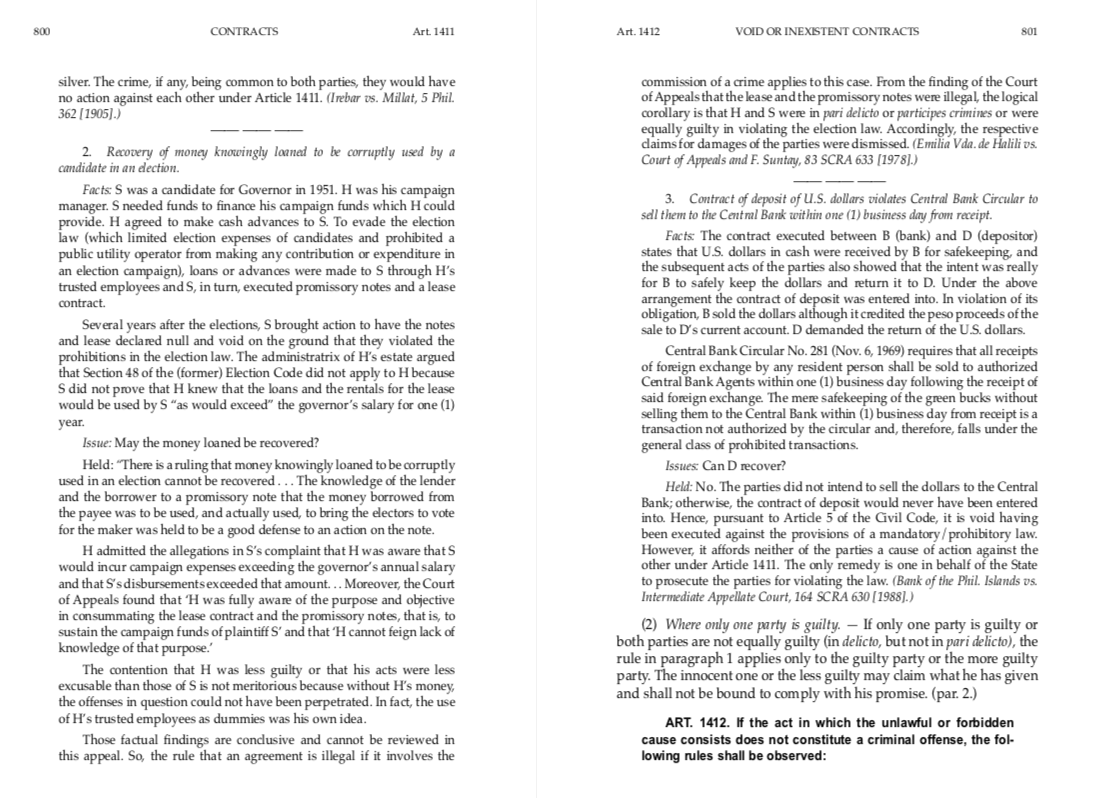
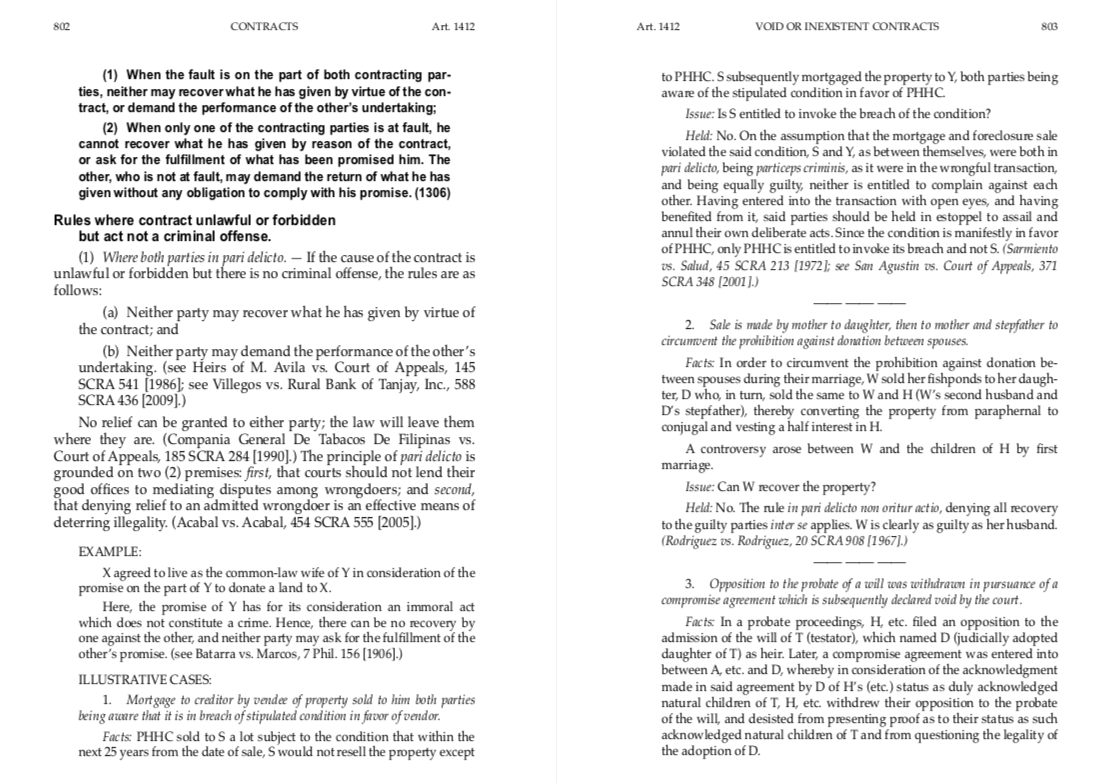
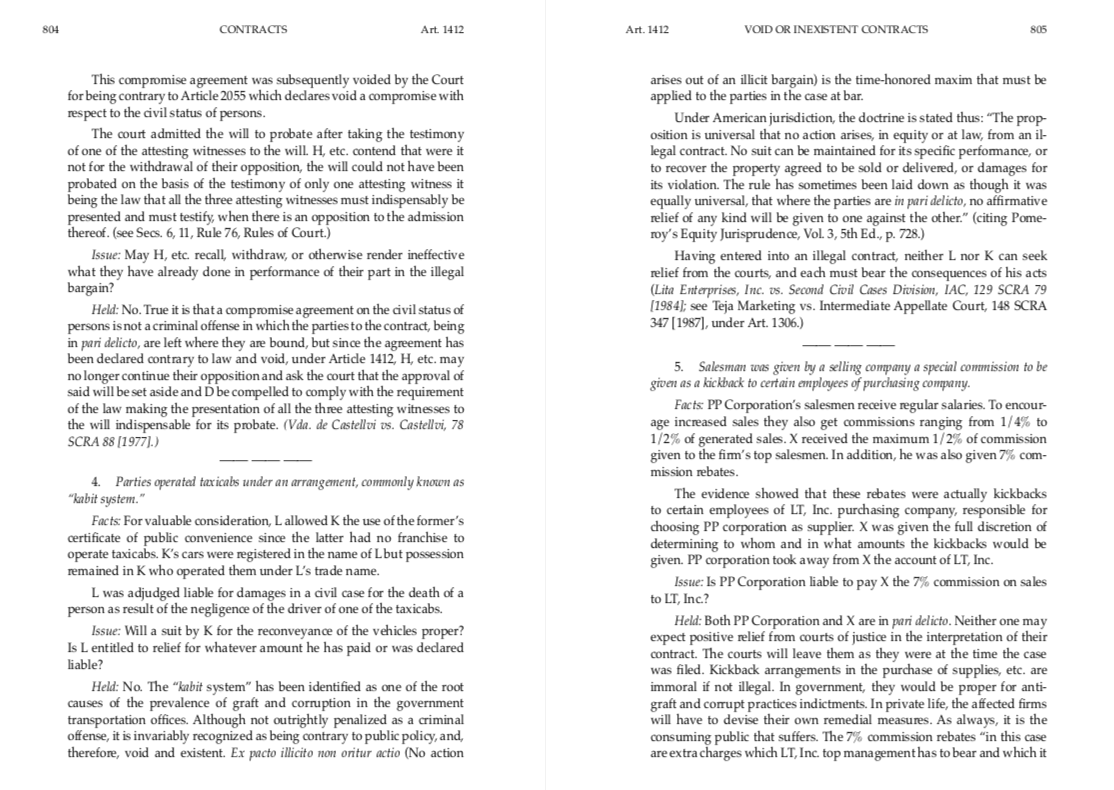
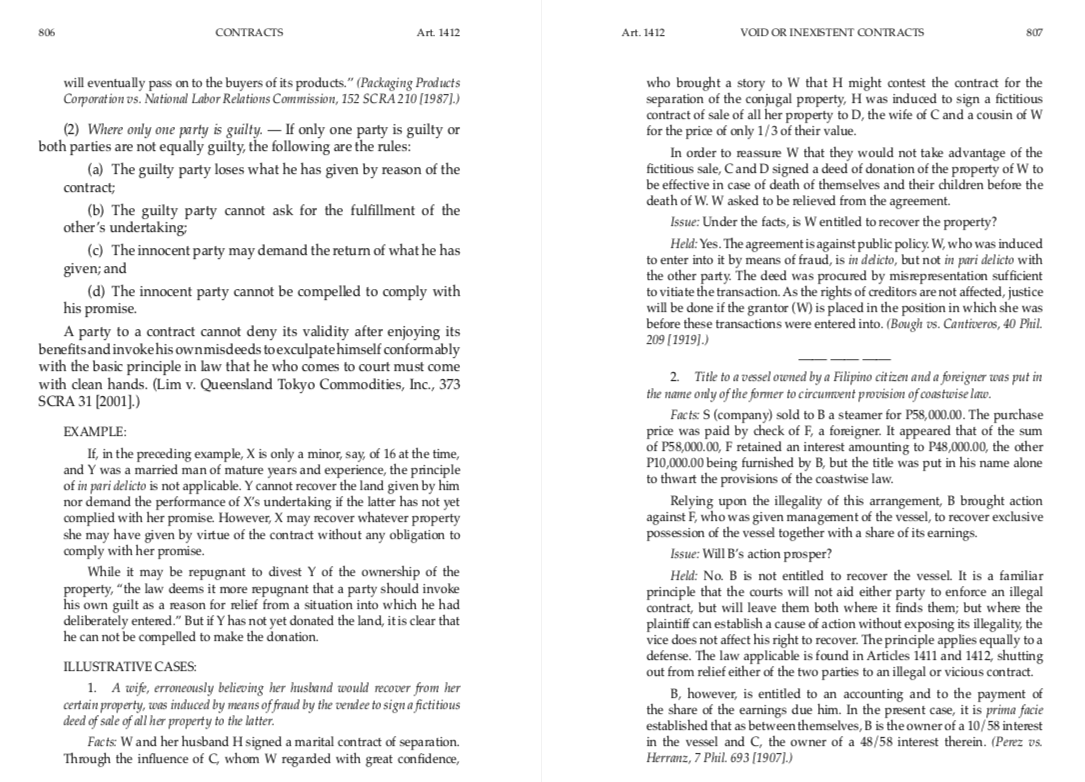
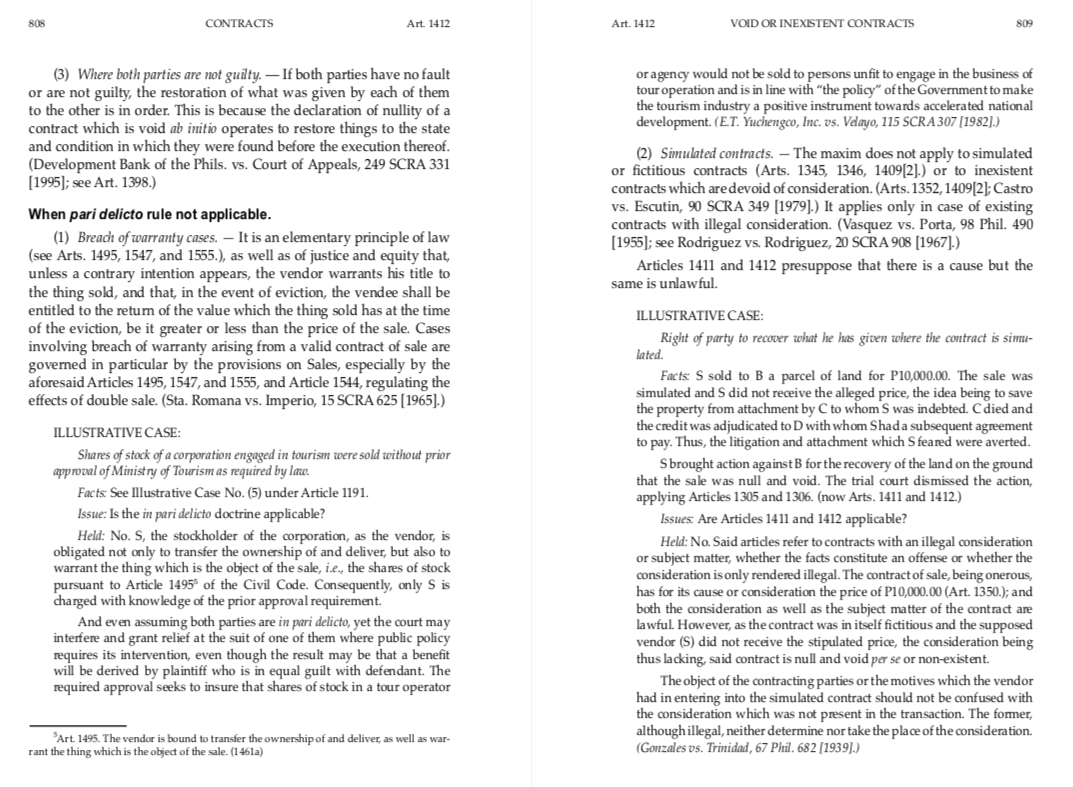
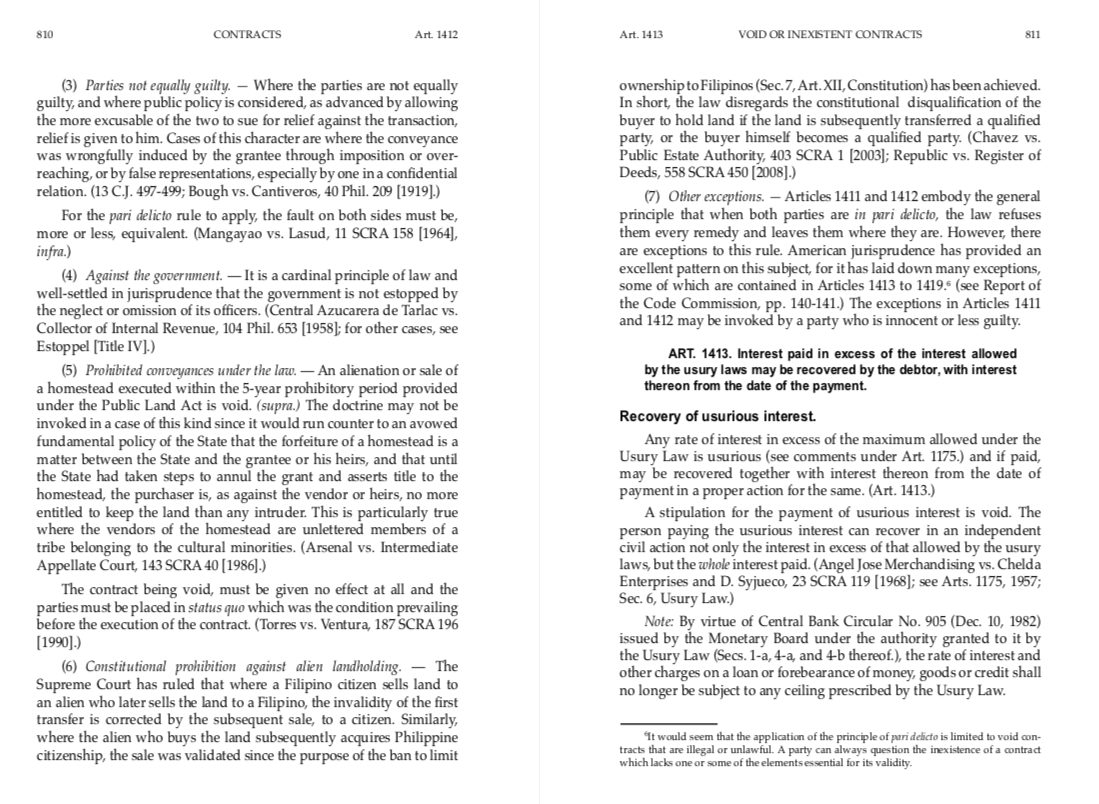
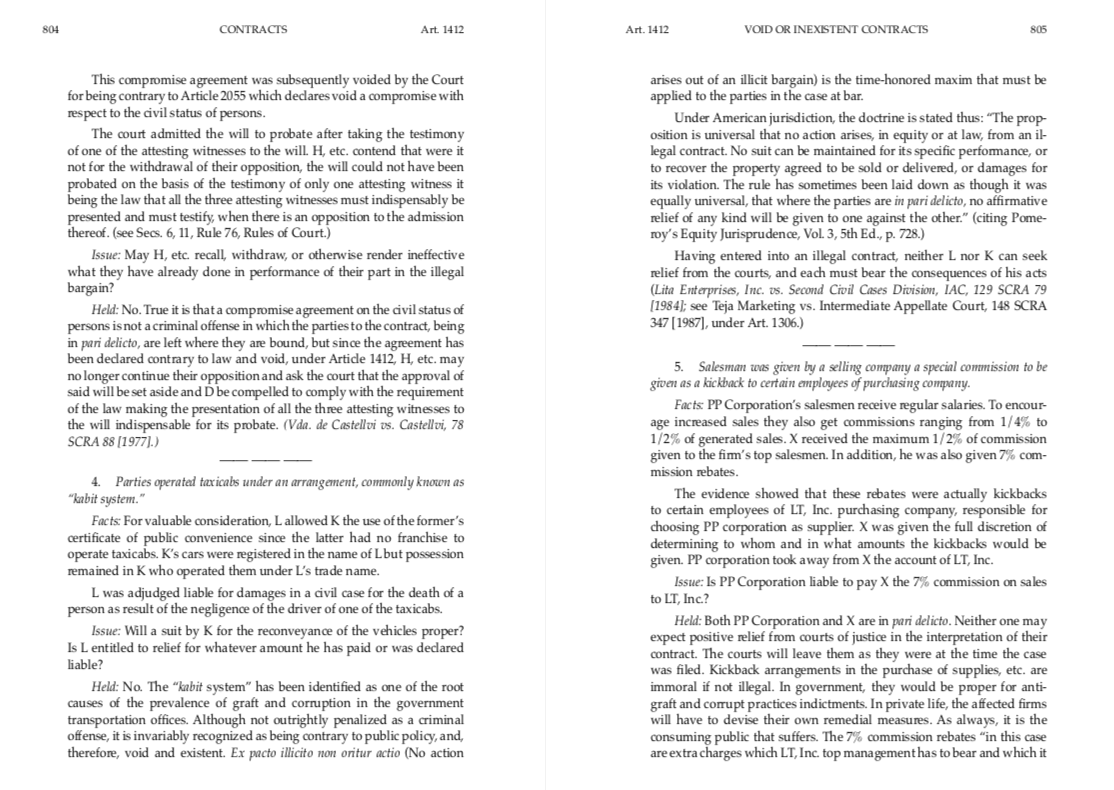
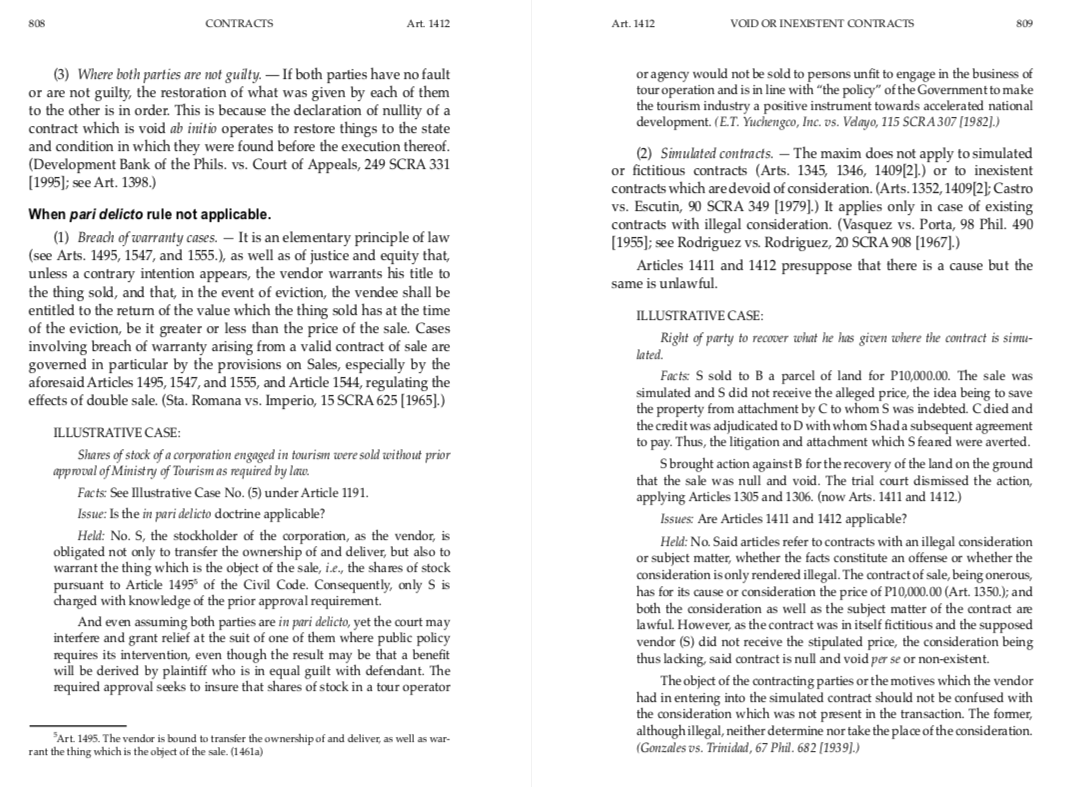
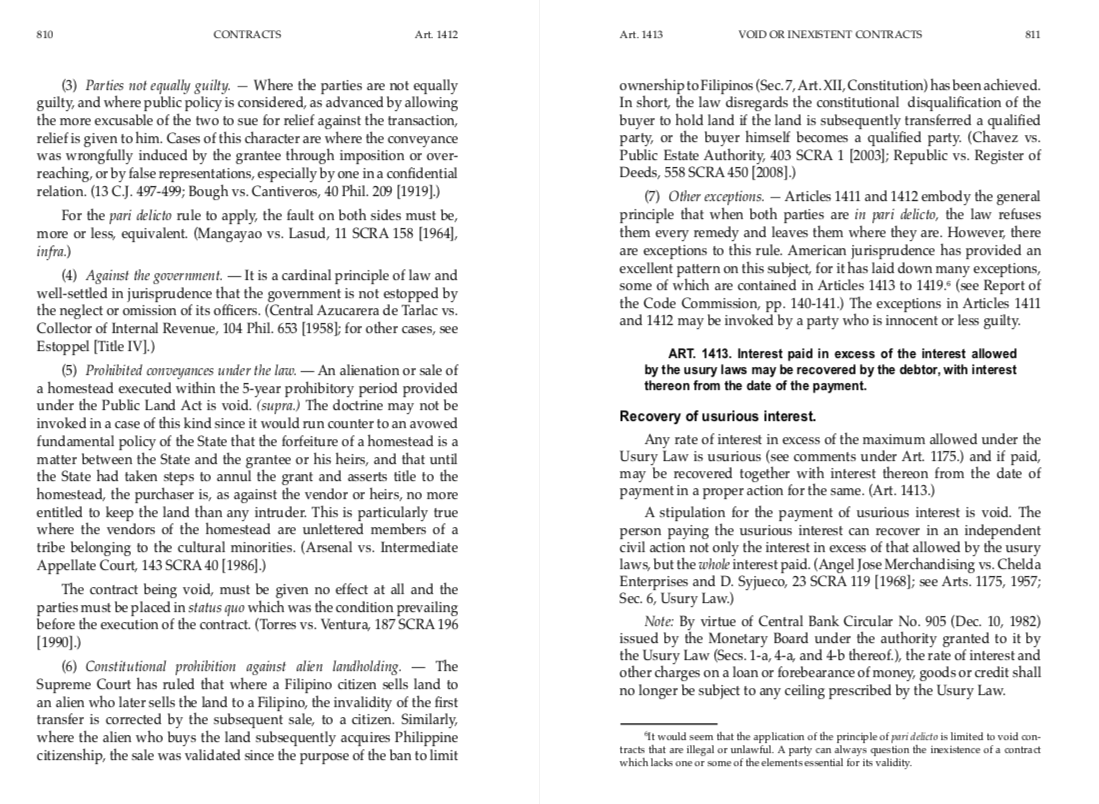
Art. 1411 VOID OR INEXISTENT CONTRACTS 797 prescription, and ordered the parties to proceed to a trial on the merits. (Constantino vs. Estenzo, 65 SCRA 675 [1975].) 4. Authority of court to dismiss, on ground of prescription, an action for annulment of a deed of sale based on fraud and absence of consideration. Facts: In his complaint against B to annul a deed of sale, S alleged that he was surprised to find that the deed was a sale for the document had been represented by B to be for a different purpose. The action of S is based upon the grounds that: (1) there is fraud in securing his signature in said deed; and (2) there was no consideration given at the time of the transaction. B raised the defense of prescription, contending that since the action was based on fraud it should have been brought within four years from the time of the discovery of the document. (see Art. 1391.) Issue: Has S's action prescribed? Held: No. His action is to dedare void and inexistent the deed of sale, which action is imprescriptible. (Encarnacion vs. Galvan, 85 SCRA526 [1978].) ART. 1411. When the nullity proceeds from the illegality of the cause or object of the contract, and the act constitutes a criminal offense, both parties being in pari delicto, they shall have no action against each other, and both shall be prosecut- ed. Moreover, the provisions of the Penal Code relative to the disposal of effects or instruments of a crime shall be applicable to the things or the price of the contract. This rule shall be applicable when only one of the parties is guilty; but the innocent one may claim what he has given, and shall not be bound to comply with his promise. (1305) Rule on pari delicto. Generally, parties to a void agreement cannot expect the aid of the law; the courts leave them as they are, because they are deemed in pari delicto, or "in equal fault." In pari delicto is "a universal doctrine which holds that no action arises, in equity or at law, from an illegal contract; no suit can be maintained for its specific performance, or to recover the property agreed to be sold or delivered, or money agreed to be paid, or damages for its violation; and where the parties are in pari delicto, no affirmative relief of any kind will be given to one against the other." Indeed, one who seeks equity and justice must come to court with clear hands.798 CONTRACTS Art. 1411 Art. 1411 VOID OR INEXISTENT CONTRACTS 799 This rule, however, is subject to exceptions (Arts. 1411-1419.) that his acts. (Lita Enterprises, Inc. vs. Intermediate Appellate Court, permit the return of that which may have been given under a void 129 SCRA 79 [1987].) Being participes criminis, having entered into contract. (Hulst vs. PR Builders, Inc., 532 SCRA 74 [2007].) the transaction with open eyes, and having benefited from it, said parties should be held in estoppel to assail and annul their own Rules where contract illegal and the act deliberate acts. (San Agustin vs. Court of Appeals, 358 SCRA 348 constitutes a criminal offense. [2001].) Under Article 1411, it must be shown that the nullity of the contract The application of the pari delicto principle is not absolute, as proceeds from an illegal cause (e.g., desire to evade the payment of there are exceptions to the application. (infra.) One of these except taxes) or object, and the act of executing said contract constitutes a tions is where the application of the rule would violate well es- criminal offense. (Ramirez vs. Ramirez, 485 SCRA 92 [2006]; Beltran vs. tablished public policy. (Silagan vs. Intermediate Appellate Court, Villarosa, 585 SCRA 283 [2009].) 1% SCRA 794 [1991]: Pajuyo vs. Court of Appeals, 430 SCRA 492 (1) Where both parties are in pari delicto.' - The following are the ef- [2004].) Another exception is when the principle is invoked with fects of a contract whose cause or object constitutes a criminal offense respect to inexistent contracts. (Medina vs. Court of Appeals, 317 and both parties are equally guilty in pari delicto: SCRA 696 [1999], citing Gonzales vs. Trinidad, 67 Phils. 682 [1939].) (a) The parties shall have no action against each other, or as stated in the legal maxim: In pari delicto melior est condition defenden- ILLUSTRATIVE CASES: tis; 1. Liability sought to be enforced by a party against another is not based (b) Both shall be prosecuted; and on the illegal contract entered into by them. (c) The things or the price of the contract, as the effects or Facts: X, captain of a steamer, salvaged a burning vessel with its cargo, by towing it to Manila. In an action against Y, the owner of the instruments of the crime, shall be confiscated in favor of the cargo, to recover salvage charges, the latter alleged as defense that the government. (par. 1; Art. 48, Revised Penal Code.) salvage was effected for the unlawful purpose of cooperating in the The rule that parties to an illegal contract, if equally guilty, will illegal importation of Mexican silver coins, then considered contraband, not be aided by the law but will both be left where it finds them, and that X previously agreed to transfer the same to his own ship and has been interpreted as barring a party from pleading the illegality convey it to Aparri. of the bargain either as a cause of action or as a defense. (Liquez Y set up a counterclaim for a part of the silver found missing vs. Court of Appeals, 102 Phil. 577 [1957]: Perez vs. Herranz, 7 Issues: (1) Is X entitled to recover the salvage charges? Phil. 695 [1907], infra.) The general rule is that neither can seek (2) Should counterclaim be allowed assuming that X actually relief from the courts, and each must bear the consequences of concealed the missing silver claimed by Y? Held: (1) Yes. The salvage was something independent of the agree- The rule on pari delicto is a rule in civil law. It is principally governed by Artides 1411 ment to convey the silver to Aparri and cannot, therefore, be affected by and 1412 of the Civil Code, and presupposes a situation where the parties are in culpability any defects which might have vitiated the latter. The burning of the ves- similarly situated, ie., in code loco. That this rule can by no means apply in a criminal case is sel was an accident unforeseen by Y, regarding which he made no con- evidenced by said Article 1411 in the first sentence. Secondly, in view of the broader grounds tract with X. The salvage was outside of the terms of the contract between of public policy, the rule may not be invoked against the State. Thirdly, in the prosecution of public crimes, the complainant is the State, ie, the People of the Philippines, while the private them, which only referred to the transfer of the silver. In conveying the offended party is but a complaining witness. Any criminal act perpetrated by the latter on silver to Manila, X rendered possible the discovery of the contraband the occasion of the commission of the crime, or which may have given rise to the criminal act which would otherwise have been avoided. im puted to the accused is not the act or conduct of the State and can by no means bind it under the doctrine of pari ddicto. (Ubarra vs. Mapalad, 220 SCRA 224 [1993] Evangelista vs. People, (2) No. The concealment of the silver, if it were true, can be regarded 227 SCRA 144 [1993]) as an act of assistance or cooperation in the unlawful importations of the800 CONTRACTS Art 1411 Art. 1412 VOID OR INEXISTENT CONTRACTS 801 silver. The crime, if any, being common to both parties, they would have commission of a crime applies to this case. From the finding of the Court no action against each other under Article 1411. (Irebar vs. Millat, 5 Phil. of Appeals that the lease and the promissory notes were illegal, the logical 362 [1905].) corollary is that H and S were in pari delicto or participes crimines or were equally guilty in violating the election law. Accordingly, the respective 2. Recovery of money knowingly loaned to be corruptly used by a daims for damages of the parties were dismissed. (Emilia Vda. de Halili vs. candidate in an election. Court of Appeals and F. Suntay, 83 SCRA 633 [1978].) Facts: S was a candidate for Governor in 1951. H was his campaign manager. S needed funds to finance his campaign funds which H could 3. Contract of deposit of U.S. dollars violates Central Bank Circular to provide. H agreed to make cash advances to S. To evade the election sell them to the Central Bank within one (1) business day from receipt. law (which limited election expenses of candidates and prohibited a Facts: The contract executed between B (bank) and D (depositor) public utility operator from making any contribution or expenditure in states that U.S. dollars in cash were received by B for safekeeping, and an election campaign), loans or advances were made to S through H's the subsequent acts of the parties also showed that the intent was really trusted employees and S, in turn, executed promissory notes and a lease for B to safely keep the dollars and return it to D. Under the above contract. arrangement the contract of deposit was entered into. In violation of its obligation, B sold the dollars although it credited the peso proceeds of the Several years after the elections, S brought action to have the notes and lease declared null and void on the ground that they violated the sale to D's current account. D demanded the return of the U.S. dollars. prohibitions in the election law. The administratrix of H's estate argued Central Bank Circular No. 281 (Nov. 6, 1969) requires that all receipts that Section 48 of the (former) Election Code did not apply to H because of foreign exchange by any resident person shall be sold to authorized S did not prove that H knew that the loans and the rentals for the lease Central Bank Agents within one (1) business day following the receipt of would be used by S "as would exceed" the governor's salary for one (1) said foreign exchange. The mere safekeeping of the green bucks without selling them to the Central Bank within (1) business day from receipt is a year. transaction not authorized by the circular and, therefore, falls under the Issue: May the money loaned be recovered? general class of prohibited transactions. Held: "There is a ruling that money knowingly loaned to be corruptly Issues: Can D recover? used in an election cannot be recovered . .. The knowledge of the lender and the borrower to a promissory note that the money borrowed from Held: No. The parties did not intend to sell the dollars to the Central the payee was to be used, and actually used, to bring the electors to vote Bank; otherwise, the contract of deposit would never have been entered into. Hence, pursuant to Article 5 of the Civil Code, it is void having for the maker was held to be a good defense to an action on the note. been executed against the provisions of a mandatory / prohibitory law. H admitted the allegations in S's complaint that H was aware that S However, it affords neither of the parties a cause of action against the would incur campaign expenses exceeding the governor's annual salary other under Article 1411. The only remedy is one in behalf of the State and that S's disbursements exceeded that amount. . . Moreover, the Court to prosecute the parties for violating the law. (Bank of the Phil. Islands vs. of Appeals found that 'H was fully aware of the purpose and objective Intermediate Appellate Court, 164 SCRA 630 [1988].) in consummating the lease contract and the promissory notes, that is, to sustain the campaign funds of plaintiff S' and that 'H cannot feign lack of (2) Where only one party is guilty. - If only one party is guilty or knowledge of that purpose.' both parties are not equally guilty (in delicto, but not in pari delicto), the The contention that H was less guilty or that his acts were less rule in paragraph 1 applies only to the guilty party or the more guilty excusable than those of S is not meritorious because without H's money, party. The innocent one or the less guilty may claim what he has given the offenses in question could not have been perpetrated. In fact, the use and shall not be bound to comply with his promise. (par. 2.) of H's trusted employees as dummies was his own idea. ART. 1412. If the act in which the unlawful or forbidden Those factual findings are conclusive and cannot be reviewed in cause consists does not constitute a criminal offense, the fol- this appeal. So, the rule that an agreement is illegal if it involves the lowing rules shall be observed:802 CONTRACTS Art. 1412 Art. 1412 VOID OR INEXISTENT CONTRACTS 803 (1) When the fault is on the part of both contracting par- to PHHC. S subsequently mortgaged the property to Y, both parties being ties, neither may recover what he has given by virtue of the con- aware of the stipulated condition in favor of PHHC. tract, or demand the performance of the other's undertaking; Issue: Is S entitled to invoke the breach of the condition? (2) When only one of the contracting parties is at fault, he cannot recover what he has given by reason of the contract, Held: No. On the assumption that the mortgage and foreclosure sale or ask for the fulfillment of what has been promised him. The violated the said condition, S and Y, as between themselves, were both in other, who is not at fault, may demand the return of what he has pari delicto, being particeps criminis, as it were in the wrongful transaction, given without any obligation to comply with his promise. (1306) and being equally guilty, neither is entitled to complain against each other. Having entered into the transaction with open eyes, and having Rules where contract unlawful or forbidden benefited from it, said parties should be held in estoppel to assail and but act not a criminal offense. annul their own deliberate acts. Since the condition is manifestly in favor (1) Where both parties in pari delicto. - If the cause of the contract is of PHHC, only PHHC is entitled to invoke its breach and not S. (Sarmiento unlawful or forbidden but there is no criminal offense, the rules are as us. Salud, 45 SCRA 213 [1972); see San Agustin us. Court of Appeals, 371 follows: SCRA 348 [2001 ].) a) Neither party may recover what he has given by virtue of the contract; and 2. Sale is made by mother to daughter, then to mother and stepfather to (b) Neither party may demand the performance of the other's circumvent the prohibition against donation between spouses. undertaking. (see Heirs of M. Avila vs. Court of Appeals, 145 Facts: In order to circumvent the prohibition against donation be- SCRA 541 [1986]: see Villegos vs. Rural Bank of Tanjay, Inc., 588 tween spouses during their marriage, W sold her fishponds to her daugh- SCRA 436 [2009].) ter, D who, in turn, sold the same to W and H (W's second husband and No relief can be granted to either party; the law will leave them D's stepfather), thereby converting the property from paraphernal to conjugal and vesting a half interest in H. where they are. (Compania General De Tabacos De Filipinas vs. Court of Appeals, 185 SCRA 284 [1990].) The principle of pari delicto is A controversy arose between W and the children of H by first grounded on two (2) premises first, that courts should not lend their marriage. good offices to mediating disputes among wrongdoers; and second, Issue: Can W recover the property? that denying relief to an admitted wrongdoer is an effective means of Held: No. The rule in pari delicto non oritur actio, denying all recovery deterring illegality. (Acabal vs. Acabal, 454 SCRA 555 [2005].) to the guilty parties inter se applies. W is clearly as guilty as her husband. EXAMPLE: (Rodriguez vs. Rodriguez, 20 SCRA 908 [1967].) X agreed to live as the common-law wife of Y in consideration of the promise on the part of Y to donate a land to X. 3. Opposition to the probate of a will was withdrawn in pursuance of a Here, the promise of Y has for its consideration an immoral act compromise agreement which is subsequently declared void by the court. which does not constitute a crime. Hence, there can be no recovery by Facts: In a probate proceedings, H, etc. filed an opposition to the one against the other, and neither party may ask for the fulfillment of the admission of the will of T (testator), which named D (judicially adopted other's promise. (see Batarra vs. Marcos, 7 Phil. 156 [1906].) daughter of T) as heir. Later, a compromise agreement was entered into ILLUSTRATIVE CASES: between A, etc. and D, whereby in consideration of the acknowledgment made in said agreement by D of H's (etc.) status as duly acknowledged 1. Mortgage to creditor by vendee of property sold to him both parties natural children of T, H, etc. withdrew their opposition to the probate being aware that it is in breach of stipulated condition in favor of vendor. of the will, and desisted from presenting proof as to their status as such Facts: PHHC sold to S a lot subject to the condition that within the acknowledged natural children of T and from questioning the legality of next 25 years from the date of sale, S would not resell the property except the adoption of D.804 CONTRACTS Art. 1412 Art. 1412 VOID OR INEXISTENT CONTRACTS 805 This compromise agreement was subsequently voided by the Court arises out of an illicit bargain) is the time-honored maxim that must be for being contrary to Article 2055 which declares void a compromise with applied to the parties in the case at bar. respect to the civil status of persons. Under American jurisdiction, the doctrine is stated thus: "The prop- The court admitted the will to probate after taking the testimony osition is universal that no action arises, in equity or at law, from an il- of one of the attesting witnesses to the will. H, etc. contend that were it legal contract. No suit can be maintained for its specific performance, or not for the withdrawal of their opposition, the will could not have been to recover the property agreed to be sold or delivered, or damages for probated on the basis of the testimony of only one attesting witness it its violation. The rule has sometimes been laid down as though it was being the law that all the three attesting witnesses must indispensably be equally universal, that where the parties are in pari delicto, no affirmative presented and must testify, when there is an opposition to the admission relief of any kind will be given to one against the other." (citing Pome- thereof. (see Secs. 6, 11, Rule 76, Rules of Court.) roy's Equity Jurisprudence, Vol. 3, 5th Ed., p. 728.) Issue: May H, etc. recall, withdraw, or otherwise render ineffective Having entered into an illegal contract, neither L nor K can seek what they have already done in performance of their part in the illegal relief from the courts, and each must bear the consequences of his acts bargain? (Lita Enterprises, Inc. vs. Second Civil Cases Division, IAC, 129 SCRA 79 Held: No. True it is that a compromise agreement on the civil status of [1984); see Teja Marketing vs. Intermediate Appellate Court, 148 SCRA persons is not a criminal offense in which the parties to the contract, being 347 [ 1987], under Art. 1306.) in pari delicto, are left where they are bound, but since the agreement has been declared contrary to law and void, under Article 1412, H, etc. may no longer continue their opposition and ask the court that the approval of 5. Salesman was given by a selling company a special commission to be said will be set aside and D be compelled to comply with the requirement given as a kickback to certain employees of purchasing company. of the law making the presentation of all the three attesting witnesses to Facts: PP Corporation's salesmen receive regular salaries. To encour the will indispensable for its probate. (Vda. de Castellvi vs. Castellvi, 78 age increased sales they also get commissions ranging from 1/4% to SCRA 88 [1977].) 1/2% of generated sales. X received the maximum 1/2% of commission given to the firm's top salesmen. In addition, he was also given 7% com- 4. Parties operated taxicabs under an arrangement, commonly known as mission rebates. "kabit system." The evidence showed that these rebates were actually kickbacks Facts: For valuable consideration, L allowed K the use of the former's to certain employees of LT, Inc. purchasing company, responsible for choosing PP corporation as supplier. X was given the full discretion of certificate of public convenience since the latter had no franchise to determining to whom and in what amounts the kickbacks would be operate taxicabs. K's cars were registered in the name of Lbut possession given. PP corporation took away from X the account of LT, Inc. remained in K who operated them under L's trade name. L was adjudged liable for damages in a civil case for the death of a Issue: Is PP Corporation liable to pay X the 7% commission on sales to LT, Inc.? person as result of the negligence of the driver of one of the taxicabs. Issue: Will a suit by K for the reconveyance of the vehicles proper? Held: Both PP Corporation and X are in pari delicto. Neither one may Is L entitled to relief for whatever amount he has paid or was declared expect positive relief from courts of justice in the interpretation of their liable? contract. The courts will leave them as they were at the time the case was filed. Kickback arrangements in the purchase of supplies, etc. are Held: No. The "kabit system" has been identified as one of the root immoral if not illegal. In government, they would be proper for anti- causes of the prevalence of graft and corruption in the government graft and corrupt practices indictments. In private life, the affected firms transportation offices. Although not outrightly penalized as a criminal will have to devise their own remedial measures. As always, it is the offense, it is invariably recognized as being contrary to public policy, and, consuming public that suffers. The 7% commission rebates "in this case therefore, void and existent. Ex pacto illicito non oritur actio (No action are extra charges which LT, Inc. top management has to bear and which it806 CONTRACTS Art 1412 Art. 1412 VOID OR INEXISTENT CONTRACTS 807 will eventually pass on to the buyers of its products." (Packaging Products who brought a story to W that H might contest the contract for the Corporation vs. National Labor Relations Commission, 152 SCRA 210 [1987].) separation of the conjugal property, H was induced to sign a fictitious contract of sale of all her property to D, the wife of C and a cousin of W (2) Where only one party is guilty. - If only one party is guilty or for the price of only 1/3 of their value. both parties are not equally guilty, the following are the rules: In order to reassure W that they would not take advantage of the (a) The guilty party loses what he has given by reason of the fictitious sale, C and D signed a deed of donation of the property of W to contract; be effective in case of death of themselves and their children before the (b) The guilty party cannot ask for the fulfillment of the death of W. W asked to be relieved from the agreement. other's undertaking Issue: Under the facts, is W entitled to recover the property? (c) The innocent party may demand the return of what he has Held: Yes. The agreement is against public policy. W, who was induced given; and to enter into it by means of fraud, is in delicto, but not in pari delicto with the other party. The deed was procured by misrepresentation sufficient (d) The innocent party cannot be compelled to comply with to vitiate the transaction. As the rights of creditors are not affected, justice his promise. will be done if the grantor (W) is placed in the position in which she was A party to a contract cannot deny its validity after enjoying its before these transactions were entered into. (Bough vs. Cantiveros, 40 Phil. benefits and invoke his ownmisdeeds to exculpate himself conformably 209 [1919].) with the basic principle in law that he who comes to court must come with clean hands. (Lim v. Queensland Tokyo Commodities, Inc., 373 2. Title to a vessel owned by a Filipino citizen and a foreigner was put in SCRA 31 [2001].) the name only of the former to circumvent provision of coastwise law. Facts: S (company) sold to B a steamer for P58,000.00. The purchase EXAMPLE: price was paid by check of F, a foreigner. It appeared that of the sum If, in the preceding example, X is only a minor, say, of 16 at the time, of P58,000.00, F retained an interest amounting to P48,000.00, the other and Y was a married man of mature years and experience, the principle P10,000.00 being furnished by B, but the title was put in his name alone of in pari delicto is not applicable. Y cannot recover the land given by him to thwart the provisions of the coastwise law. nor demand the performance of X's undertaking if the latter has not yet Relying upon the illegality of this arrangement, B brought action complied with her promise. However, X may recover whatever property against F, who was given management of the vessel, to recover exclusive she may have given by virtue of the contract without any obligation to possession of the vessel together with a share of its earnings. comply with her promise. Issue: Will B's action prosper? While it may be repugnant to divest Y of the ownership of the Held: No. B is not entitled to recover the vessel. It is a familiar property, "the law deems it more repugnant that a party should invoke principle that the courts will not aid either party to enforce an illegal his own guilt as a reason for relief from a situation into which he had contract, but will leave them both where it finds them; but where the deliberately entered." But if Y has not yet donated the land, it is clear that plaintiff can establish a cause of action without exposing its illegality, the he can not be compelled to make the donation. vice does not affect his right to recover. The principle applies equally to a defense. The law applicable is found in Articles 1411 and 1412, shutting ILLUSTRATIVE CASES: out from relief either of the two parties to an illegal or vicious contract. 1. A wife, erroneously believing her husband would recover from her B, however, is entitled to an accounting and to the payment of certain property, was induced by means of fraud by the vendee to sign a fictitious the share of the earnings due him. In the present case, it is prima facie deed of sale of all her property to the latter. established that as between themselves, B is the owner of a 10/58 interest Facts: W and her husband H signed a marital contract of separation. in the vessel and C, the owner of a 48/58 interest therein. (Perez vs. Through the influence of C, whom W regarded with great confidence, Herranz, 7 Phil. 693 [1907].)809 CONTRACTS Art. 1412 Art. 1412 VOID OR INEXISTENT CONTRACTS 809 (3) Where both parties are not guilty. - If both parties have no fault or agency would not be sold e sold to persons unfit to engage in the business of or are not guilty, the restoration of what was given by each of them tour operation and is in line with "the policy" of the Government to make to the other is in order. This is because the declaration of nullity of a the tourism industry a positive instrument towards accelerated national contract which is void ab initio operates to restore things to the state development. (E.T. Yuchengco, Inc. vs. Velayo, 115 SCRA 307 [1982].) and condition in which they were found before the execution thereof. (Development Bank of the Phils. vs. Court of Appeals, 249 SCRA 331 (2) Simulated contracts. - The maxim does not apply to simulated [1995]; see Art. 1398.) or fictitious contracts (Arts. 1345, 1346, 1409[2].) or to inexistent contracts which are devoid of consideration. (Arts. 1352, 1409[2]: Castro When pari delicto rule not applicable. vs. Escutin, 90 SCRA 349 [1979].) It applies only in case of existing contracts with illegal consideration. (Vasquez vs. Porta, 98 Phil. 490 (1) Breach of warranty cases. - It is an elementary principle of law [1955]; see Rodriguez vs. Rodriguez, 20 SCRA 908 [1967].) (see Arts. 1495, 1547, and 1555.), as well as of justice and equity that, unless a contrary intention appears, the vendor warrants his title to Articles 1411 and 1412 presuppose that there is a cause but the the thing sold, and that, in the event of eviction, the vendee shall be same is unlawful. entitled to the return of the value which the thing sold has at the time ILLUSTRATIVE CASE: of the eviction, be it greater or less than the price of the sale. Cases involving breach of warranty arising from a valid contract of sale are Right of party to recover what he has given where the contract is simu- lated . governed in particular by the provisions on Sales, especially by the aforesaid Articles 1495, 1547, and 1555, and Article 1544, regulating the Facts: S sold to B a parcel of land for P10,000.00. The sale was effects of double sale. (Sta. Romana vs. Imperio, 15 SCRA 625 [1965].) simulated and S did not receive the alleged price, the idea being to save the property from attachment by C to whom S was indebted. C died and ILLUSTRATIVE CASE: the credit was adjudicated to D with whom Shad a subsequent agreement to pay. Thus, the litigation and attachment which S feared were averted. Shares of stock of a corporation engaged in tourism were sold without prior approval of Ministry of Tourism as required by law. S brought action against B for the recovery of the land on the ground that the sale was null and void. The trial court dismissed the action, Facts: See Illustrative Case No. (5) under Article 1191. applying Articles 1305 and 1306. (now Arts. 1411 and 1412.) Issue: Is the in pari delicto doctrine applicable? Issues: Are Articles 1411 and 1412 applicable? Held: No. S, the stockholder of the corporation, as the vendor, is obligated not only to transfer the ownership of and deliver, but also to Held: No. Said articles refer to contracts with an illegal consideration warrant the thing which is the object of the sale, i.e., the shares of stock or subject matter, whether the facts constitute an offense or whether the pursuant to Article 1495 of the Civil Code. Consequently, only S is consideration is only rendered illegal. The contract of sale, being onerous, charged with knowledge of the prior approval requirement. has for its cause or consideration the price of P10,000.00 (Art. 1350.); and both the consideration as well as the subject matter of the contract are And even assuming both parties are in pari delicto, yet the court may lawful. However, as the contract was in itself fictitious and the supposed interfere and grant relief at the suit of one of them where public policy vendor (S) did not receive the stipulated price, the consideration being requires its intervention, even though the result may be that a benefit thus lacking, said contract is null and void per se or non-existent. will be derived by plaintiff who is in equal guilt with defendant. The required approval seeks to insure that shares of stock in a tour operator The object of the contracting parties or the motives which the vendor had in entering into the simulated contract should not be confused with the consideration which was not present in the transaction. The former, Art. 1495. The vendor is bound to transfer the ownership of and deliver, as well as war- although illegal, neither determine nor take the place of the consideration. rant the thing which is the object of the sale. (1461a) (Gonzales vs. Trinidad, 67 Phil. 682 [1939].)810 CONTRACTS Art. 1412 Art. 1413 VOID OR INEXISTENT CONTRACTS 811 (3) Parties not equally guilty. - Where the parties are not equally ownership to Filipinos (Sec.7, Art. XII, Constitution) has been achieved. guilty, and where public policy is considered, as advanced by allowing In short, the law disregards the constitutional disqualification of the the more excusable of the two to sue for relief against the transaction, buyer to hold land if the land is subsequently transferred a qualified relief is given to him. Cases of this character are where the conveyance party, or the buyer himself becomes a qualified party. (Chavez vs. was wrongfully induced by the grantee through imposition or over- Public Estate Authority, 403 SCRA 1 [2003]; Republic vs. Register of reaching, or by false representations, especially by one in a confidential Deeds, 558 SCRA 450 [2008].) relation. (13 C.J. 497-499; Bough vs. Cantiveros, 40 Phil. 209 [1919].) (7) Other exceptions. - Articles 1411 and 1412 embody the general For the pari delicto rule to apply, the fault on both sides must be, principle that when both parties are in pari delicto, the law refuses more or less, equivalent. (Mangayao vs. Lasud, 11 SCRA 158 [1964], them every remedy and leaves them where they are. However, there infra.) are exceptions to this rule. American jurisprudence has provided an (4) Against the government. - It is a cardinal principle of law and excellent pattern on this subject, for it has laid down many exceptions, well-settled in jurisprudence that the government is not estopped by some of which are contained in Articles 1413 to 1419. (see Report of the neglect or omission of its officers. (Central Azucarera de Tarlac vs. the Code Commission, pp. 140-141.) The exceptions in Articles 1411 Collector of Internal Revenue, 104 Phil. 653 [1958]; for other cases, see and 1412 may be invoked by a party who is innocent or less guilty. Estoppel [Title IV].) ART. 1413. Interest paid in excess of the interest allowed (5) Prohibited conveyances under the law. - An alienation or sale of by the usury laws may be recovered by the debtor, with interest a homestead executed within the 5-year prohibitory period provided thereon from the date of the payment. under the Public Land Act is void. (supra.) The doctrine may not be invoked in a case of this kind since it would run counter to an avowed Recovery of usurious interest. fundamental policy of the State that the forfeiture of a homestead is a Any rate of interest in excess of the maximum allowed under the matter between the State and the grantee or his heirs, and that until Usury Law is usurious (see comments under Art. 1175.) and if paid, the State had taken steps to annul the grant and asserts title to the may be recovered together with interest thereon from the date of homestead, the purchaser is, as against the vendor or heirs, no more payment in a proper action for the same. (Art. 1413.) entitled to keep the land than any intruder. This is particularly true A stipulation for the payment of usurious interest is void. The where the vendors of the homestead are unlettered members of a person paying the usurious interest can recover in an independent tribe belonging to the cultural minorities. (Arsenal vs. Intermediate civil action not only the interest in excess of that allowed by the usury Appellate Court, 143 SCRA 40 [1986].) laws, but the whole interest paid. (Angel Jose Merchandising vs. Chelda The contract being void, must be given no effect at all and the Enterprises and D. Syjueco, 23 SCRA 119 [1968]; see Arts. 1175, 1957; parties must be placed in status quo which was the condition prevailing Sec. 6, Usury Law.) before the execution of the contract. (Torres vs. Ventura, 187 SCRA 196 Note: By virtue of Central Bank Circular No. 905 (Dec. 10, 1982) [1990].) issued by the Monetary Board under the authority granted to it by (6) Constitutional prohibition against alien landholding. - The the Usury Law (Secs. 1-a, 4-a, and 4-b thereof.), the rate of interest and Supreme Court has ruled that where a Filipino citizen sells land to other charges on a loan or forebearance of money, goods or credit shall an alien who later sells the land to a Filipino, the invalidity of the first no longer be subject to any ceiling prescribed by the Usury Law. transfer is corrected by the subsequent sale, to a citizen. Similarly, where the alien who buys the land subsequently acquires Philippine It would seem that the application of the principle of pari delicto is limited to void con- citizenship, the sale was validated since the purpose of the ban to limit tracts that are illegal or unlawful. A party can always question the inexistence of a contract which lacks one or some of the elements essential for its validity
Step by Step Solution
There are 3 Steps involved in it

Get step-by-step solutions from verified subject matter experts
 Study Help