Question: Hello! please answer all 10 questions clearly please its sometimes hard to understand the experts please thank you! 4 A linear programming computer package is
Hello! please answer all 10 questions clearly please its sometimes hard to understand the experts please thank you!
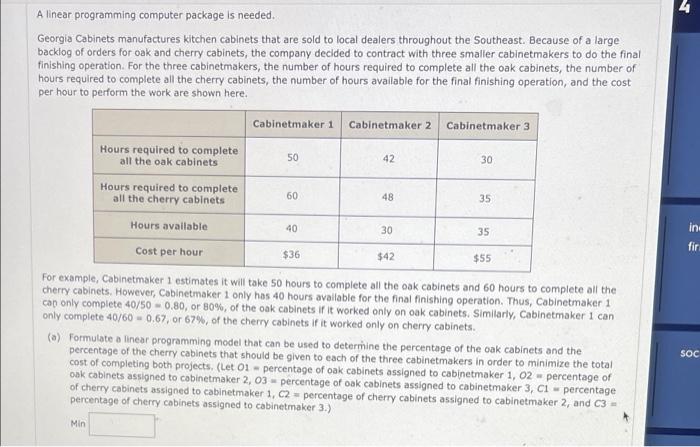
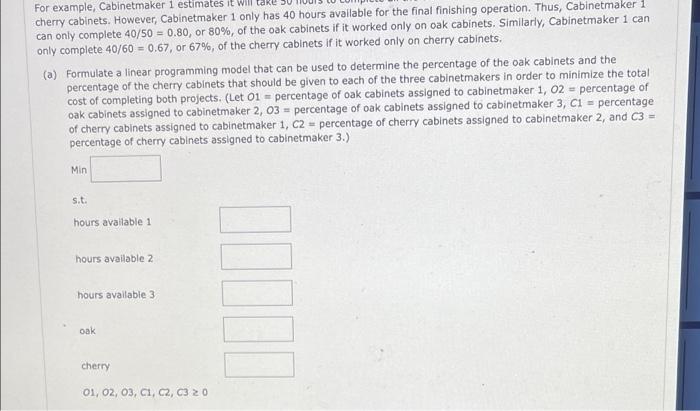
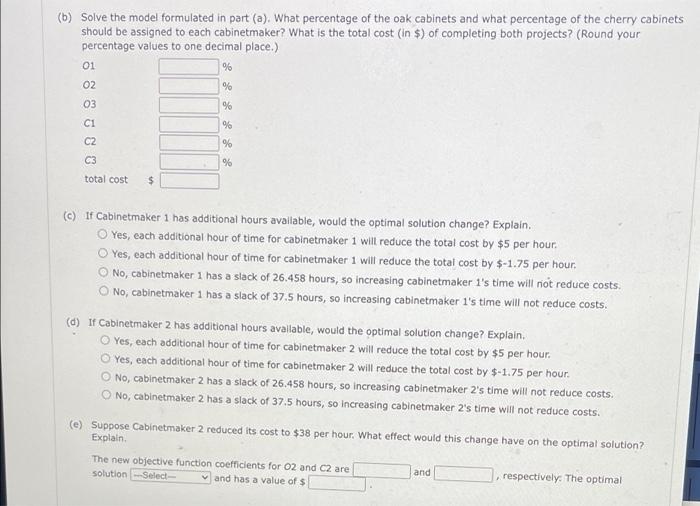
4 A linear programming computer package is needed. Georgia Cabinets manufactures kitchen cabinets that are sold to local dealers throughout the Southeast. Because of a large backlog of orders for oak and cherry cabinets, the company decided to contract with three smaller cabinetmakers to do the final finishing operation. For the three cabinetmakers, the number of hours required to complete all the oak cabinets, the number of hours required to complete all the cherry cabinets, the number of hours available for the final finishing operation, and the cost per hour to perform the work are shown here. in. fir Cabinetmaker 1 Cabinetmaker 2 Cabinetmaker 3 Hours required to complete 50 42 30 all the oak cabinets Hours required to complete 60 48 35 all the cherry cabinets Hours available 40 30 35 Cost per hour $36 $42 $55 For example, Cabinetmaker 1 estimates it will take 50 hours to complete all the oak cabinets and 60 hours to complete all the cherry cabinets. However, Cabinetmaker 1 only has 40 hours available for the final finishing operation. Thus, Cabinetmaker 1 can only complete 40/50 - 0.80, or 80%, of the oak cabinets if it worked only on oak cabinets. Similarly, Cabinetmaker I can only complete 40/60 - 0.67, or 67%, of the cherry cabinets if it worked only on cherry cabinets. (s) Formulate a linear programming model that can be used to determine the percentage of the oak cabinets and the percentage of the cherry cabinets that should be given to each of the three cabinetmakers in order to minimize the total cost of completing both projects. (Let 01 - percentage of oak cabinets assigned to cabinetmaker 1, 02 - percentage of oak cabinets assigned to cabinetmaker 2, 03 - percentage of oak cabinets assigned to cabinetmaker 3, CI - percentage of cherry cabinets assigned to cabinetmaker 1, C2-percentage of cherry cabinets assigned to cabinetmaker 2, and C3 percentage of cherry cabinets assigned to cabinetmaker 3.) Min SOC For example, Cabinetmaker 1 estimates it will cherry cabinets. However, Cabinetmaker 1 only has 40 hours available for the final finishing operation. Thus, Cabinetmaker 1 can only complete 40/50 = 0.80, or 80%, of the oak cabinets if it worked only on oak cabinets. Similarly, Cabinetmaker 1 can only complete 40/60 = 0.67, or 67%, of the cherry cabinets if it worked only on cherry cabinets (a) Formulate a linear programming model that can be used to determine the percentage of the oak cabinets and the percentage of the cherry cabinets that should be given to each of the three cabinetmakers in order to minimize the total cost of completing both projects. (Let 01 = percentage of oak cabinets assigned to cabinetmaker 1, 02 = percentage of oak cabinets assigned to cabinetmaker 2,03 = percentage of oak cabinets assigned to cabinetmaker 3, C1 = percentage of cherry cabinets assigned to cabinetmaker 1, C2 - percentage of cherry cabinets assigned to cabinetmaker 2, and C3 = percentage of cherry cabinets assigned to cabinetmaker 3.) Min s.t. hours available 1 hours available 2 hours available 3 NINJA oak cherry 01, 02, 03, C1, C2, C3 20 (b) solve the model formulated in part (a). What percentage of the oak cabinets and what percentage of the cherry cabinets should be assigned to each cabinetmaker? What is the total cost (in $) of completing both projects? (Round your percentage values to one decimal place.) 01 % 02 % 03 %% C1 % C2 9% C3 % total cost $ (c) If Cabinetmaker 1 has additional hours available, would the optimal solution change? Explain. Yes, each additional hour of time for cabinetmaker 1 will reduce the total cost by $5 per hour. Yes, each additional hour of time for cabinetmaker I will reduce the total cost by $-1.75 per hour. O No, cabinetmaker 1 has a slack of 26.458 hours, so increasing cabinetmaker 1's time will not reduce costs. No, cabinetmaker 1 has a slack of 37.5 hours, so increasing cabinetmaker 1's time will not reduce costs. (d) If Cabinetmaker 2 has additional hours available, would the optimal solution change? Explain. Yes, each additional hour of time for cabinetmaker 2 will reduce the total cost by $5 per hour. Yes, each additional hour of time for cabinetmaker 2 will reduce the total cost by $-1.75 per hour. O No, cabinetmaker 2 has a slack of 26.458 hours, so increasing cabinetmaker 2's time will not reduce costs. No, cabinetmaker 2 has a slack of 37.5 hours, so increasing cabinetmaker 2's time will not reduce costs. (e) Suppose Cabinetmaker 2 reduced its cost to $38 per hour. What effect would this change have on the optimal solution? Explain The new objective function coefficients for O2 and C2 are solution --Select- and has a value of $ and respectively. The optimal









 Study Help