







Question: Hello. Please answer the following question, ensure that your answer is correct and is supported by calculations, explanations and algebraic work. Try to only utilize
Hello. Please answer the following question, ensure that your answer is correct and is supported by calculations, explanations and algebraic work. Try to only utilize the sections/topics seen below. Solutions for Ordinary Differential Equations must be given in real values form(i.e. no complex or imaginary values). Please organize your work, in a reasonably neat and coherent way. Again, ensure to justify your answer in a clear and reasonable way, as well as in a detailed manner. Answers not supported or justified will receive a thumbs down. Thank you so much, I hope you have a great day! :) Topics potentially utilized in the following question:
? Section 2.1: Separate and Integrate ? Section 2.2: Slope Fields ? Section 2.3: Integrating Factors ? Section 2.4, Section 6.1: Existence, Uniqueness, and Eulers Method ? Section 2.7: The Phase Line ? Section 3.1: 2nd order linear ODE?Section 3.2: 2nd order homogeneous linear ODE ? Section 3.4: 2nd order nonhomogeneous linear ODE ? Section 3.3: Damped Mass-Spring System ? Section 3.5: Forced Oscillators ? Section 3.5: added detail for steady state ? Section 3.5: Beats and Resonance ? first order linear (autonomous) systems ? linear systems II (like phase planes and direction fields) ? linear systems III(like eigenvalues and eigenvectors) ? linear systems IV (like rewriting undamped oscillators as a system, using eyelets principle and linearity principle, classification of equilibrium point ? Linear systems V (eigenvalues, trace of a matrix) ? Systems (evecs) ? Nonlinear systems ? Equilibrium point analysis ? parameters in non linear systems/Bifurcation ? Equilibrium Point analysis failure & Qualitative Analysis
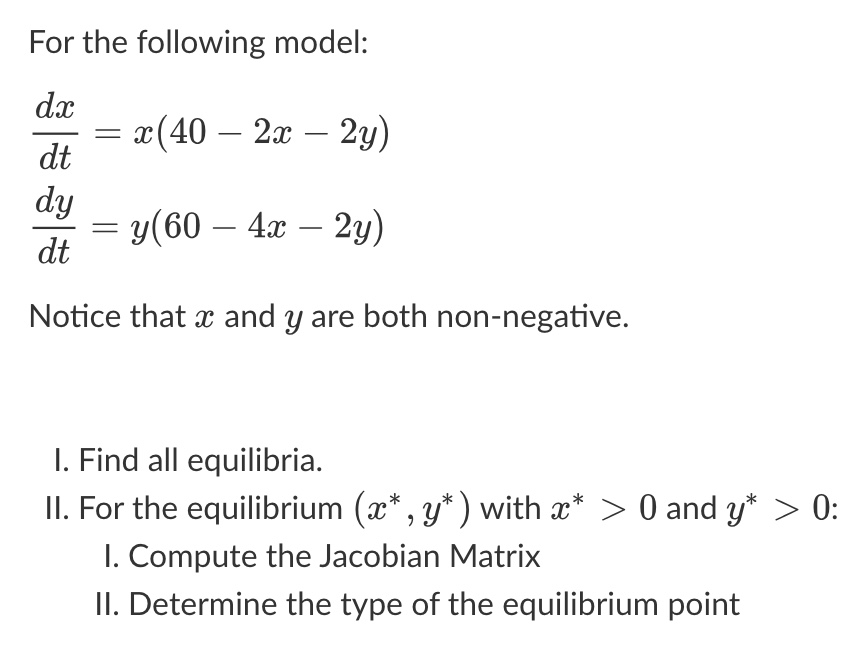
For the following model: dx = x(40 - 2x - 2y) dt dy dt = y(60 - 4x - 2y) Notice that x and y are both non-negative. 1. Find all equilibria. Il. For the equilibrium (ac* , y* ) with a* > 0 and y* > 0: I. Compute the Jacobian Matrix Il. Determine the type of the equilibrium point
Step by Step Solution
There are 3 Steps involved in it

Get step-by-step solutions from verified subject matter experts
 Study Help