Question: Hello! Please answer the highlighted question. Thank you A particular rail freight company LogCo needs to set a price/ton (in R$/ton) to transport grains (corn)
Hello! Please answer the highlighted question. Thank you
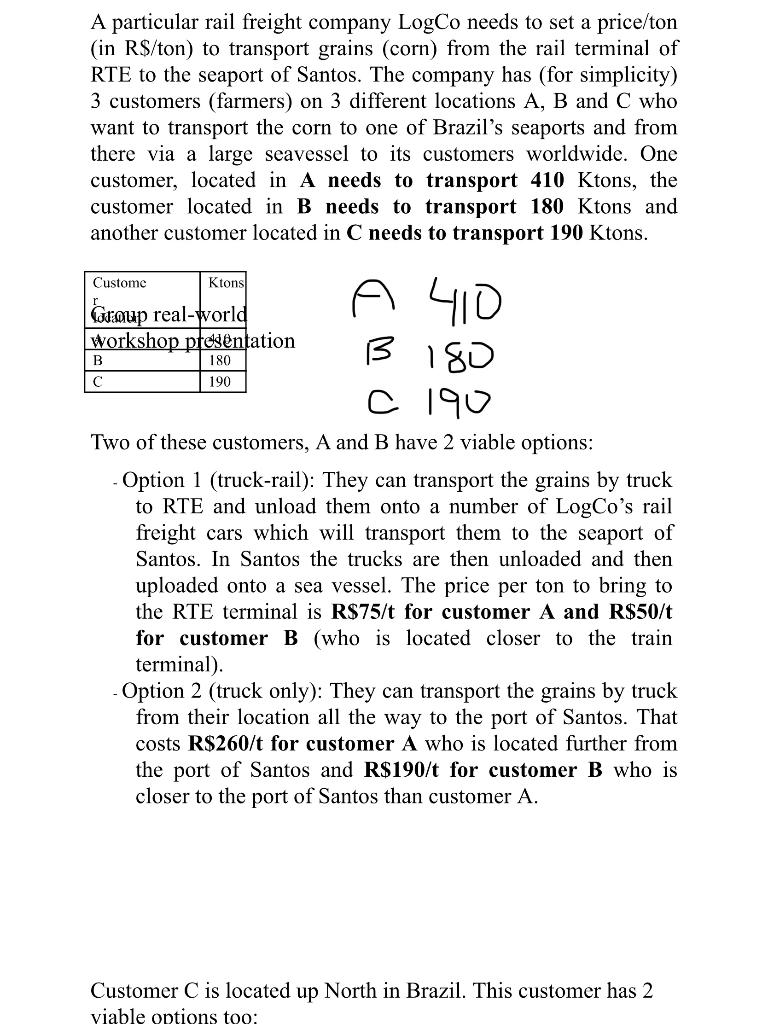
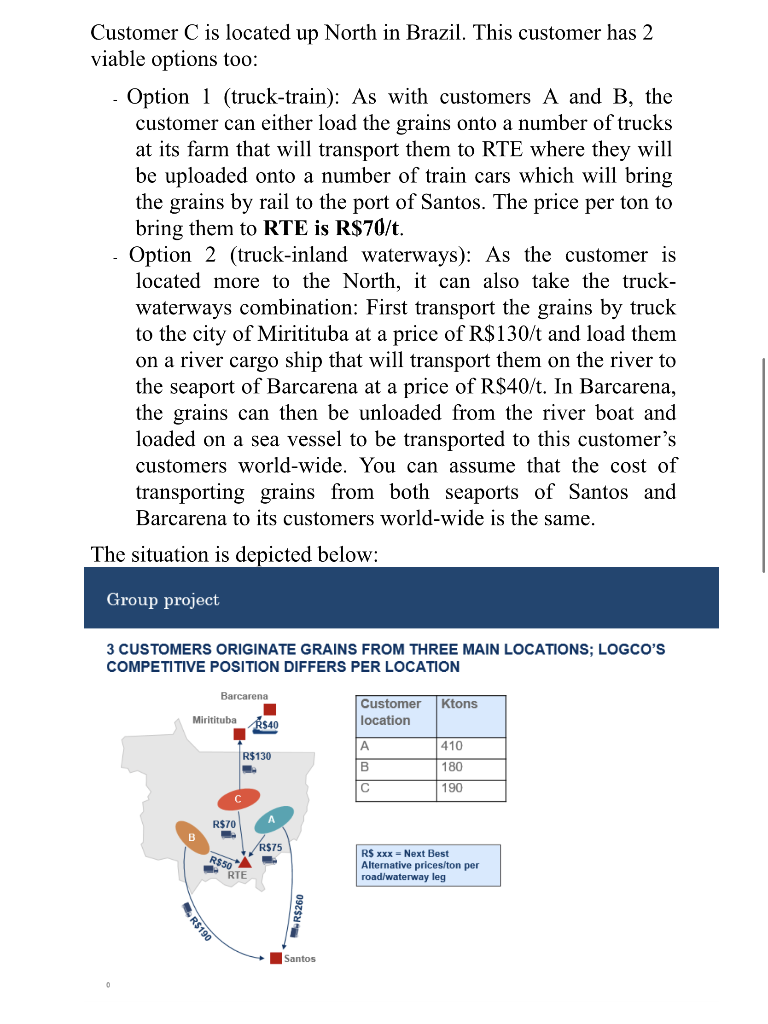
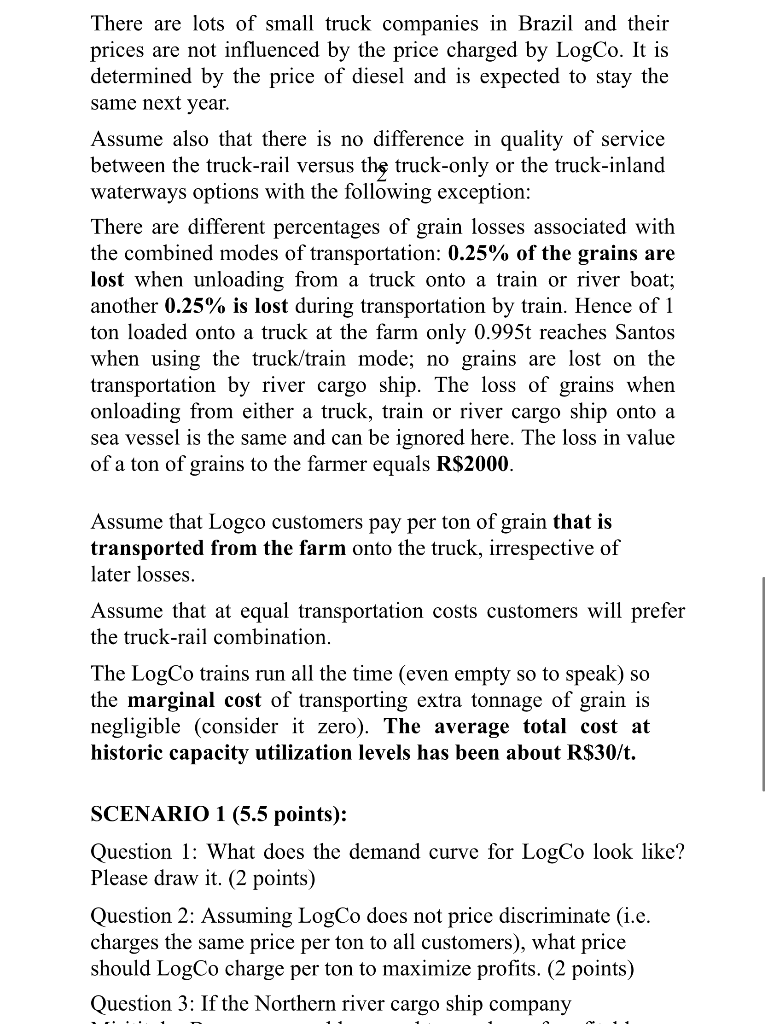
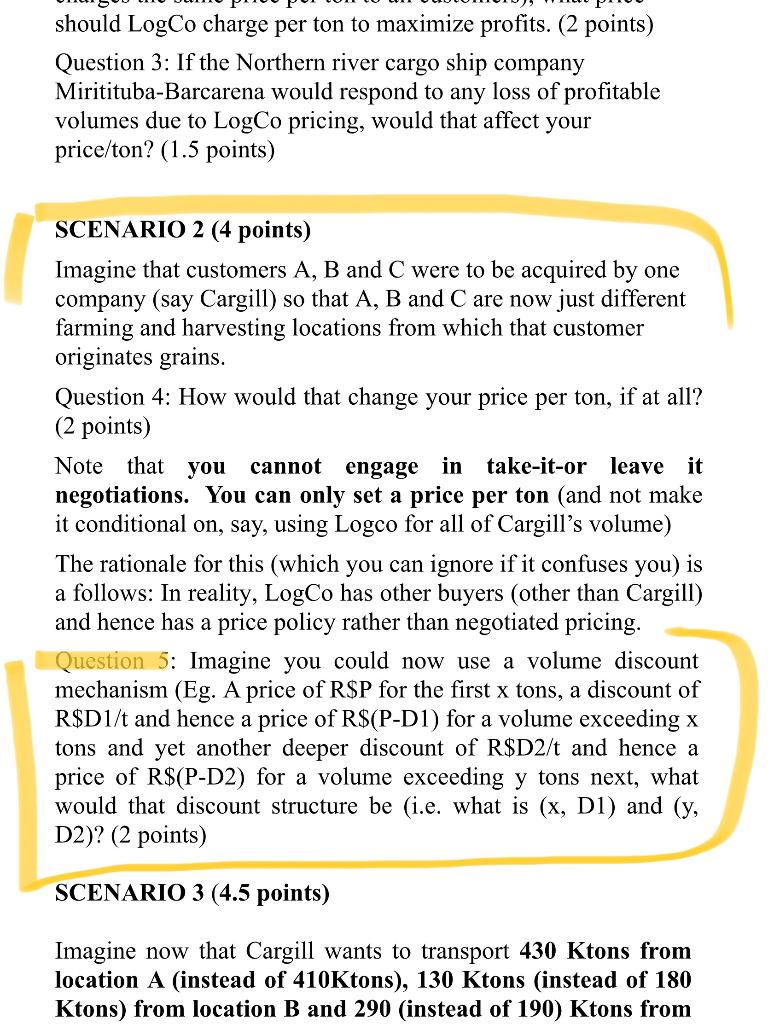
A particular rail freight company LogCo needs to set a price/ton (in R$/ton) to transport grains (corn) from the rail terminal of RTE to the seaport of Santos. The company has (for simplicity) 3 customers (farmers) on 3 different locations A, B and C who want to transport the corn to one of Brazil's seaports and from there via a large scavessel to its customers worldwide. One customer, located in A needs to transport 410 Ktons, the customer located in B needs to transport 180 Ktons and another customer located in C needs to transport 190 Ktons. Custome Ktons F) Carmaup real-world workshop presentation 410 180 | 190 B 180 190 C Two of these customers, A and B have 2 viable options: Option 1 (truck-rail): They can transport the grains by truck to RTE and unload them onto a number of LogCo's rail freight cars which will transport them to the seaport of Santos. In Santos the trucks are then unloaded and then uploaded onto a sea vessel. The price per ton to bring to the RTE terminal is R$75/t for customer A and R$50/t for customer B (who is located closer to the train terminal). -Option 2 (truck only): They can transport the grains by truck from their location all the way to the port of Santos. That costs R$260/t for customer A who is located further from the port of Santos and R$190/t for customer B who is closer to the port of Santos than customer A. Customer C is located up North in Brazil. This customer has 2 viable options too: Customer C is located up North in Brazil. This customer has 2 viable options too: Option 1 (truck-train): As with customers A and B, the customer can either load the grains onto a number of trucks at its farm that will transport them to RTE where they will be uploaded onto a number of train cars which will bring the grains by rail to the port of Santos. The price per ton to bring them to RTE is R$70/t. Option 2 (truck-inland waterways): As the customer is located more to the North, it can also take the truck- waterways combination: First transport the grains by truck to the city of Miritituba at a price of R$ 130/t and load them on a river cargo ship that will transport them on the river to the seaport of Barcarena at a price of R$40/t. In Barcarena, the grains can then be unloaded from the river boat and loaded on a sea vessel to be transported to this customer's customers world-wide. You can assume that the cost of transporting grains from both seaports of Santos and Barcarena to its customers world-wide is the same. The situation is depicted below: Group project 3 CUSTOMERS ORIGINATE GRAINS FROM THREE MAIN LOCATIONS; LOGCO'S COMPETITIVE POSITION DIFFERS PER LOCATION Barcarena Ktons Customer location Miritituba R$40 A R$130 B 410 180 190 R$70 . R$75 R$50A - RTE R$ xxx = Next Best Alternative prices/ton per road/waterway leg R$190 Santos There are lots of small truck companies in Brazil and their prices are not influenced by the price charged by LogCo. It is determined by the price of diesel and is expected to stay the same next year. Assume also that there is no difference in quality of service between the truck-rail versus the truck-only or the truck-inland waterways options with the following exception: There are different percentages of grain losses associated with the combined modes of transportation: 0.25% of the grains are lost when unloading from a truck onto a train or river boat; another 0.25% is lost during transportation by train. Hence of 1 ton loaded onto a truck at the farm only 0.995t reaches Santos when using the truck/train mode; no grains are lost on the transportation by river cargo ship. The loss of grains when onloading from either a truck, train or river cargo ship onto a sea vessel is the same and can be ignored here. The loss in value of a ton of grains to the farmer equals R$2000. Assume that Logco customers pay per ton of grain that is transported from the farm onto the truck, irrespective of later losses. Assume that at equal transportation costs customers will prefer the truck-rail combination. The LogCo trains run all the time (even empty so to speak) so the marginal cost of transporting extra tonnage of grain is negligible (consider it zero). The average total cost at historic capacity utilization levels has been about R$30/t. SCENARIO 1 (5.5 points): Question 1: What does the demand curve for LogCo look like? Please draw it. (2 points) Question 2: Assuming LogCo does not price discriminate (i.e. charges the same price per ton to all customers), what price should LogCo charge per ton to maximize profits. (2 points) Question 3: If the Northern river cargo ship company should LogCo charge per ton to maximize profits. (2 points) Question 3: If the Northern river cargo ship company Miritituba-Barcarena would respond to any loss of profitable volumes due to LogCo pricing, would that affect your price/ton? (1.5 points) SCENARIO 2 (4 points) Imagine that customers A, B and C were to be acquired by one company (say Cargill) so that A, B and C are now just different farming and harvesting locations from which that customer originates grains. Question 4: How would that change your price per ton, if at all? (2 points) Note that you cannot engage in take-it-or leave it negotiations. You can only set a price per ton (and not make it conditional on, say, using Logco for all of Cargill's volume) The rationale for this (which you can ignore if it confuses you) is a follows: In reality, LogCo has other buyers (other than Cargill) and hence has a price policy rather than negotiated pricing. Question 5: Imagine you could now use a volume discount mechanism (Eg. A price of R$P for the first x tons, a discount of R$D1/t and hence a price of R$(P-D1) for a volume exceeding x tons and yet another deeper discount of R$D2/t and hence a price of R$(P-D2) for a volume exceeding y tons next, what would that discount structure be (i.e. what is (x, D1) and (y, D2)? (2 points) SCENARIO 3 (4.5 points) Imagine now that Cargill wants to transport 430 Ktons from location A (instead of 410Ktons), 130 Ktons (instead of 180 Ktons) from location B and 290 (instead of 190) Ktons from A particular rail freight company LogCo needs to set a price/ton (in R$/ton) to transport grains (corn) from the rail terminal of RTE to the seaport of Santos. The company has (for simplicity) 3 customers (farmers) on 3 different locations A, B and C who want to transport the corn to one of Brazil's seaports and from there via a large scavessel to its customers worldwide. One customer, located in A needs to transport 410 Ktons, the customer located in B needs to transport 180 Ktons and another customer located in C needs to transport 190 Ktons. Custome Ktons F) Carmaup real-world workshop presentation 410 180 | 190 B 180 190 C Two of these customers, A and B have 2 viable options: Option 1 (truck-rail): They can transport the grains by truck to RTE and unload them onto a number of LogCo's rail freight cars which will transport them to the seaport of Santos. In Santos the trucks are then unloaded and then uploaded onto a sea vessel. The price per ton to bring to the RTE terminal is R$75/t for customer A and R$50/t for customer B (who is located closer to the train terminal). -Option 2 (truck only): They can transport the grains by truck from their location all the way to the port of Santos. That costs R$260/t for customer A who is located further from the port of Santos and R$190/t for customer B who is closer to the port of Santos than customer A. Customer C is located up North in Brazil. This customer has 2 viable options too: Customer C is located up North in Brazil. This customer has 2 viable options too: Option 1 (truck-train): As with customers A and B, the customer can either load the grains onto a number of trucks at its farm that will transport them to RTE where they will be uploaded onto a number of train cars which will bring the grains by rail to the port of Santos. The price per ton to bring them to RTE is R$70/t. Option 2 (truck-inland waterways): As the customer is located more to the North, it can also take the truck- waterways combination: First transport the grains by truck to the city of Miritituba at a price of R$ 130/t and load them on a river cargo ship that will transport them on the river to the seaport of Barcarena at a price of R$40/t. In Barcarena, the grains can then be unloaded from the river boat and loaded on a sea vessel to be transported to this customer's customers world-wide. You can assume that the cost of transporting grains from both seaports of Santos and Barcarena to its customers world-wide is the same. The situation is depicted below: Group project 3 CUSTOMERS ORIGINATE GRAINS FROM THREE MAIN LOCATIONS; LOGCO'S COMPETITIVE POSITION DIFFERS PER LOCATION Barcarena Ktons Customer location Miritituba R$40 A R$130 B 410 180 190 R$70 . R$75 R$50A - RTE R$ xxx = Next Best Alternative prices/ton per road/waterway leg R$190 Santos There are lots of small truck companies in Brazil and their prices are not influenced by the price charged by LogCo. It is determined by the price of diesel and is expected to stay the same next year. Assume also that there is no difference in quality of service between the truck-rail versus the truck-only or the truck-inland waterways options with the following exception: There are different percentages of grain losses associated with the combined modes of transportation: 0.25% of the grains are lost when unloading from a truck onto a train or river boat; another 0.25% is lost during transportation by train. Hence of 1 ton loaded onto a truck at the farm only 0.995t reaches Santos when using the truck/train mode; no grains are lost on the transportation by river cargo ship. The loss of grains when onloading from either a truck, train or river cargo ship onto a sea vessel is the same and can be ignored here. The loss in value of a ton of grains to the farmer equals R$2000. Assume that Logco customers pay per ton of grain that is transported from the farm onto the truck, irrespective of later losses. Assume that at equal transportation costs customers will prefer the truck-rail combination. The LogCo trains run all the time (even empty so to speak) so the marginal cost of transporting extra tonnage of grain is negligible (consider it zero). The average total cost at historic capacity utilization levels has been about R$30/t. SCENARIO 1 (5.5 points): Question 1: What does the demand curve for LogCo look like? Please draw it. (2 points) Question 2: Assuming LogCo does not price discriminate (i.e. charges the same price per ton to all customers), what price should LogCo charge per ton to maximize profits. (2 points) Question 3: If the Northern river cargo ship company should LogCo charge per ton to maximize profits. (2 points) Question 3: If the Northern river cargo ship company Miritituba-Barcarena would respond to any loss of profitable volumes due to LogCo pricing, would that affect your price/ton? (1.5 points) SCENARIO 2 (4 points) Imagine that customers A, B and C were to be acquired by one company (say Cargill) so that A, B and C are now just different farming and harvesting locations from which that customer originates grains. Question 4: How would that change your price per ton, if at all? (2 points) Note that you cannot engage in take-it-or leave it negotiations. You can only set a price per ton (and not make it conditional on, say, using Logco for all of Cargill's volume) The rationale for this (which you can ignore if it confuses you) is a follows: In reality, LogCo has other buyers (other than Cargill) and hence has a price policy rather than negotiated pricing. Question 5: Imagine you could now use a volume discount mechanism (Eg. A price of R$P for the first x tons, a discount of R$D1/t and hence a price of R$(P-D1) for a volume exceeding x tons and yet another deeper discount of R$D2/t and hence a price of R$(P-D2) for a volume exceeding y tons next, what would that discount structure be (i.e. what is (x, D1) and (y, D2)? (2 points) SCENARIO 3 (4.5 points) Imagine now that Cargill wants to transport 430 Ktons from location A (instead of 410Ktons), 130 Ktons (instead of 180 Ktons) from location B and 290 (instead of 190) Ktons from









 Study Help