







Question: Hello, please answer this brief in IRAC format 1 page length Treadwell v. J.D. Construction Co. 938 A.2d 794 (Me. 2007) In the early 1990s,
Hello, please answer this brief in IRAC format 1 page length
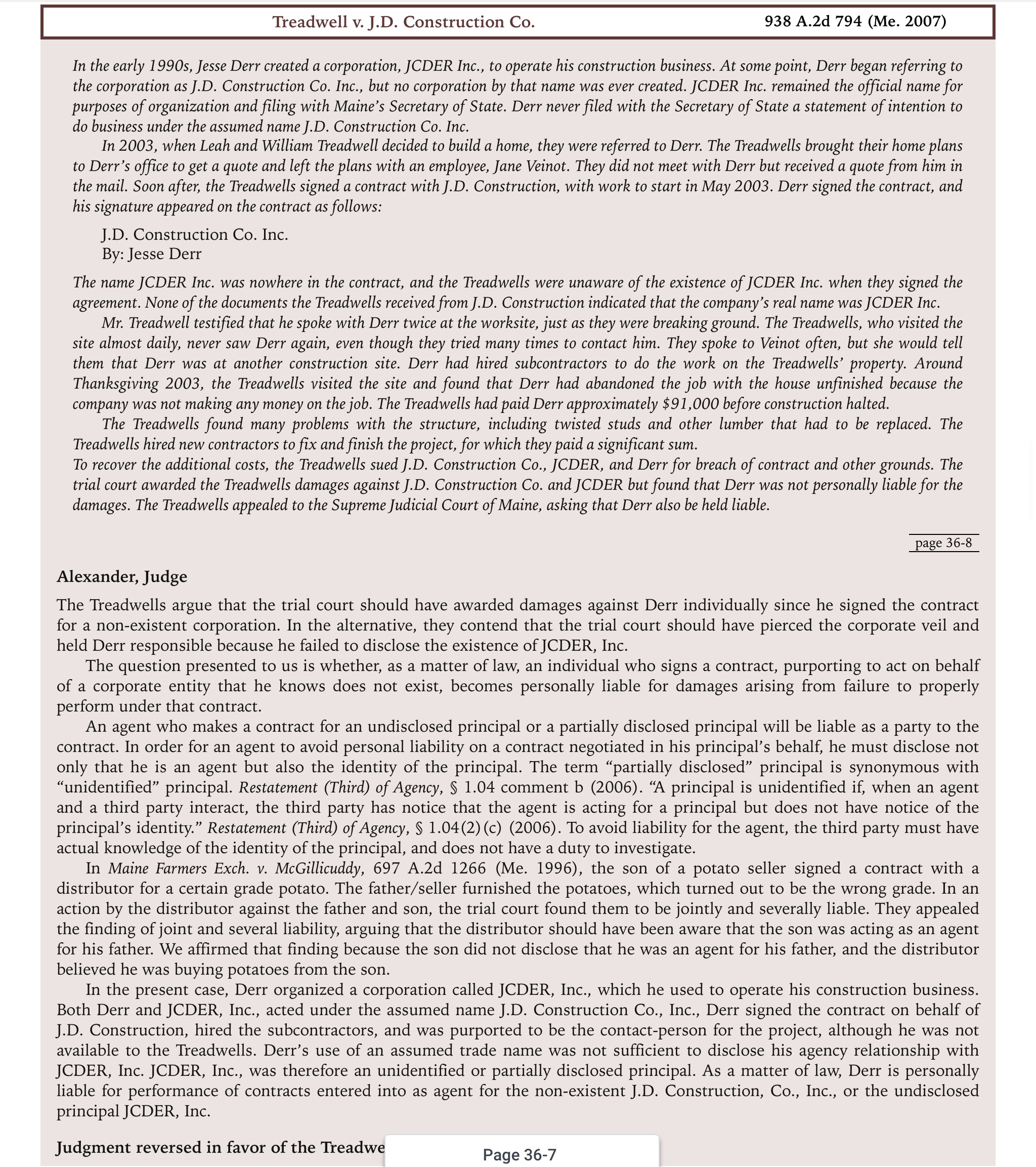
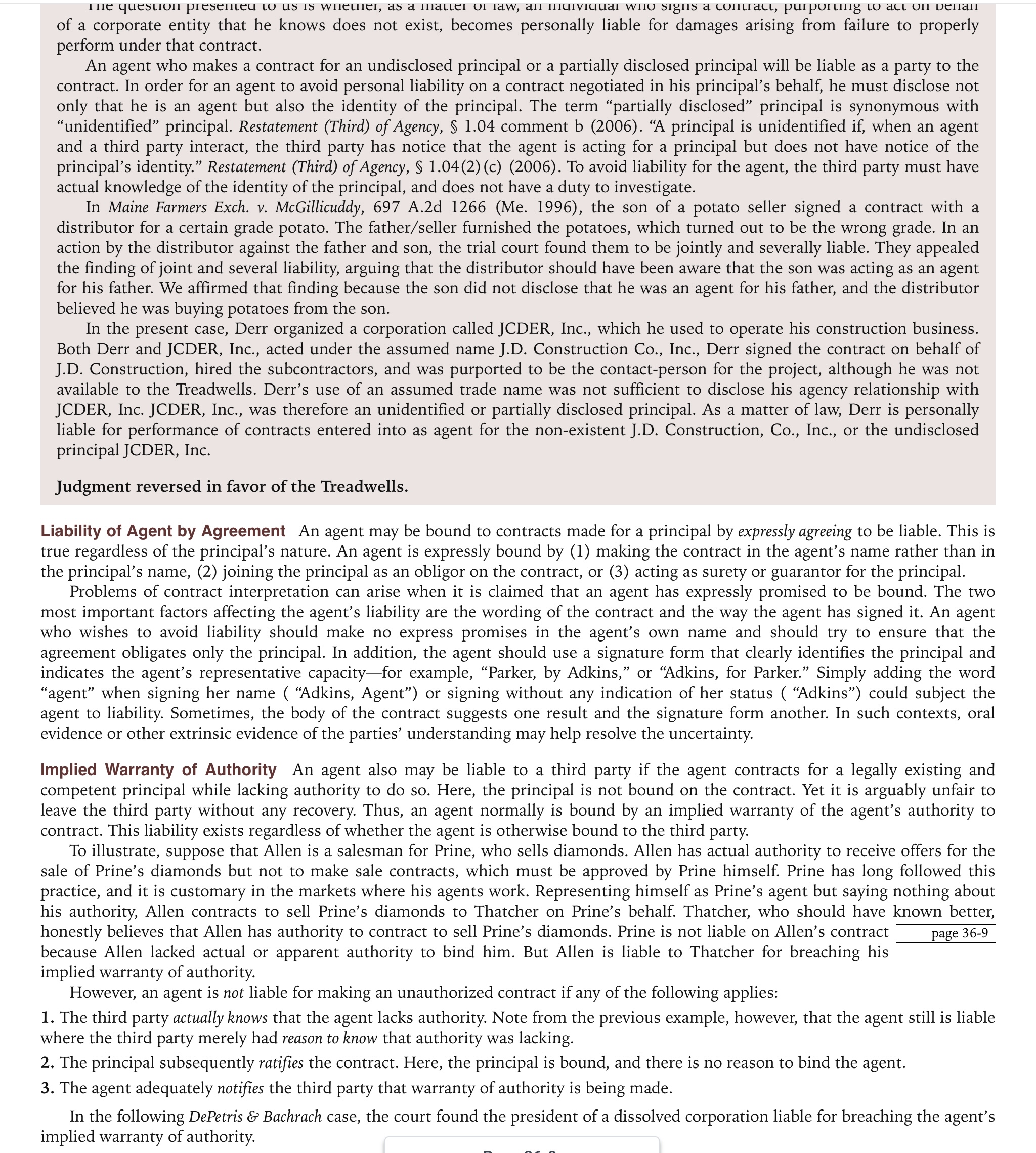
Treadwell v. J.D. Construction Co. 938 A.2d 794 (Me. 2007) In the early 1990s, Jesse Derr created a corporation, JCDER Inc., to operate his construction business. At some point, Derr began referring to the corporation as J.D. Construction Co. Inc., but no corporation by that name was ever created. JCDER Inc. remained the official name for purposes of organization and filing with Maine's Secretary of State. Derr never filed with the Secretary of State a statement of intention to do business under the assumed name J.D. Construction Co. Inc. In 2003, when Leah and William Treadwell decided to build a home, they were referred to Derr. The Treadwells brought their home plans to Derr's office to get a quote and left the plans with an employee, Jane Veinot. They did not meet with Derr but received a quote from him in the mail. Soon after, the Treadwells signed a contract with J.D. Construction, with work to start in May 2003. Derr signed the contract, and his signature appeared on the contract as follows: J.D. Construction Co. Inc. By: Jesse Derr The name JCDER Inc. was nowhere in the contract, and the Treadwells were unaware of the existence of JCDER Inc. when they signed the agreement. None of the documents the Treadwells received from J.D. Construction indicated that the company's real name was JCDER Inc. Mr. Treadwell testified that he spoke with Derr twice at the worksite, just as they were breaking ground. The Treadwells, who visited the site almost daily, never saw Derr again, even though they tried many times to contact him. They spoke to Veinot often, but she would tell them that Derr was at another construction site. Derr had hired subcontractors to do the work on the Treadwells' property. Around Thanksgiving 2003, the Treadwells visited the site and found that Derr had abandoned the job with the house unfinished because the company was not making any money on the job. The Treadwells had paid Derr approximately $91,000 before construction halted. The Treadwells found many problems with the structure, including twisted studs and other lumber that had to be replaced. The Treadwells hired new contractors to fix and finish the project, for which they paid a significant sum. To recover the additional costs, the Treadwells sued J.D. Construction Co., JCDER, and Derr for breach of contract and other grounds. The trial court awarded the Treadwells damages against J.D. Construction Co. and JCDER but found that Derr was not personally liable for the damages. The Treadwells appealed to the Supreme Judicial Court of Maine, asking that Derr also be held liable. page 36-8 Alexander, Judge The Treadwells argue that the trial court should have awarded damages against Derr individually since he signed the contract for a non-existent corporation. In the alternative, they contend that the trial court should have pierced the corporate veil and held Derr responsible because he failed to disclose the existence of JCDER, Inc. The question presented to us is whether, as a matter of law, an individual who signs a contract, purporting to act on behalf of a corporate entity that he knows does not exist, becomes personally liable for damages arising from failure to properly perform under that contract. An agent who makes a contract for an undisclosed principal or a partially disclosed principal will be liable as a party to the contract. In order for an agent to avoid personal liability on a contract negotiated in his principal's behalf, he must disclose not only that he is an agent but also the identity of the principal. The term "partially disclosed" principal is synonymous with "unidentified" principal. Restatement (Third) of Agency, S1.04 comment b (2006). "A principal is unidentified if, when an agent and a third party interact, the third party has notice that the agent is acting for a principal but does not have notice of the principal's identity." Restatement (Third) of Agency, S1.04 (2) (c) (2006). To avoid liability for the agent, the third party must have actual knowledge of the identity of the principal, and does not have a duty to investigate. In Maine Farmers Exch. v. McGillicuddy, 697 A.2d 1266 (Me. 1996), the son of a potato seller signed a contract with a distributor for a certain grade potato. The father/seller furnished the potatoes, which turned out to be the wrong grade. In an action by the distributor against the father and son, the trial court found them to be jointly and severally liable. They appealed the finding of joint and several liability, arguing that the distributor should have been aware that the son was acting as an agent for his father. We affirmed that finding because the son did not disclose that he was an agent for his father, and the distributor believed he was buying potatoes from the son. In the present case, Derr organized a corporation called JCDER, Inc., which he used to operate his construction business. Both Derr and JCDER, Inc., acted under the assumed name J.D. Construction Co., Inc., Derr signed the contract on behalf of J.D. Construction, hired the subcontractors, and was purported to be the contact-person for the project, although he was not available to the Treadwells. Derr's use of an assumed trade name was not sufficient to disclose his agency relationship with JCDER, Inc. JCDER, Inc., was therefore an unidentified or partially disclosed principal. As a matter of law, Derr is personally liable for performance of contracts entered into as agent for the non-existent J.D. Construction, Co., Inc., or the undisclosed principal JCDER, Inc. Judgment reversed in favor of the Treadwe Page 36-7 of a corporate entity that he knows does not exist, becomes personally liable for damages arising from failure to properly perform under that contract. An agent who makes a contract for an undisclosed principal or a partially disclosed principal will be liable as a party to the contract. In order for an agent to avoid personal liability on a contract negotiated in his principal's behalf, he must disclose not only that he is an agent but also the identity of the principal. The term "partially disclosed" principal is synonymous with "unidentified" principal. Restatement (Third) of Agency, $1.04 comment b (2006). "A principal is unidentified if, when an agent and a third party interact, the third party has notice that the agent is acting for a principal but does not have notice of the principal's identity." Restatement (Third) of Agency, S1.04(2) (c) (2006). To avoid liability for the agent, the third party must have actual knowledge of the identity of the principal, and does not have a duty to investigate. In Maine Farmers Exch. v. McGillicuddy, 697 A.2d 1266 (Me. 1996), the son of a potato seller signed a contract with a distributor for a certain grade potato. The father/seller furnished the potatoes, which turned out to be the wrong grade. In an action by the distributor against the father and son, the trial court found them to be jointly and severally liable. They appealed the finding of joint and several liability, arguing that the distributor should have been aware that the son was acting as an agent for his father. We affirmed that finding because the son did not disclose that he was an agent for his father, and the distributor believed he was buying potatoes from the son. In the present case, Derr organized a corporation called JCDER, Inc., which he used to operate his construction business. Both Derr and JCDER, Inc., acted under the assumed name J.D. Construction Co., Inc., Derr signed the contract on behalf of J.D. Construction, hired the subcontractors, and was purported to be the contact-person for the project, although he was not available to the Treadwells. Derr's use of an assumed trade name was not sufficient to disclose his agency relationship with JCDER, Inc. JCDER, Inc., was therefore an unidentified or partially disclosed principal. As a matter of law, Derr is personally liable for performance of contracts entered into as agent for the non-existent J.D. Construction, Co., Inc., or the undisclosed principal JCDER, Inc. Judgment reversed in favor of the Treadwells. Liability of Agent by Agreement An agent may be bound to contracts made for a principal by expressly agreeing to be liable. This is true regardless of the principal's nature. An agent is expressly bound by (1) making the contract in the agent's name rather than in the principal's name, (2) joining the principal as an obligor on the contract, or (3) acting as surety or guarantor for the principal. Problems of contract interpretation can arise when it is claimed that an agent has expressly promised to be bound. The two most important factors affecting the agent's liability are the wording of the contract and the way the agent has signed it. An agent who wishes to avoid liability should make no express promises in the agent's own name and should try to ensure that the agreement obligates only the principal. In addition, the agent should use a signature form that clearly identifies the principal and indicates the agent's representative capacity_for example, "Parker, by Adkins," or "Adkins, for Parker." Simply adding the word "agent" when signing her name ("Adkins, Agent") or signing without any indication of her status ( "Adkins") could subject the agent to liability. Sometimes, the body of the contract suggests one result and the signature form another. In such contexts, oral evidence or other extrinsic evidence of the parties' understanding may help resolve the uncertainty. Implied Warranty of Authority An agent also may be liable to a third party if the agent contracts for a legally existing and competent principal while lacking authority to do so. Here, the principal is not bound on the contract. Yet it is arguably unfair to leave the third party without any recovery. Thus, an agent normally is bound by an implied warranty of the agent's authority to contract. This liability exists regardless of whether the agent is otherwise bound to the third party. To illustrate, suppose that Allen is a salesman for Prine, who sells diamonds. Allen has actual authority to receive offers for the sale of Prine's diamonds but not to make sale contracts, which must be approved by Prine himself. Prine has long followed this practice, and it is customary in the markets where his agents work. Representing himself as Prine's agent but saying nothing about his authority, Allen contracts to sell Prine's diamonds to Thatcher on Prine's behalf. Thatcher, who should have known better, honestly believes that Allen has authority to contract to sell Prine's diamonds. Prine is not liable on Allen's contract page 36-9 because Allen lacked actual or apparent authority to bind him. But Allen is liable to Thatcher for breaching his implied warranty of authority. However, an agent is not liable for making an unauthorized contract if any of the following applies: 1. The third party actually knows that the agent lacks authority. Note from the previous example, however, that the agent still is liable where the third party merely had reason to know that authority was lacking. 2. The principal subsequently ratifies the contract. Here, the principal is bound, and there is no reason to bind the agent. 3. The agent adequately notifies the third party that warranty of authority is being made. In the following DePetris \& Bachrach case, the court found the president of a dissolved corporation liable for breaching the agent's
Step by Step Solution
There are 3 Steps involved in it

Get step-by-step solutions from verified subject matter experts
 Study Help