







Question: Hello :) Please help me answer the following questions # 6 (multiple screen shots) , 8, 9, and 10 (multiple screen shots). Additionally, explain your
![absolute minimum value of f on the closed interval [2, 7]. (Use](https://s3.amazonaws.com/si.experts.images/answers/2024/06/6666393fd2bcb_3596666393fb4f87.jpg)
Hello :) Please help me answer the following questions # 6 (multiple screen shots) , 8, 9, and 10 (multiple screen shots). Additionally, explain your given answer. Thank you for your expertise!
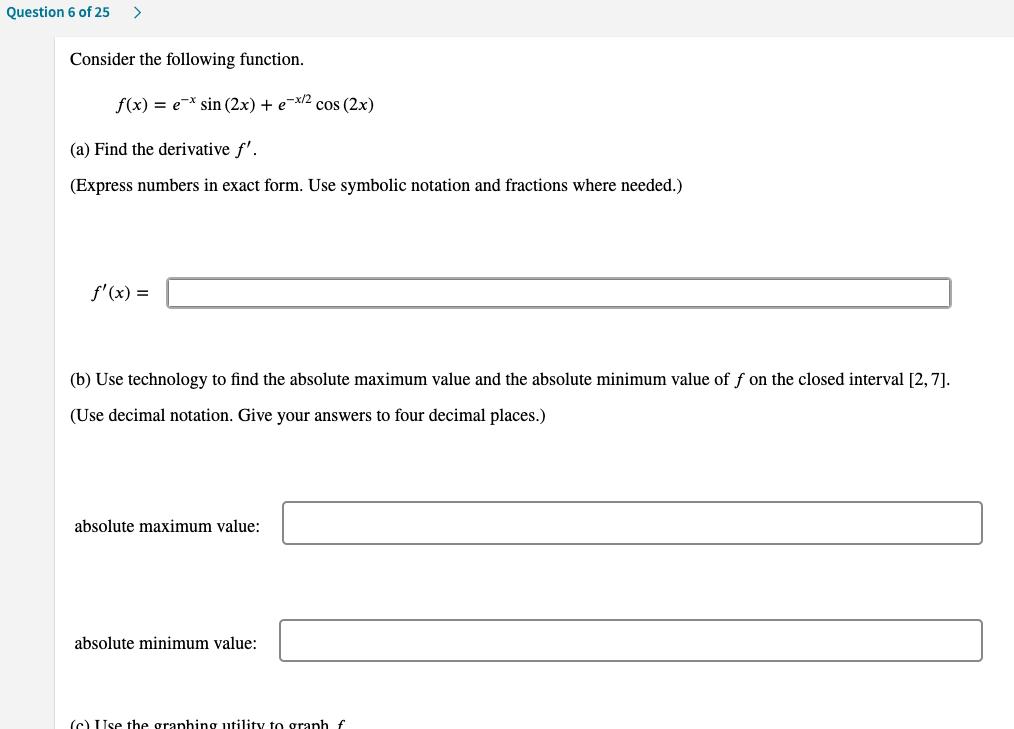
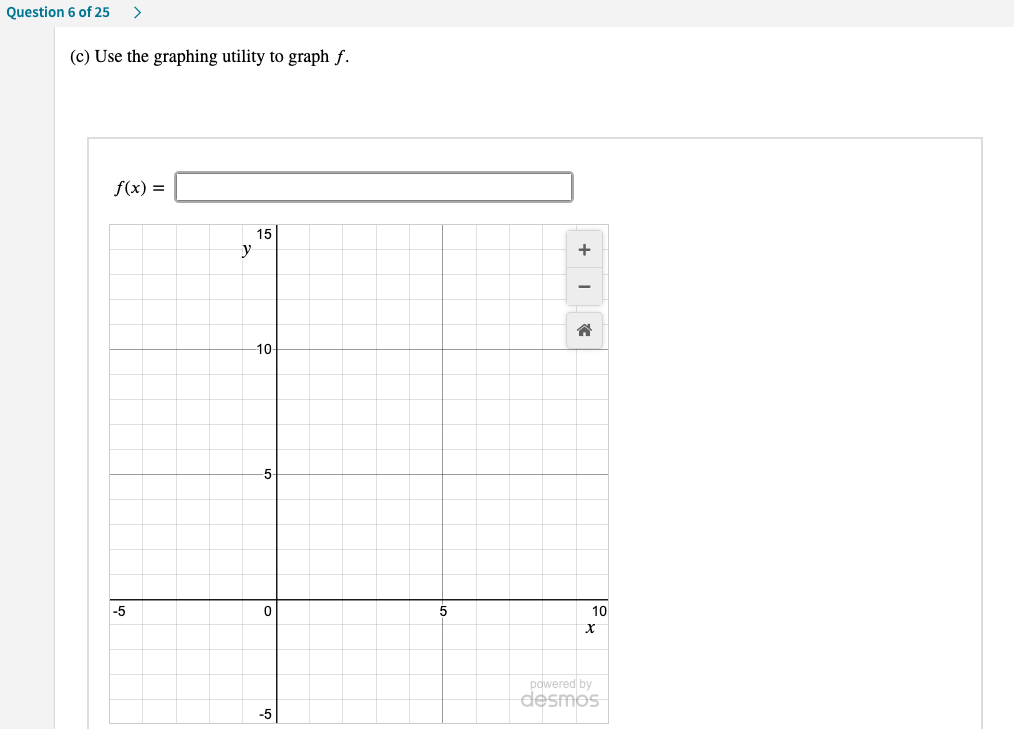
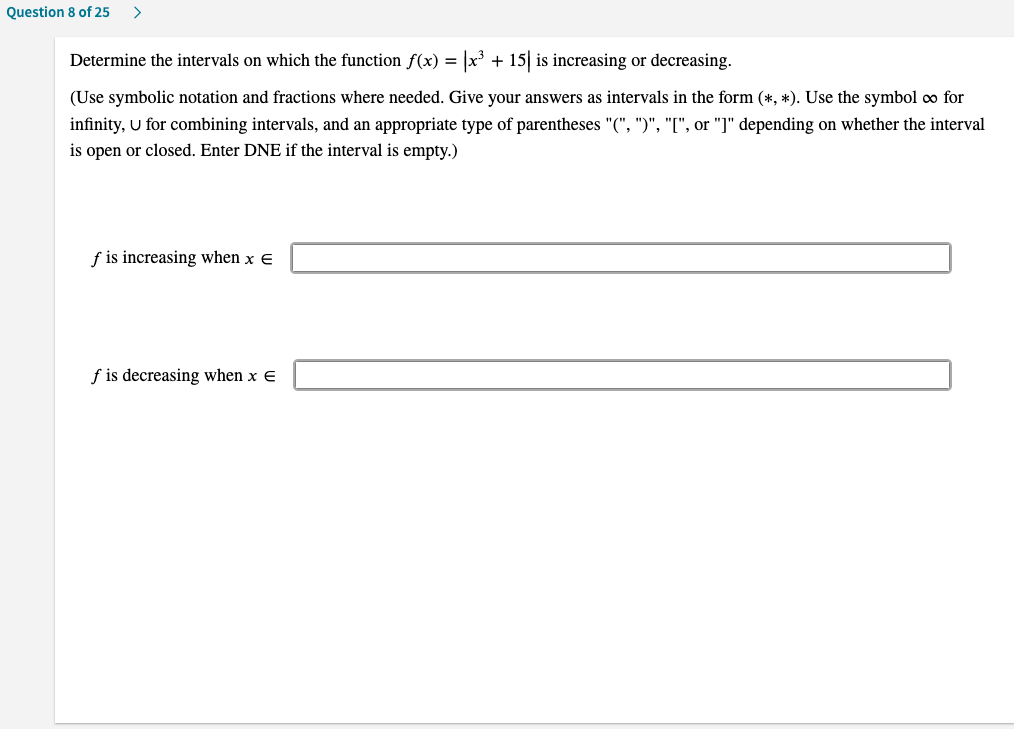
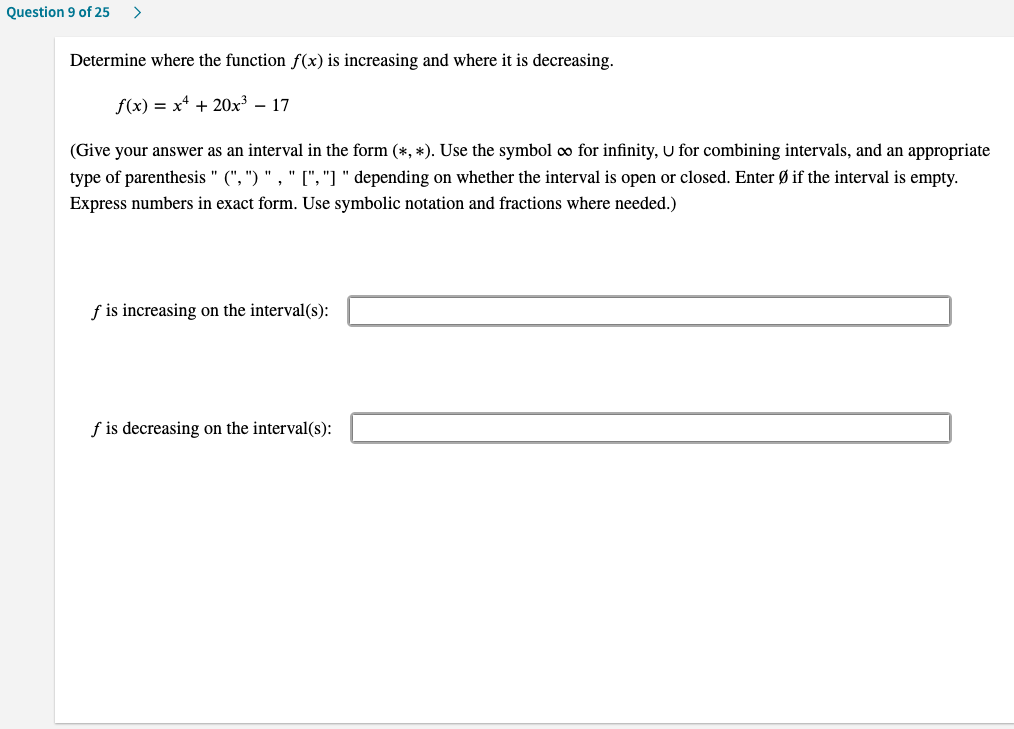
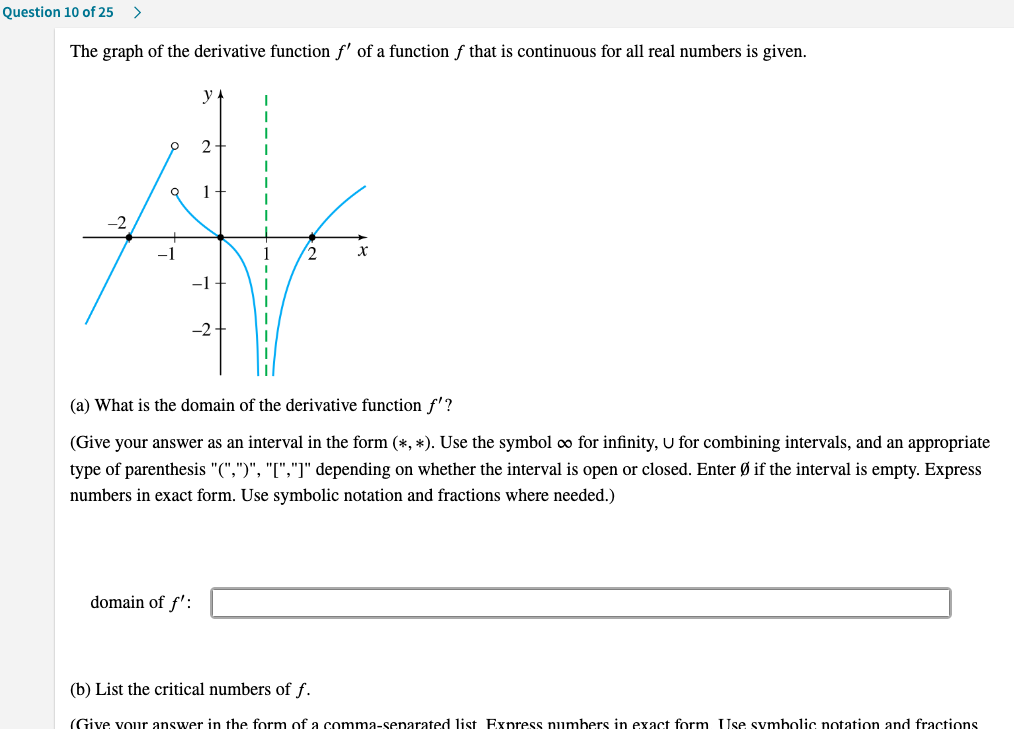
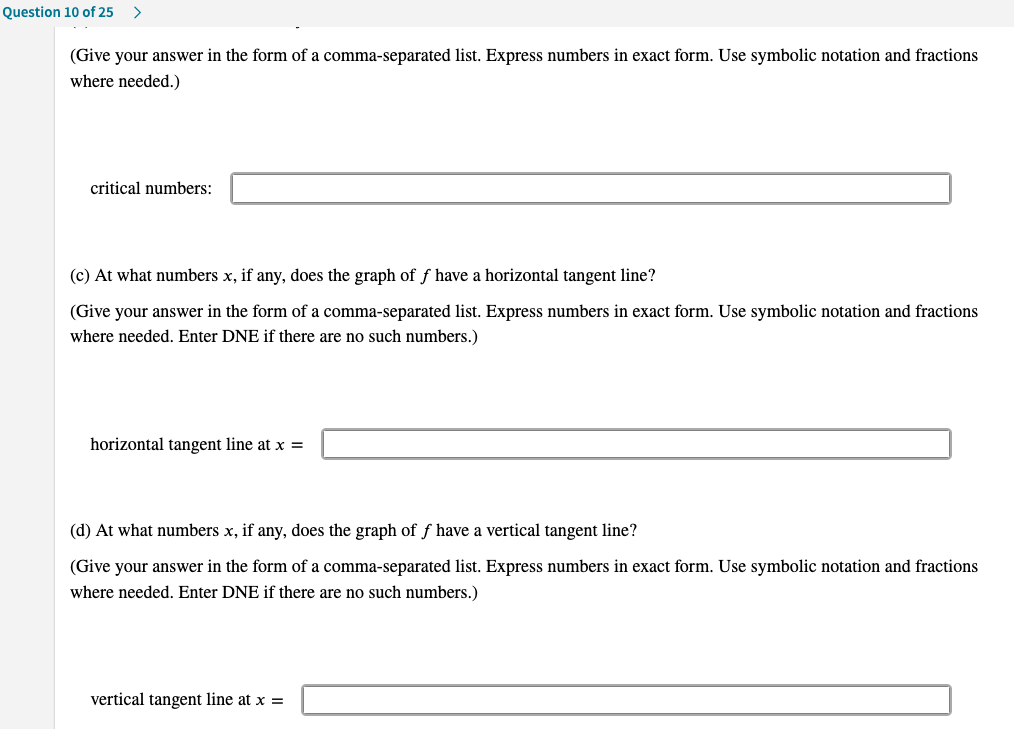
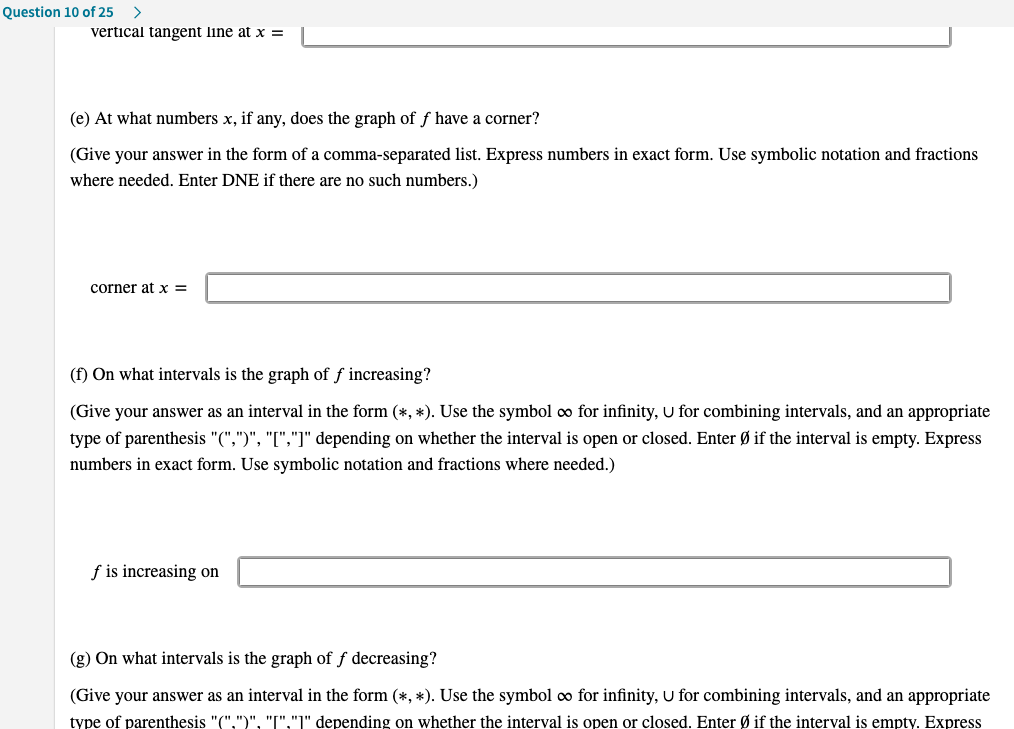
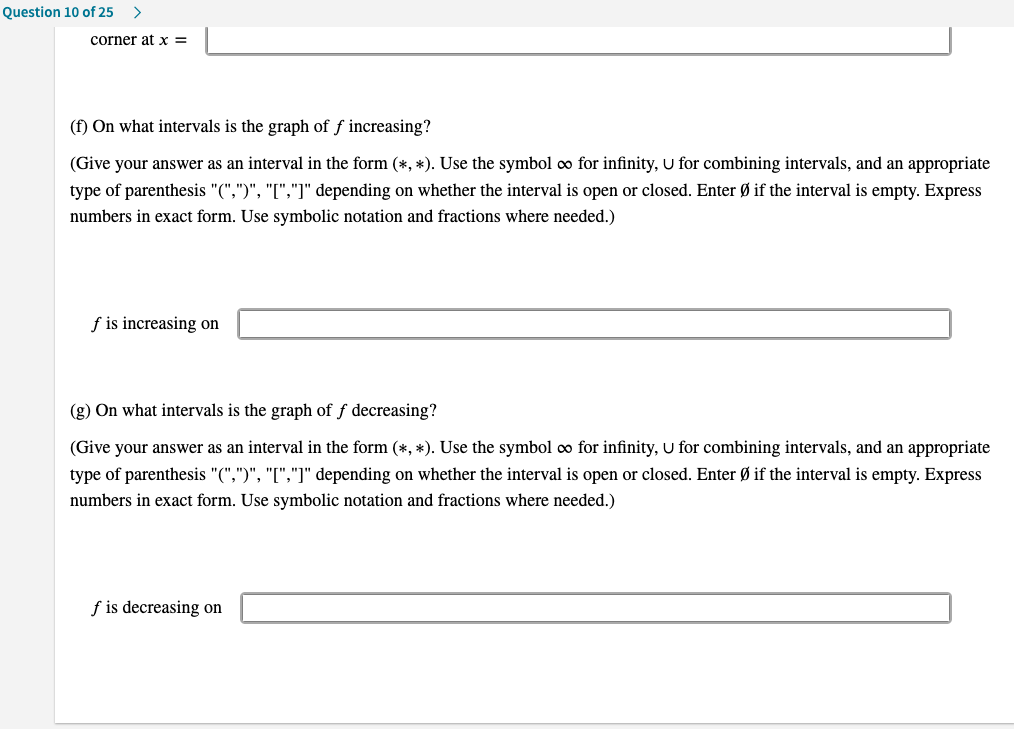
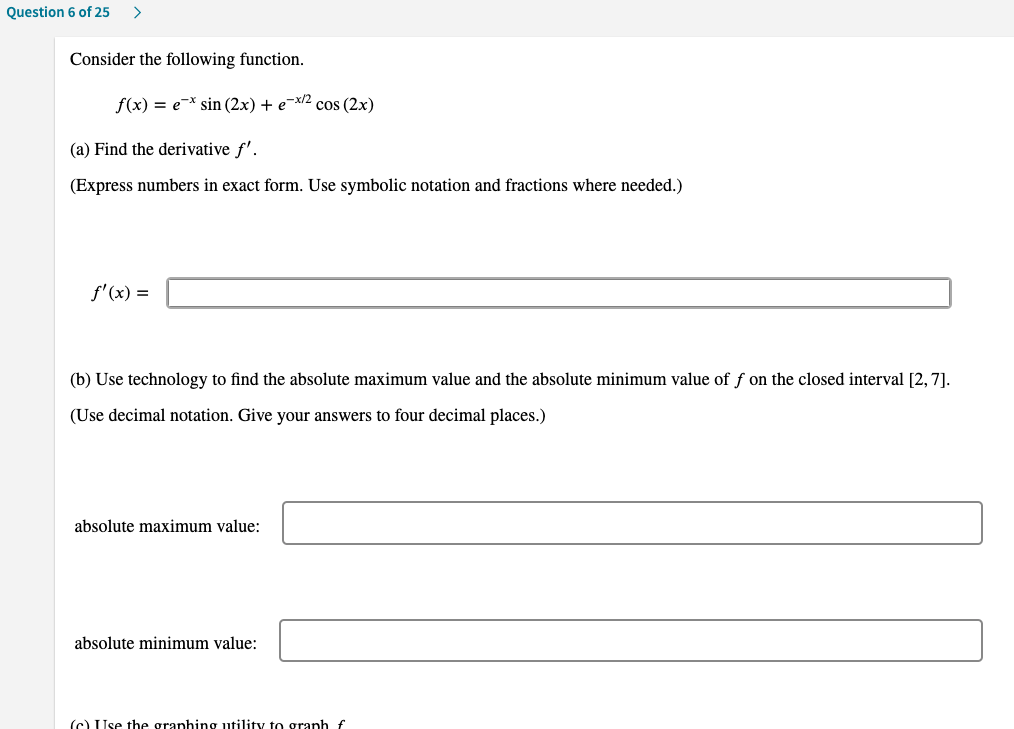
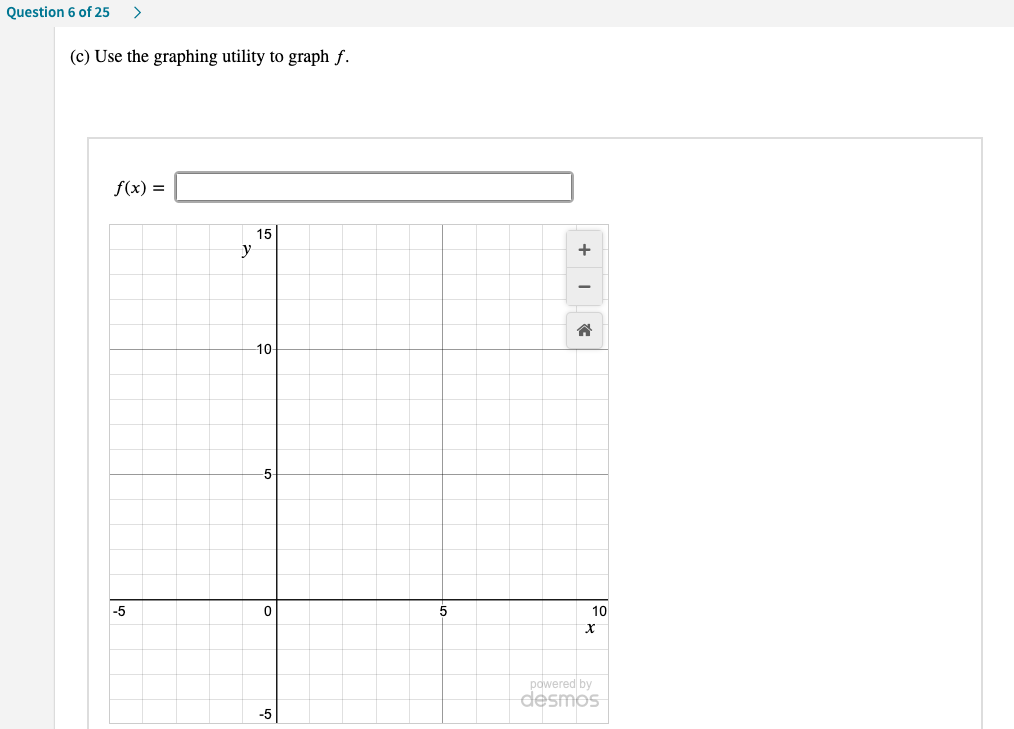
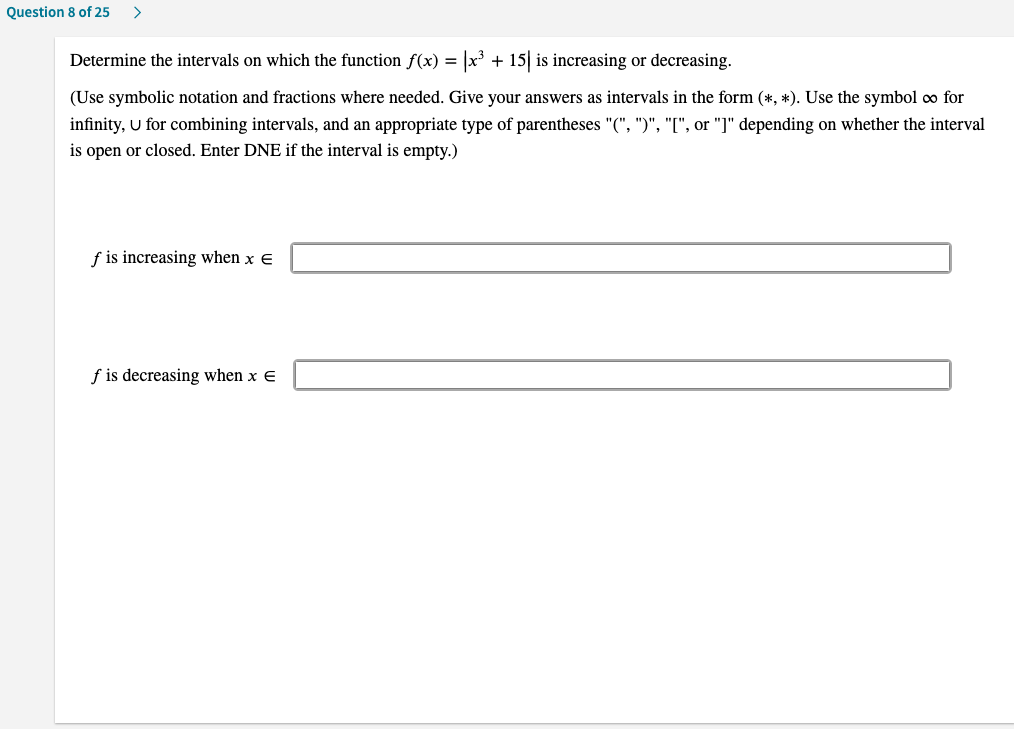
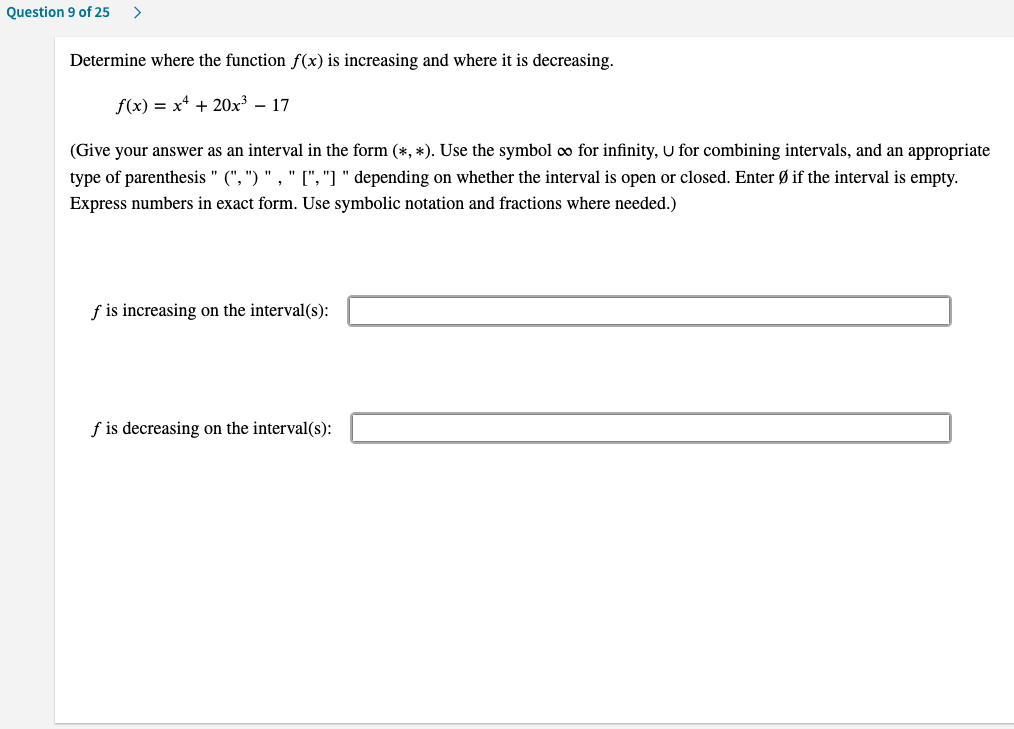
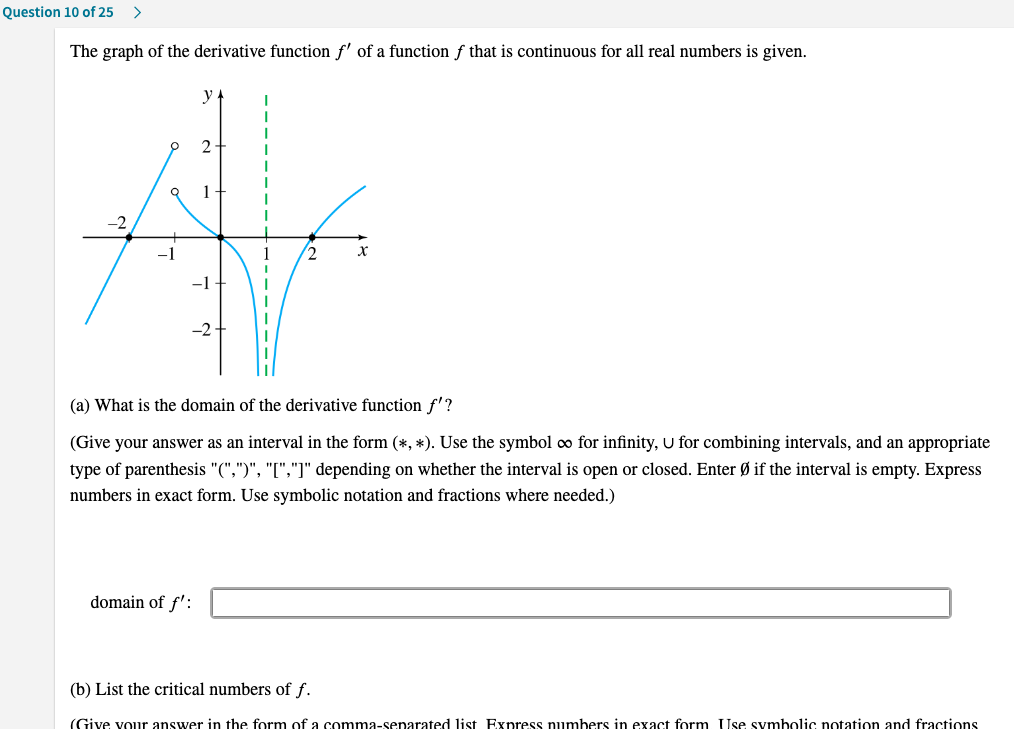
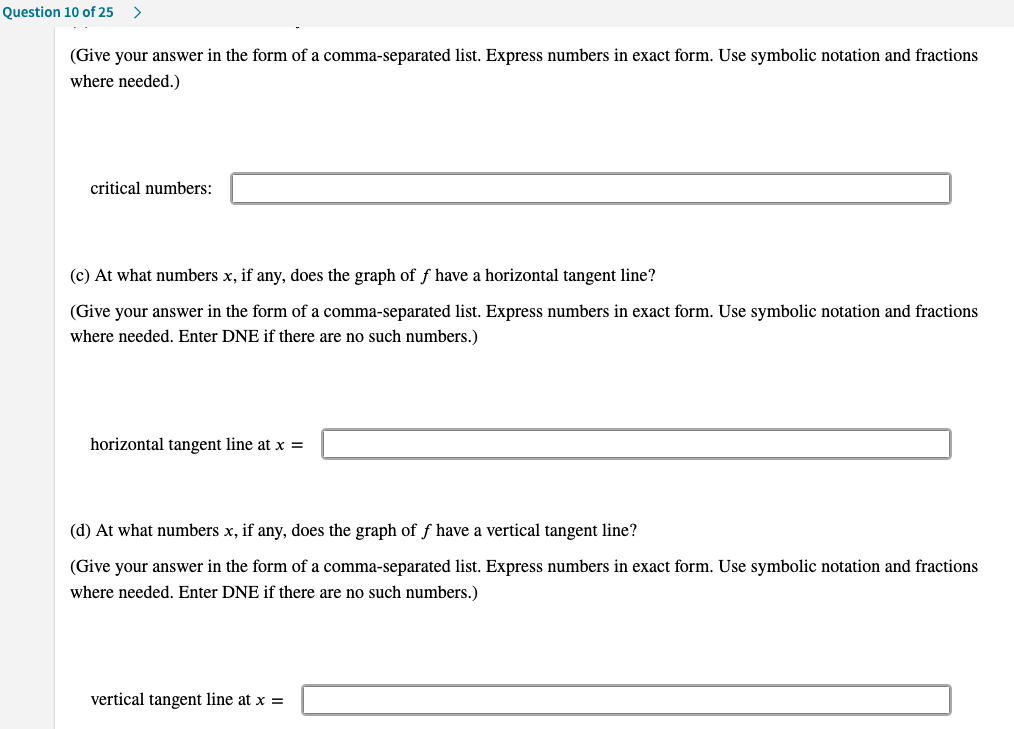
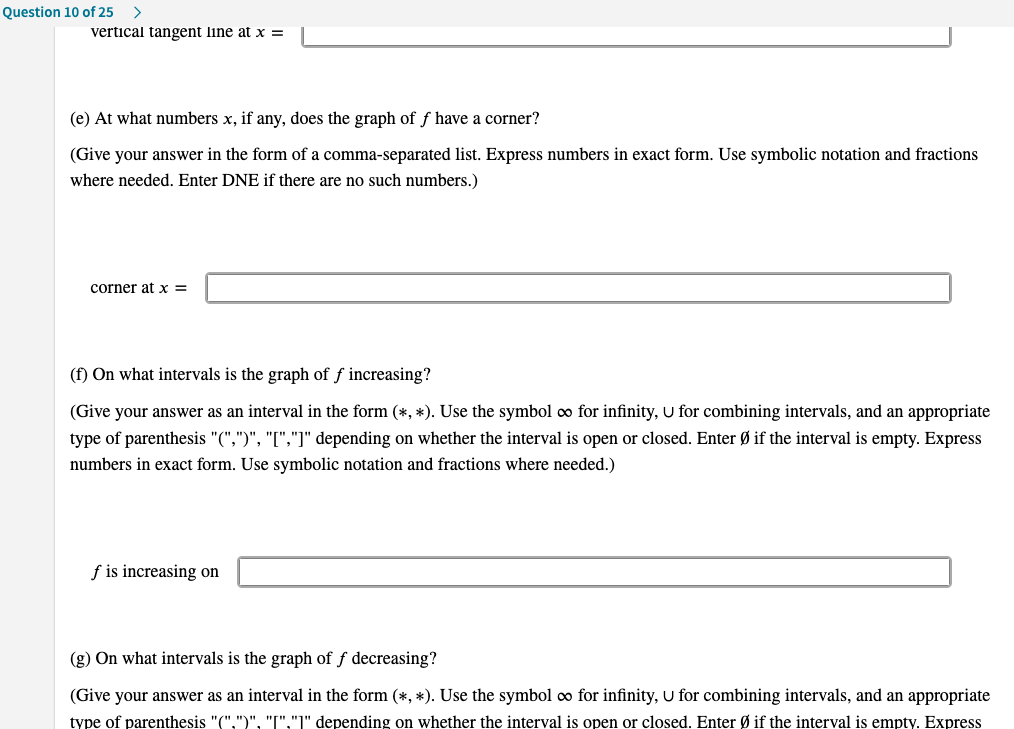
Question 6 of 25 > Consider the following function. f(x) = e * sin (2x) + e-*/2 cos (2x) (a) Find the derivative f'. (Express numbers in exact form. Use symbolic notation and fractions where needed.) f' ( x) = (b) Use technology to find the absolute maximum value and the absolute minimum value of f on the closed interval [2, 7]. (Use decimal notation. Give your answers to four decimal places.) absolute maximum value: absolute minimum value:Question 6 of 25 > (c) Use the graphing utility to graph f. f (x) = 15 + 10 -5 -5 0 5 10 powered by desmos -5Question 8 of 25 > Determine the intervals on which the function f(x) = (x + 15| is increasing or decreasing. (Use symbolic notation and fractions where needed. Give your answers as intervals in the form (*, *). Use the symbol co for infinity, U for combining intervals, and an appropriate type of parentheses "(", ")", "[", or "]" depending on whether the interval is open or closed. Enter DNE if the interval is empty.) f is increasing when x E f is decreasing when x EQuestion 9 of 25 > Determine 1EMhere the function f(x) is increasing and where it is decreasing. x) = x4 + 20x3 1? [Give your answer as an interval in the form (an, an). Use the symbol on for innity, U for combining intervals, and an appropriate type of parenthesis " [", " " , " [", "] " depending on whether the interval is open or closed. Enter 5 if the interval is empty. Express numbers in exact form. Use symbolic notation and fractions where needed.) fie... Question 10 of 25 > The graph of the derivative function f' of a function f that is continuous for all real numbers is given. -2 2 X -1 (a) What is the domain of the derivative function f'? (Give your answer as an interval in the form (*, *). Use the symbol co for infinity, U for combining intervals, and an appropriate type of parenthesis "(",")", "[","]" depending on whether the interval is open or closed. Enter O if the interval is empty. Express numbers in exact form. Use symbolic notation and fractions where needed.) domain of f': (b) List the critical numbers of f.Question 10 of 25 > (Give your answer in the form of a comma-separated list. Express numbers in exact form. Use symbolic notation and fractions where needed.) critical numbers: (c) At what numbers x, if any, does the graph of f have a horizontal tangent line? (Give your answer in the form of a comma-separated list. Express numbers in exact form. Use symbolic notation and fractions where needed. Enter DNE if there are no such numbers.) horizontal tangent line at x = (d) At what numbers x, if any, does the graph of f have a vertical tangent line? (Give your answer in the form of a comma-separated list. Express numbers in exact form. Use symbolic notation and fractions where needed. Enter DNE if there are no such numbers.) vertical tangent line at x =Question 10 of 25 > vertical tangent line at x = (e) At what numbers x, if any, does the graph of f have a corner? (Give your answer in the form of a comma-separated list. Express numbers in exact form. Use symbolic notation and fractions where needed. Enter DNE if there are no such numbers.) corner at x = (f) On what intervals is the graph of f increasing? (Give your answer as an interval in the form (*, *). Use the symbol co for infinity, U for combining intervals, and an appropriate type of parenthesis "(",")", "[","]" depending on whether the interval is open or closed. Enter O if the interval is empty. Express numbers in exact form. Use symbolic notation and fractions where needed.) f is increasing on (g) On what intervals is the graph of f decreasing? (Give your answer as an interval in the form (*, *). Use the symbol co for infinity, U for combining intervals, and an appropriate type of parenthesis "(".")". "I"."]" depending on whether the interval is open or closed. Enter if the interval is empty. ExpressQuestion 10 of 25 > eorneratx: l I (f) On what intervals is the graph of f increasing? [Give your answer as an interval in the form (at, at). Use the symbol on for innity, U for combining intervals, and an appropriate type of parenthesis "[" "J", "[","]" depending on whether the interval is open or closed. Enter 3 if the interval is empty. Express 5 numbers in exact form. Use symbolic notation and fractions where needed.) (g) [In what intervals is the graph of f decreasing? [Give your answer as an interval in the form (at, at). Use the symbol on for innity, U for combining intervals, and an appropriate type of parenthesis "[" "J", "[","]" depending on whether the interval is open or closed. Enter B if the interval is empty. Express 5 numbers in exact form. Use symbolic notation and fractions where needed.)
Step by Step Solution
There are 3 Steps involved in it

Get step-by-step solutions from verified subject matter experts
 Study Help