







Question: Hello , please i need questions 3 and 9 3 _ Explain how the 93.75 $ million cost of goods estimate for 1996 was obtained
Hello , please i need questions 3 and 9
3 _ Explain how the 93.75 $ million cost of goods estimate for 1996 was obtained
9 _ Use the percent of sales method to forecast the amount of financing . Why does this estimate differ from your answer in question4 ?
Financial Forecasting
George Tipton began the Tipton Ice Cream Company nearly five decades ago. Hepatented a soft ice cream and the right from the outset paid special attention to quality.
We only make one product, but we make it in many flavors and we make it well, Tipton was fond of saying. The company was an immediate success and sales quickly reached seven figures.
DEBT AVERSION
The firm expects strong growth in the coming year (1996) and Brenda Hood, Tiptons chief financial officer, hopes she can make a strong case for borrowing to finance the companys expansion. She realizes, however, that she is likely to face stiff opposition from the Tipton family. George Tipton, perhaps unduly influenced by the GreatDepression of the 1930s, detested borrowing money and his motto was Never a lendernor borrower be. For nearly 25 years all the companys stock was owned by the Tipton family, but due to expansion new shares have been sold during the last 15 years toindividuals outside the family. By 1995 the Tipton family owns 60 percent of all shares,and although the family has not been very active in running the firm, it does insist on one family tradition: Never a lender nor borrower be. To this day Tipton has never owed anything beyond its accounts payable and accruals.Hood knows this is an extreme case of debt aversion and the policy has hurt the owners profits. For example, historically Tipton has been slightly above the industry average in the return on total assets but consistently below in return on owners equity.
At each annual meeting she has tried unsuccessfully to convince the Tipton clan to use more debt. And each year Hood heard a chorus of Never a lender But perhaps this year would be different.She recalls two sessions on financial management that she held for the non-financialexecutives of Tipton. Some member of the Tipton family had attended these sessions.She explained that when sales increase, then inventory, cash, and accounts receivablesmust also increase.
Further, if the firms existing operation capacity was insufficient to support the increase sales, additional fixed assets would be required. She had also
stressed the need for pro forma statements to determine the magnitude of the fundsneeded. It was the first time members of the Tipton family had received any formalfinancial exposure, and she recalls they seemed interested and attentive.At the previous annual meetings Hood had avoided using any technical financialanalysis to make her case for
borrowing. But now she thinks, why not?
FORECASTING ASSUMPTIONS
She decides to estimate (1) the amount of funds Tipton will have to obtain in 1996; (2)the 1996 income statement assuming all of the financing is done through borrowing;and (3) another income statement assuming all new stock is issued. To help in theestimates Hood enlists Frank Davis, a recent MBA. Davis reminds her that 1996 isexpected to be a big year for the company; sales are predicted to increase by 25percent. Due to the strong demand, marketing feels any cost increases can easilypassed on. Consequently, the gross margin should exceed the current level of 21percent. Hood notes that the sales-to-inventory ratio will be lowered to 6.5, and thatpurchases should total $101,481,000. This suggests cost of goods for 1996 would be$93,750,000.
What about administrative and selling expenses? Hood asks Davis. He informs herthat management salaries would have to rise sharply because these salaries increasedvery slightly over the past three years. Davis believes a 20 percent increase inadministrative and selling expenses is reasonable.Fixed assets are likely to change sharply in the coming year. Currently, Tipton isoperating virtually near capacity, demand is expected to remain high, and thus extracapacity will be needed. In addition, some major improvements to existing equipmentwill have to be made in order for the company to remain competitive. The planning forthese changes has been anticipated for some time, and though all of these changes donot have to be made in 1996, it is clear that the company cannot grow beyond 1996without them. In any event, it is urgent that the financing question be resolved as soonas possible. A reasonable estimate is that Tipton will purchase %5 million of new plantand equipment in 1996.
During the past year weve been a bit slow in paying our suppliers, Hood remarks.We definitely will have to pay more promptly or were going to have some annoyedcreditors; plus well pick up cash discounts by paying earlier. See if you can come up with an estimate of our payables using past information.Hood and Davis also feel that over the last few years factors (other than sales)affecting accruals and receivables have been relatively constant. For example, the company has not altered its credit policy in the last three years. Nor can they think of any reason why these items should change significantly in the coming year. Of course, an exact relationship between each of these and sales is unlikel y to exist, Hoodcautions. We can expect some yearly random fluctuation. And keep in mind thebig/little mix will be changing since well be selling to smaller food chains. This has implications for our receivables since these firms are relatively slow to pay. This shouldnt be a major factor, Frank, but it is something you should be aware of when youmake your estimate.
Hood and Davis think the cash management of the firm has been a bit sloppy over the past few years, and both agree the company could make do with a lower level ofliquidity. Davis suggests he assume a level of 2 percent of sales, which is the approximate industry average, and Hood agrees. What about dividends? Davis asksHood. Our payout ratio is usually around 50 percent. Howev er, if we borrow all the extra money, lets work backward on the dividends; that is, out of net income subtract the amount of the retained earnings we would obtain if we used all- equity financing.
FORECASTING RESTRICTIONS
There are two final problems. While Hood believes the company should use more debt,she recognizes that the final decision rests with the Tipton family. Given their debtaversion it is important that any projection not appear too debt-heavy. She also wondershow much flexibility she would have to use short-term debt, assuming the decision toborrow is made. Hood, therefore, instructs Davis to work within the following constraints when doing the forecast. As working hypotheses she wants Tiptons debt ratio t o remainbelow 0.5, and the current and quick ratios must not fall below 2 and 1, respectively. In other words, the financial projection cannot violate any one of these restrictions. Given these limitations, see how much flexibility we have in raising any funds needed, Hood tells Davis.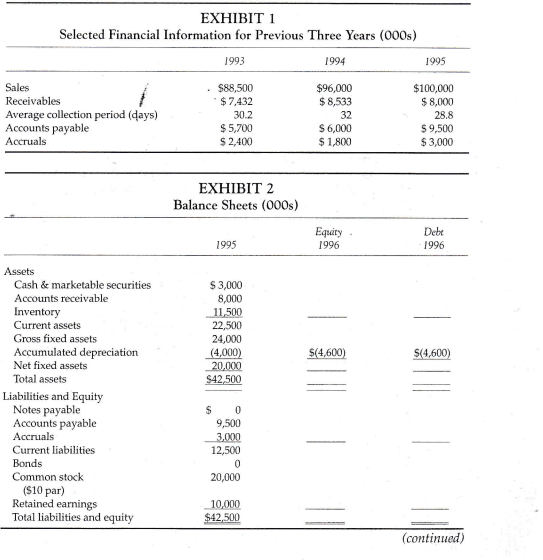
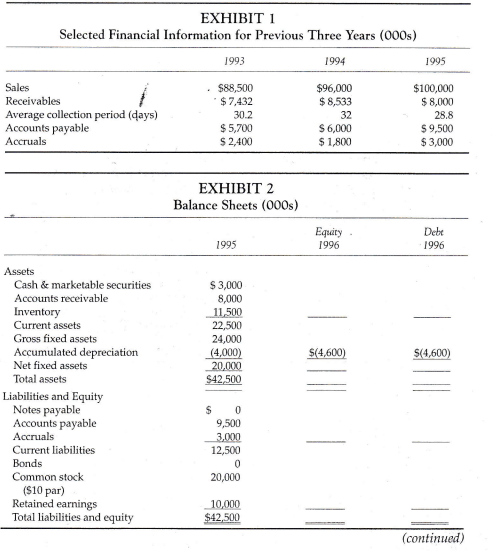
EXHIBIT 1 Selected Financial Information for Previous Three Years (000s) 1993 1994 1995 Sales Receivables Average collection period (days) Accounts payable Accruals $88,500 $ 7,432 30.2 $ 5,700 $ 2,400 $96,000 $ 8,533 32 $6,000 $1,800 $100,000 $ 8,000 28.8 $ 9,500 $3,000 EXHIBIT 2 Balance Sheets (000s) Equity 1996 Debe 1996 1995 $3,000 8,000 11,500 22,500 24,000 (4,000) 20,000 $42,500 $(4,600) S(4,600) Assets Cash & marketable securities Accounts receivable Inventory Current assets Gross fixed assets Accumulated depreciation Net fixed assets Total assets Liabilities and Equity Notes payable Accounts payable Accruals Current liabilities Bonds Common stock ($10 par) Retained earnings Total liabilities and equity $ 0 9,500 3,000 12,500 0 20,000 10,000 $42,500 --- (continued) EXHIBIT 1 Selected Financial Information for Previous Three Years (000s) 1993 1994 1995 Sales Receivables Average collection period (days) Accounts payable Accruals $88,500 $ 7,432 30.2 $ 5,700 $ 2,400 $96,000 $ 8,533 32 $6,000 $1,800 $100,000 $ 8,000 28.8 $ 9,500 $3,000 EXHIBIT 2 Balance Sheets (000s) Equity 1996 Debe 1996 1995 $3,000 8,000 11,500 22,500 24,000 (4,000) 20,000 $42,500 $(4,600) S(4,600) Assets Cash & marketable securities Accounts receivable Inventory Current assets Gross fixed assets Accumulated depreciation Net fixed assets Total assets Liabilities and Equity Notes payable Accounts payable Accruals Current liabilities Bonds Common stock ($10 par) Retained earnings Total liabilities and equity $ 0 9,500 3,000 12,500 0 20,000 10,000 $42,500 (continued) EXHIBIT 1 Selected Financial Information for Previous Three Years (000s) 1993 1994 1995 Sales Receivables Average collection period (days) Accounts payable Accruals $88,500 $ 7,432 30.2 $ 5,700 $ 2,400 $96,000 $ 8,533 32 $6,000 $1,800 $100,000 $ 8,000 28.8 $ 9,500 $3,000 EXHIBIT 2 Balance Sheets (000s) Equity 1996 Debe 1996 1995 $3,000 8,000 11,500 22,500 24,000 (4,000) 20,000 $42,500 $(4,600) S(4,600) Assets Cash & marketable securities Accounts receivable Inventory Current assets Gross fixed assets Accumulated depreciation Net fixed assets Total assets Liabilities and Equity Notes payable Accounts payable Accruals Current liabilities Bonds Common stock ($10 par) Retained earnings Total liabilities and equity $ 0 9,500 3,000 12,500 0 20,000 10,000 $42,500 --- (continued) EXHIBIT 1 Selected Financial Information for Previous Three Years (000s) 1993 1994 1995 Sales Receivables Average collection period (days) Accounts payable Accruals $88,500 $ 7,432 30.2 $ 5,700 $ 2,400 $96,000 $ 8,533 32 $6,000 $1,800 $100,000 $ 8,000 28.8 $ 9,500 $3,000 EXHIBIT 2 Balance Sheets (000s) Equity 1996 Debe 1996 1995 $3,000 8,000 11,500 22,500 24,000 (4,000) 20,000 $42,500 $(4,600) S(4,600) Assets Cash & marketable securities Accounts receivable Inventory Current assets Gross fixed assets Accumulated depreciation Net fixed assets Total assets Liabilities and Equity Notes payable Accounts payable Accruals Current liabilities Bonds Common stock ($10 par) Retained earnings Total liabilities and equity $ 0 9,500 3,000 12,500 0 20,000 10,000 $42,500 (continued)
Step by Step Solution
There are 3 Steps involved in it

Get step-by-step solutions from verified subject matter experts
 Study Help