







Question: Hello! Please solve question 4 making every step of the solution and calculations explicit. Thank you! A Hankel Transform of Axisymmetric Laplacian In this appendix
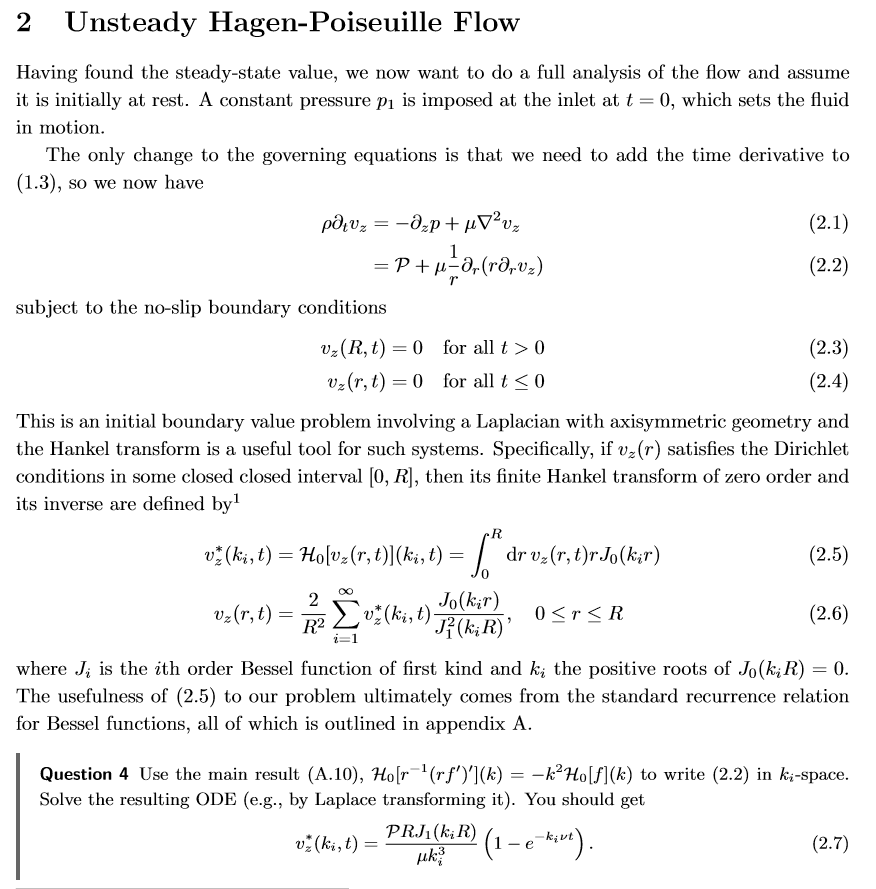
Hello! Please solve question 4 making every step of the solution and calculations explicit. Thank you!
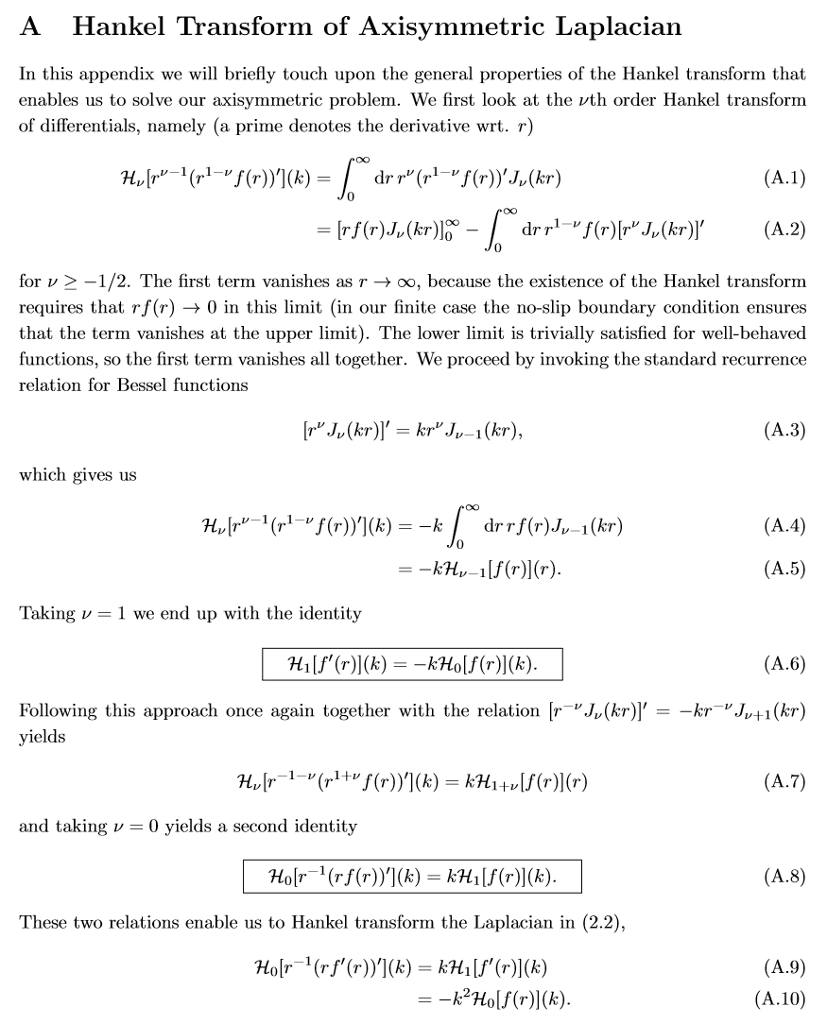
A Hankel Transform of Axisymmetric Laplacian In this appendix we will briefly touch upon the general properties of the Hankel transform that enables us to solve our axisymmetric problem. We first look at the vth order Hankel transform of differentials, namely (a prime denotes the derivative wrt. r) 0 (A.2) for v 2-1/2. The first term vanishes as , because the existence of the Hankel transform requires that rf(r) ? 0 in this limit (in our finite case the no-slip boundary condition ensures that the term vanishes at the upper limit). The lower limit is trivially satisfied for well-behaved functions, so the first term vanishes all together. We proceed by invoking the standard recurrence relation for Bessel functions (A.3) which gives us (A.4) (A.5) Taking v 1 we end up with the identity (A.6) Following this approach once again together with the relation [r "J'(kr)' =-kr "..+1(kr) yields (A.7) and taking v 0 yields a second identity (A.8) These two relations enable us to Hankel transform the Laplacian in (2.2), (A.9) (A.10) k2Holf (r)|(k) A Hankel Transform of Axisymmetric Laplacian In this appendix we will briefly touch upon the general properties of the Hankel transform that enables us to solve our axisymmetric problem. We first look at the vth order Hankel transform of differentials, namely (a prime denotes the derivative wrt. r) 0 (A.2) for v 2-1/2. The first term vanishes as , because the existence of the Hankel transform requires that rf(r) ? 0 in this limit (in our finite case the no-slip boundary condition ensures that the term vanishes at the upper limit). The lower limit is trivially satisfied for well-behaved functions, so the first term vanishes all together. We proceed by invoking the standard recurrence relation for Bessel functions (A.3) which gives us (A.4) (A.5) Taking v 1 we end up with the identity (A.6) Following this approach once again together with the relation [r "J'(kr)' =-kr "..+1(kr) yields (A.7) and taking v 0 yields a second identity (A.8) These two relations enable us to Hankel transform the Laplacian in (2.2), (A.9) (A.10) k2Holf (r)|(k)
Step by Step Solution
There are 3 Steps involved in it

Get step-by-step solutions from verified subject matter experts
 Study Help