







Question: Hello pros, I only need answers to problem 2. the problem 1 is fyi. Thank you! the data file beersales is in R package TSA
Hello pros, I only need answers to problem 2. the problem 1 is fyi. Thank you!
the data file beersales is in R package TSA ( time-series analysis). please answer problem 2, thank you!
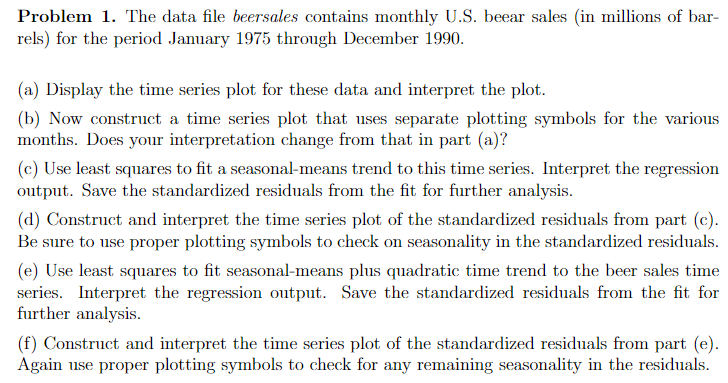
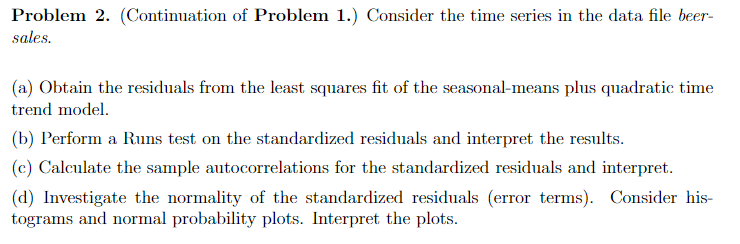
Problem 1. The data file beersales contains monthly U.S. beear sales (in millions of bar- rels) for the period January 1975 through December 1990. (a) Display the time series plot for these data and interpret the plot. (b) Now construct a time series plot that uses separate plotting symbols for the various months. Does your interpretation change from that in part (a)? (c) Use least squares to fit a seasonal-means trend to this time series. Interpret the regression output. Save the standardized residuals from the fit for further analysis. (d) Construct and interpret the time series plot of the standardized residuals from part (c). Be sure to use proper plotting symbols to check on seasonality in the standardized residuals. (e) Use least squares to fit seasonal-means plus quadratic time trend to the beer sales time series. Interpret the regression output. Save the standardized residuals from the fit for further analysis. (f) Construct and interpret the time series plot of the standardized residuals from part (e) Again use proper plotting symbols to check for any remaining seasonality in the residuals. Problem 2. (Continuation of Problem 1.) Consider the time series in the data file beer- sales. (a) Obtain the residuals from the least squares fit of the seasonal-means plus quadratic time trend model (b) Perform a Runs test on the standardized residuals and interpret the results. (c) Calculate the sample autocorrelations for the standardized residuals and interpret. (d) Investigate the normality of the standardized residuals (error terms). Consider his- tograms and normal probability plots. Interpret the plots
Step by Step Solution
There are 3 Steps involved in it

Get step-by-step solutions from verified subject matter experts
 Study Help