Question: Hello so I'm working on a microwave / chocolate bar assignment in my class and I need help with it as I was a little
Hello so I'm working on a microwave / chocolate bar assignment in my class and I need help with it as I was a little confused getting started.
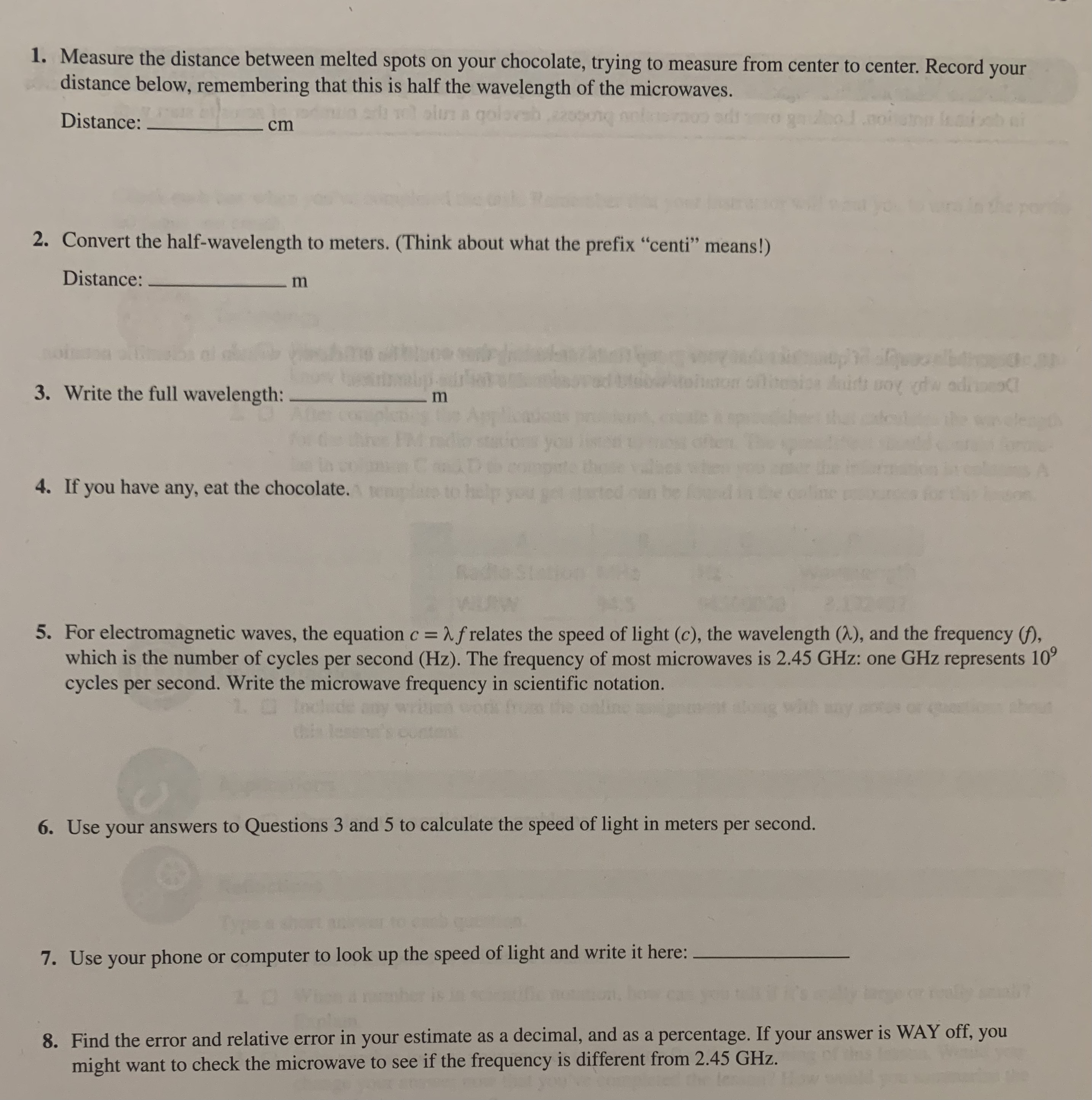
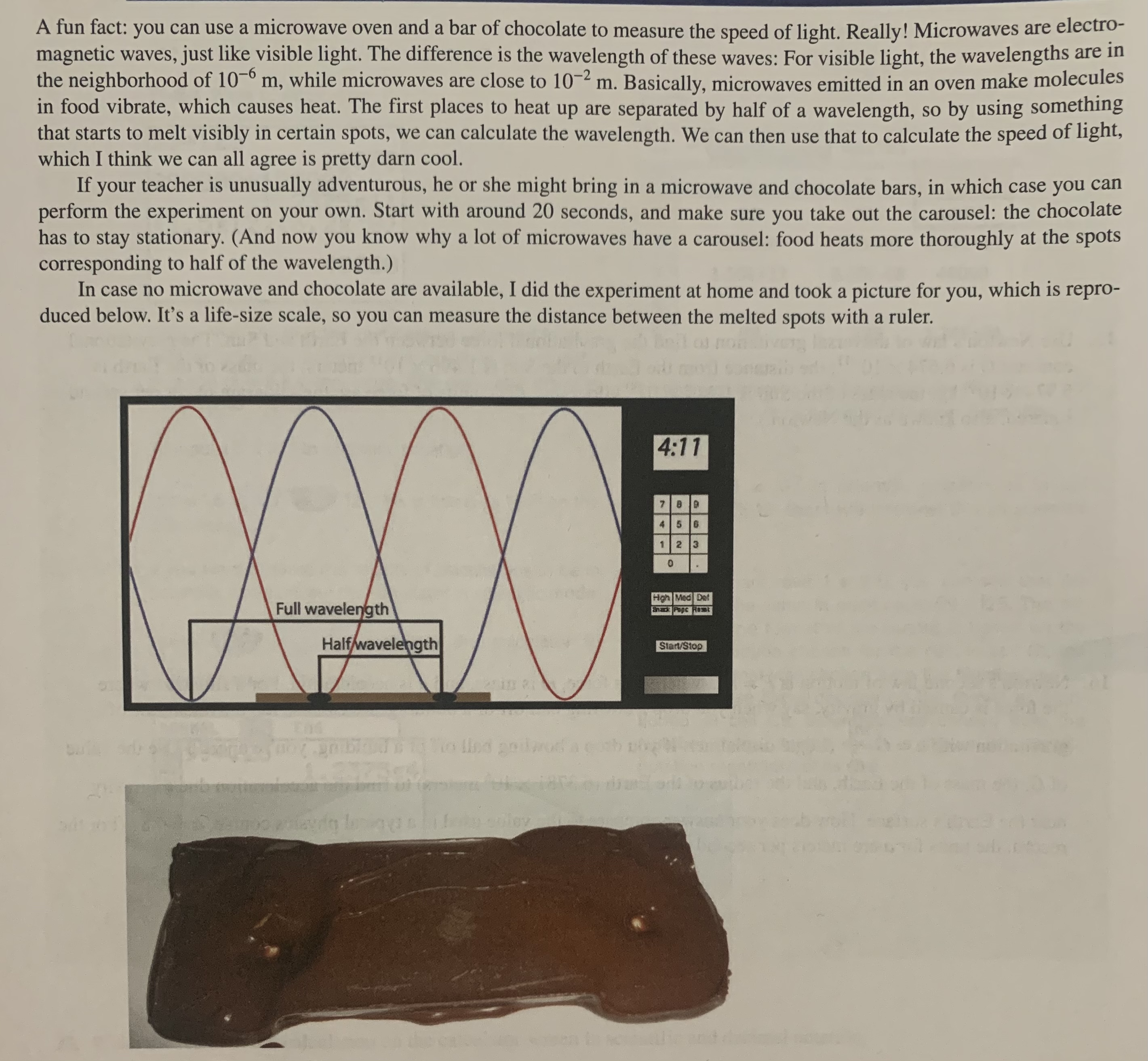
1. Measure the distance between melted spots on your chocolate, trying to measure from center to center. Record your distance below, remembering that this is half the wavelength of the microwaves. Distance: cm 2. Convert the half-wavelength to meters. (Think about what the prefix "centi" means!) Distance: 3. Write the full wavelength: -m 4. If you have any, eat the chocolate. Has to help 5. For electromagnetic waves, the equation c = 2 f relates the speed of light (c), the wavelength (2), and the frequency (f), which is the number of cycles per second (Hz). The frequency of most microwaves is 2.45 GHz: one GHz represents 10' cycles per second. Write the microwave frequency in scientific notation. 6. Use your answers to Questions 3 and 5 to calculate the speed of light in meters per second. 7. Use your phone or computer to look up the speed of light and write it here: 8. Find the error and relative error in your estimate as a decimal, and as a percentage. If your answer is WAY off, you might want to check the microwave to see if the frequency is different from 2.45 GHz.A fun fact: you can use a microwave oven and a bar of chocolate to measure the speed of light. Really! Microwaves are electro- magnetic waves, just like visible light. The difference is the wavelength of these waves: For visible light, the wavelengths are in the neighborhood of 10 m, while microwaves are close to 1072 m. Basically, microwaves emitted in an oven make molecules in food vibrate, which causes heat. The first places to heat up are separated by half of a wavelength, so by using something that starts to melt visibly in certain spots, we can calculate the wavelength. We can then use that to calculate the speed of light, which I think we can all agree is pretty darn cool. If your teacher is unusually adventurous, he or she might bring in a microwave and chocolate bars, in which case you can perform the experiment on your own. Start with around 20 seconds, and make sure you take out the carousel: the chocolate has to stay stationary. (And now you know why a lot of microwaves have a carousel: food heats more thoroughly at the spots corresponding to half of the wavelength.) In case no microwave and chocolate are available, I did the experiment at home and took a picture for you, which is repro- duced below. It's a life-size scale, so you can measure the distance between the melted spots with a ruler. 4:11 7 8 8 4 5 6 1 2 3 Full wavelength High Med Def Half/wavelength Start/Stop









 Study Help