







Question: Hello thank you for helping * * * This is the most Important part * * * Make sure to identify and define the decision
Hello thank you for helping This is the most Important part Make sure to identify and define the decision variables, and formulate the objective function and constraints for each problem. put these excel find quality answers terms are easiest understand
Sleekfon and Sturdyfon are two major cell phone manufacturers that have recently
merged.
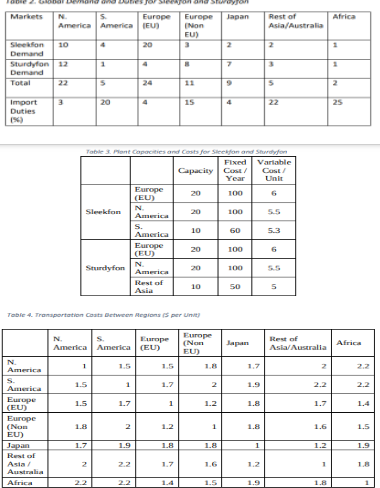
Their current market sizes are shown in Table All demand is in millions of units.
Sleekfon has three production facilities in Europe EU North America, and South America.
Sturdyfon also has three production facilities in Europe EU North America, and the rest of Asia.
The capacity in millions of units annual fixed costs in millions of $ and variable production costs $ per unit for each plant are shown in Table
Transportation costs are shown in Table All transportation costs are shown in dollars per unit.
can be tricky
Duties are applied on each unit based on the fixed cost per unit capacity, variable cost per unit, and
transportation cost. Thus, a unit currently shipped from North America to Africa has a fixed cost per unit
of capacity of $ from Table a variable production cost of $ and a transportation
cost of $ The percent import duty is thus applied on $ to give a total cost
on import of $
For the questions to follow, assume that the market
demand is as in Table
The merged company has estimated that scaling back a millionunit plant to million unit and saves
percent in fixed costs.
Variable costs at a scaledback plant are unaffected. Shutting a plant down either million or million units saves percent in fixed costs.
Heres what I willl be answering with the constriants and objectives u give
a What is the lowest cost achievable for the production and distribution network after the merger if
none of the plants is shut down? Which plants serve which markets?
b What is the lowest cost achievable for the production and distribution network after the merger if
plants can be scaled back or shut down in batches of million units of capacity? Which plants serve
which markets?
thank you very much
Step by Step Solution
There are 3 Steps involved in it
1 Expert Approved Answer
Step: 1 Unlock

Question Has Been Solved by an Expert!
Get step-by-step solutions from verified subject matter experts
Step: 2 Unlock
Step: 3 Unlock
 Study Help