Question: hello there. i need help with Question 1. thank you. CLOSING CASE Productivity Improvement at United Technologies Corporation In 2007, George David, the long-time CEO
hello there.
i need help with Question 1.
thank you.
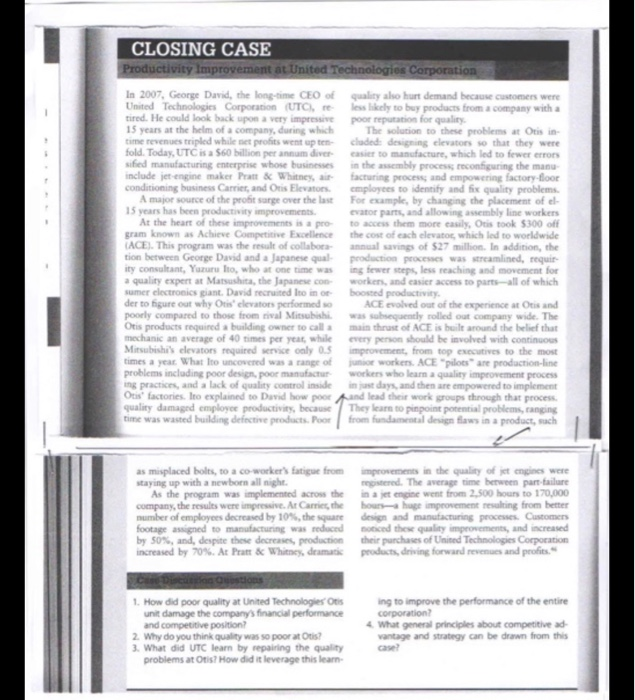
CLOSING CASE Productivity Improvement at United Technologies Corporation In 2007, George David, the long-time CEO of quality also hurt demand because customers were United Technologies Corporation (UTC), re less likely to buy products from a company with a tired. He could look back upon a very impressive poor reputation for quality 15 years at the helm of a company, during which The solution to these problems at Otis in time revenues tripled while et profits went up ten ladede designing elevators so that they were fold. Today, UTC is a 560 billion per annum diver easier to manufacture, which led to fewer errors sified manufacturing enterprise whose businesses in the assembly process reconfiguring the manu include jet engine maker Pratt & Whitney, air facturing process and empowering factory floor conditioning business Carrier, and Otis Elevators. employees to identify and fix quality problems. A major source of the profit surge over the last For example, by changing the placement of el 15 years has been productivity improvements evator parts, and allowing assembly line workers At the heart of these improvements is a pro to access them more easily, Otis took $300 off gram known as Achieve Competitive Excellence the cost of each elevator, which led to worldwide (ACE). This program was the result of collabora annual savings of $27 million. In addition, the tion between George David and a Japanese qual production processes was streamlined, requir- ity consultant, Yuzuru Io, who at one time was ing fewer steps, less reaching and movement for a quality expert at Matsushita, the Japanese con workers, and easier access to parts all of which sumer electronics giant. David recruited to in or boosted productivity der to figure out why Otis'clevators performed so ACE evolved out of the experience at Otis and poorly compared to those from rival Mitsubishi was subsequently rolled out company wide. The Otis products required a building owner to call a main thrust of ACE is built around the belief that mechanic an average of 40 times per year, while every person should be involved with continuous Mitsubishi devators required service only 05 improvement from top executives to the most times a year. What to uncovered was a range of junior workers. ACE"pilots" are production line problems including poor design, poor manufactur workers who learn a quality improvement process ing practices, and a lack of quality control inside in just days, and then are empowered to implement Otisfactories to explained to David bow poor and lead their work groups through that process quality damaged employee productivity, because They learn to pinpoint potential problems, ranging time was wasted building defective products. Poor from fundamental design flows in a product, such as misplaced bolts, to a co-workers fatigue from improvements in the quality of engines were staying up with a newborn all night. registered. The average time between part failure As the program was implemented across the in a tengine went from 2.500 hours to 170,000 company, the results were impressive. Ar Carrie, the house improvement resulting from better number of employees decreased by 10%, the square design and manufacturing processes. Customers footage assigned to manufacturing was reduced noticed the quality improvements, and increased by 50%, and, despite these decreases, production their purchases of United Technologies Corporation increased by 70%. At Pratt & Whitney, dramatic products, driving forward revenues and profits." 1. How did poor quality at United Technologies Otis unit damage the company's financial performance and competitive position? 2. Why do you think quality was so poor at tis? 3. What did UTC learn by repairing the quality problems at Otis? How did it leverage this learn ing to improve the performance of the entire corporation! 4 What general principles about competitive ad vantage and strategy can be drawn from this









 Study Help