







Question: hello. this is an example gives in the lecture for my process economics class but the solutions weren't given . I'm trying to work it
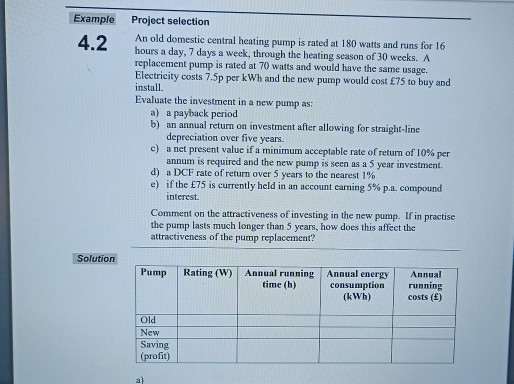
hello. this is an example gives in the lecture for my process economics class but the solutions weren't given . I'm trying to work it out. I did e fine I believe. but for a-d I'm struggling. for a how do I find the NCF or the CCF to find the payback time. b for b I calculated the profit above but how do I factor in depreciation when I don't know the scrap value. for c does that mean assume year 5? I'm just struggling to find missing data. please help if you can. thank you
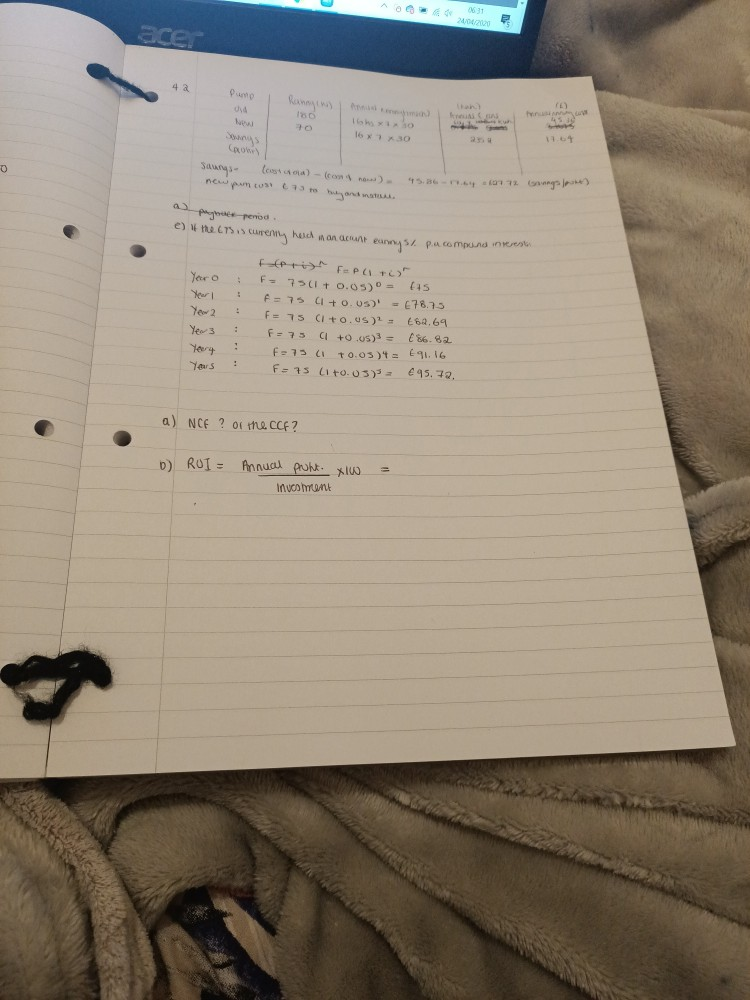
Example 4.2. Project selection An old domestic central heating pump is rated at 180 watts and runs for 16 hours a day, 7 days a week, through the heating season of 30 weeks. A replacement pump is rated at 70 watts and would have the same usage. Electricity costs 7.5p per kWh and the new pump would cost 75 to buy and install. Evaluate the investment in a new pump as: a) a payback period b) an annual return on investment after allowing for straight-line depreciation over five years. c) a net present value if a minimum acceptable rate of return of 10% per annum is required and the new pump is seen as a 5 year investment d) a DCF rate of return over 5 years to the nearest 1% e) if the 75 is currently held in an account carning 5% p.a. compound interest. Comment on the attractiveness of investing in the new pump. If in practise the pump lasts much longer than 5 years, how does this affect the attractiveness of the pump replacement? Solution Pump Rating (W) Annual running time (h) Annual energy consumption (kWh) Annual running costs (f) Old New Saving (profit) 240 Pump 01d fo 10 16x7x30 Sans Caroni 164 new post 45.36 . 172 Gang ) towards p -penod. el het en hud on eann 5% pa compound in f Year o year Y2 Year 3 Yearg Years oferit FPCity 7511 +0.05) fts f = 75 cto.us)' = 78.75 F= 75 (1 +0.05) - 62.69 F= 75 a to.us)3 = 86.82 f= 75 C +0.03)t = 91.16 F=75 Cito.05) 95.72. : : : a) NCE ? Or the CCF? O RUI= Annual punt. x1W Iniciant =
Step by Step Solution
There are 3 Steps involved in it

Get step-by-step solutions from verified subject matter experts
 Study Help