







Question: Hello, was attempting this stats problem and couldn't get through it. Thank you! (9 points) Education. Post-secondary educational institutions in the United States (trade schools,
Hello, was attempting this stats problem and couldn't get through it.
Thank you!
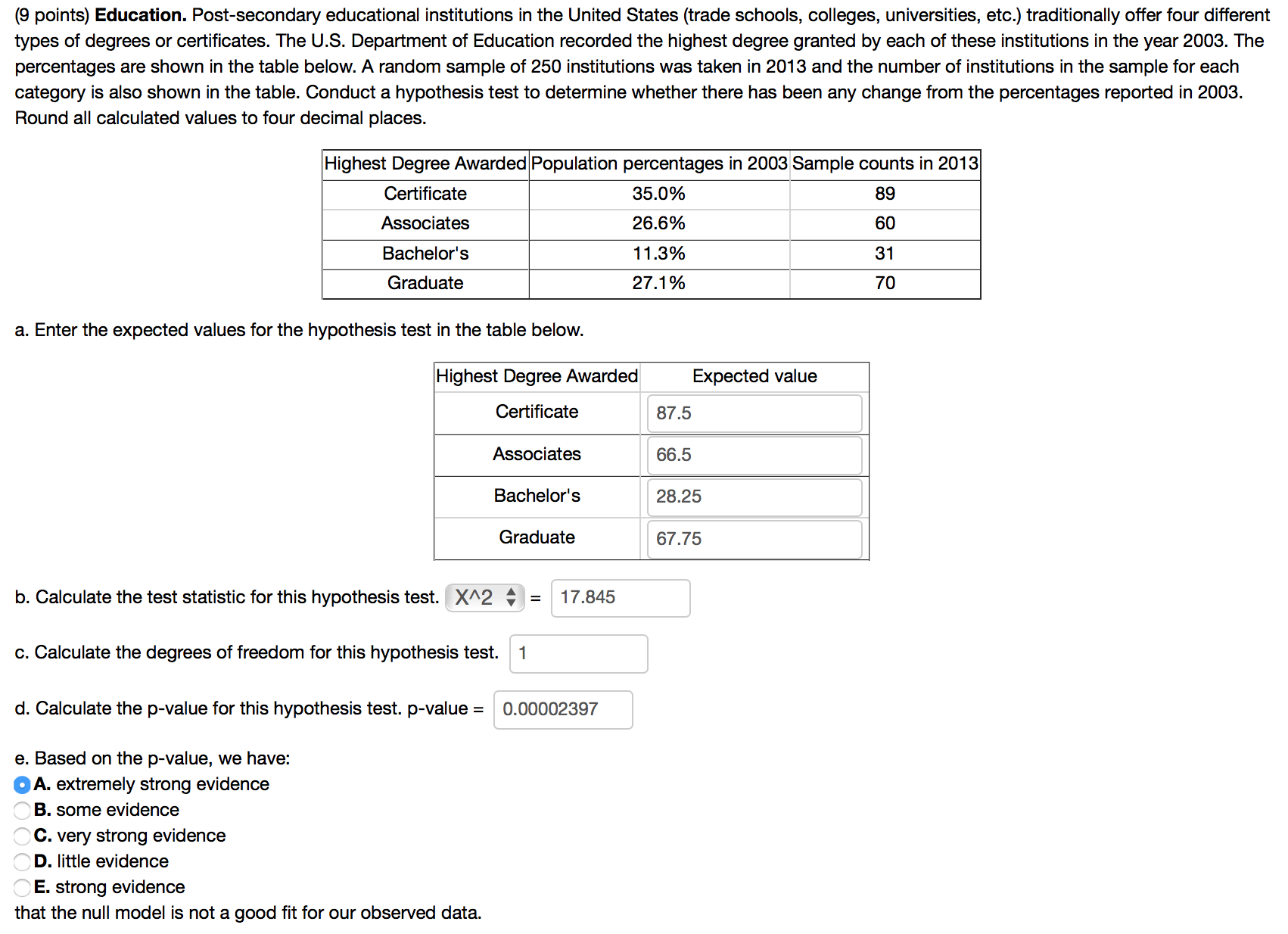
(9 points) Education. Post-secondary educational institutions in the United States (trade schools, colleges. universities, etc.) traditionally offer four different types of degrees or certificates. The U.S. Department of Education recorded the highest degree granted by each of these institutions in the year 2003. The percentages are shown in the table below. A random sample of 250 institutions was taken in 2013 and the number of institutions in the sample for each category is also shown in the table. Conduct a hypothesis test to determine whether there has been any change from the percentages reported in 2003. Round all calculated values to four decimal places. Highest Degree Awarded Population percentages in 2003 Sample counts in 2013 Certificate 35.0% 89 Associates 26.6% 60 Bachelor's 11.3% 31 Graduate 27.1 % 70 a. Enter the expected values for the hypothesis test in the table below. Highest Degree Awarded Expected value Certificate 87.5 Associates 66.5 Bachelor's 28.25 Graduate 67.75 b. Calculate the test statistic for this hypothesis test. X/'2 6 = 17.845 c. Calculate the degrees of freedom for this hypothesis test. 1 d. Calculate the pvalue for this hypothesis test. p-value = 0.0000239? e. Based on the pvalue, we have: 0A. extremely strong evidence A B. some evidence A c. very strong evidence A D. little evidence A E. strong evidence that the null model is not a good fit for our observed data
Step by Step Solution
There are 3 Steps involved in it

Get step-by-step solutions from verified subject matter experts
 Study Help