







Question: Help After you have completed the assignment, please save, scan, or take photos of your work and upload your files to the questions below. Crowdmark
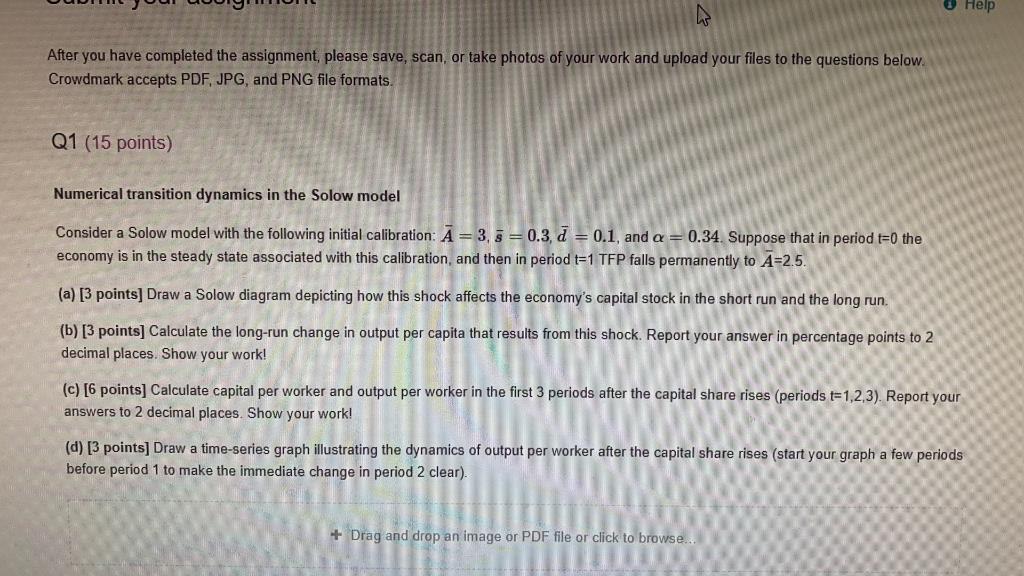
Help After you have completed the assignment, please save, scan, or take photos of your work and upload your files to the questions below. Crowdmark accepts PDF, JPG, and PNG file formats Q1 (15 points) Numerical transition dynamics in the Solow model Consider a Solow model with the following initial calibration: A =3,3=0.3.d = 0.1, and a=0.34 Suppose that in period t=0 the economy is in the steady state associated with this calibration, and then in period t=1 TFP falls permanently to A=2.5. (a) [3 points] Draw a Solow diagram depicting how this shock affects the economy's capital stock in the short run and the long run. (b) [3 points] Calculate the long-run change in output per capita that results from this shock. Report your answer in percentage points to 2 decimal places. Show your work! (c) [6 points] Calculate capital per worker and output per worker in the first 3 periods after the capital share rises (periods t=1,2,3). Report your answers to 2 decimal places. Show your work! (d) [3 points] Draw a time-series graph illustrating the dynamics of output per worker after the capital share rises (start your graph a few periods before period 1 to make the immediate change in period 2 clear). + Drag and drop an image or PDF file or click to browse. Help After you have completed the assignment, please save, scan, or take photos of your work and upload your files to the questions below. Crowdmark accepts PDF, JPG, and PNG file formats Q1 (15 points) Numerical transition dynamics in the Solow model Consider a Solow model with the following initial calibration: A =3,3=0.3.d = 0.1, and a=0.34 Suppose that in period t=0 the economy is in the steady state associated with this calibration, and then in period t=1 TFP falls permanently to A=2.5. (a) [3 points] Draw a Solow diagram depicting how this shock affects the economy's capital stock in the short run and the long run. (b) [3 points] Calculate the long-run change in output per capita that results from this shock. Report your answer in percentage points to 2 decimal places. Show your work! (c) [6 points] Calculate capital per worker and output per worker in the first 3 periods after the capital share rises (periods t=1,2,3). Report your answers to 2 decimal places. Show your work! (d) [3 points] Draw a time-series graph illustrating the dynamics of output per worker after the capital share rises (start your graph a few periods before period 1 to make the immediate change in period 2 clear). + Drag and drop an image or PDF file or click to browse
Step by Step Solution
There are 3 Steps involved in it

Get step-by-step solutions from verified subject matter experts
 Study Help