







Question: help answer please Description: Carbohydrates can be broken down into individual sugar molecules known as monosaccharides. All sugars found in higher organisms are D-sugars, D
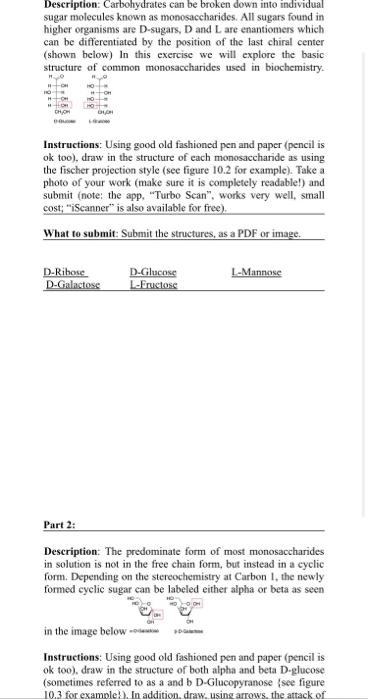
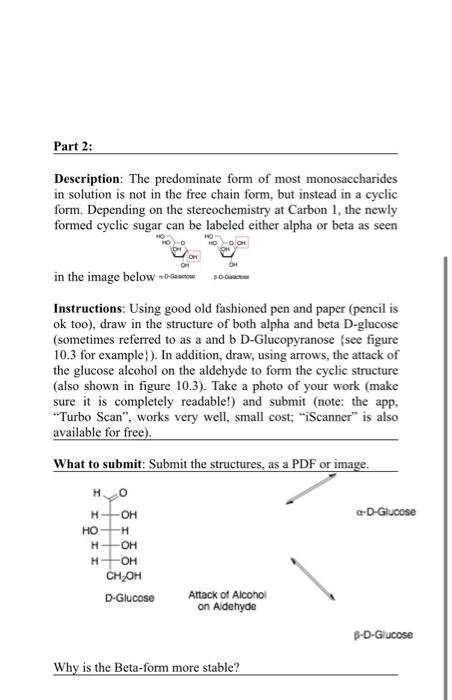
Description: Carbohydrates can be broken down into individual sugar molecules known as monosaccharides. All sugars found in higher organisms are D-sugars, D and L are enantiomers which can be differentiated by the position of the last chiral center (shown below) In this exercise we will explore the basic structure of common monosaccharides used in biochemistry # Instructions: Using good old fashioned pen and paper (pencil is ok too), draw in the structure of each monosaccharide as using the fischer projection style (see figure 10.2 for example). Take a photo of your work (make sure it is completely readable!) and submit (note: the app, "Turbo Sean", works very well, small cost; "iScanner" is also available for free). What to submit: Submit the structures, as a PDF or image. L-Mannose D-Ribose D-Galactose D-Glucose L-Fructose Part 2: Description: The predominate form of most monosaccharides in solution is not in the free chain form, but instead in a cyclic form. Depending on the stereochemistry at Carbon 1, the newly formed cyclic sugar can be labeled either alpha or beta as seen in the image below - Instructions: Using good old fashioned pen and paper (pencil is ok too)draw in the structure of both alpha and beta D-glucose (sometimes referred to as a and b D-Glucopyranose (see figure 10.3 for example). In addition, draw. using arrows, the attack of Part 2: Description: The predominate form of most monosaccharides in solution is not in the free chain form, but instead in a cyclic form. Depending on the stereochemistry at Carbon 1, the newly formed cyclic sugar can be labeled either alpha or beta as seen in the image below Instructions: Using good old fashioned pen and paper (pencil is ok too), draw in the structure of both alpha and beta D-glucose (sometimes referred to as a and b D-Glucopyranose see figure 10.3 for example). In addition, draw, using arrows, the attack of the glucose alcohol on the aldehyde to form the cyclic structure (also shown in figure 10.3). Take a photo of your work (make sure it is completely readable!) and submit (note: the app, **Turbo Scan", works very well, small cost; "Scanner" is also available for free). What to submit: Submit the structures, as a PDF or image. . a-D-Glucose OH HO -H H OH H OH CH OH D-Glucose Attack of Alcohol on Aldehyde B-D-Glucose Why is the Beta-form more stable
Step by Step Solution
There are 3 Steps involved in it

Get step-by-step solutions from verified subject matter experts
 Study Help