







Question: Help answer the question: 1. Based ln tbe evidence provided in the case, hoe effective were Vale Mining Company's ethical safeguards? a) highly ineffective, because
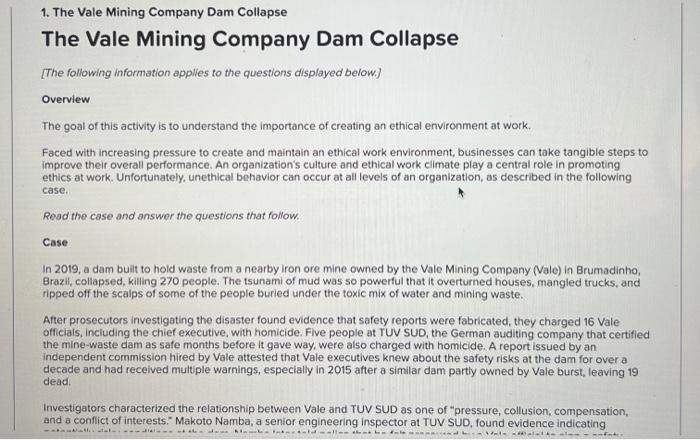
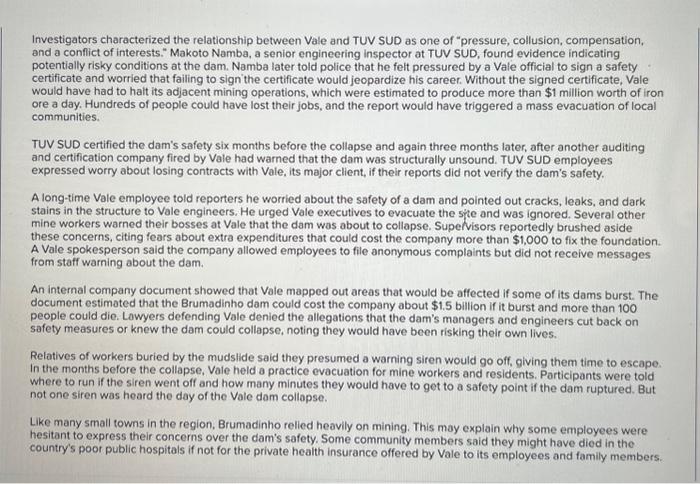
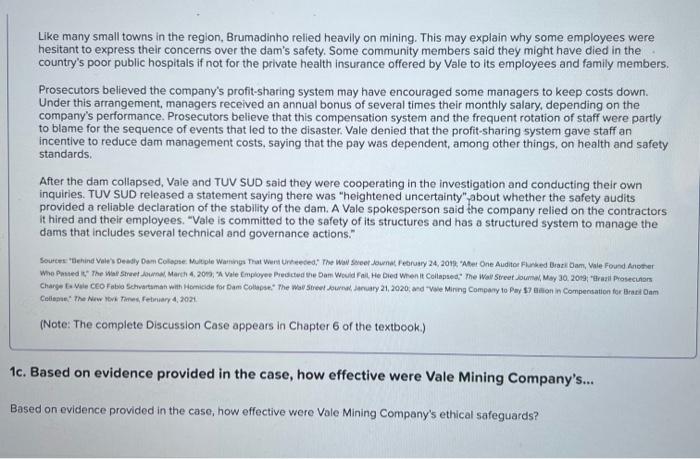
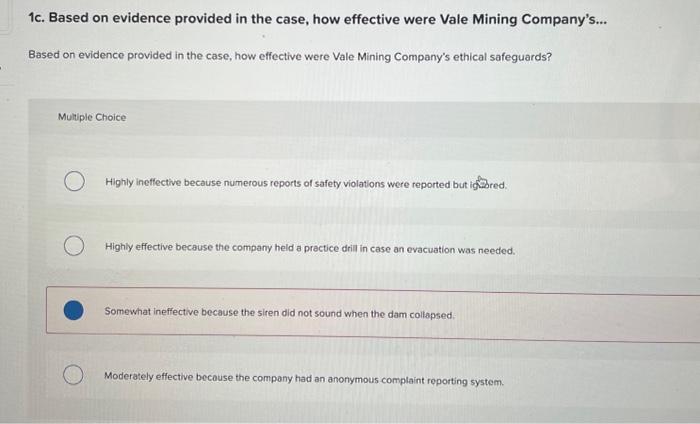
[The following information applies to the questions displayed below.] Overview The goal of this activity is to understand the importance of creating an ethical environment at work. Faced with increasing pressure to create and maintain an ethical work environment, businesses can take tangible steps to improve their overall performance. An organization's culture and ethical work climate play a central role in promoting ethics at work. Unfortunately, unethical behavior can occur at all levels of an organization, as described in the following case. Read the case and answer the questions that follow. Case In 2019, a dam built to hold waste from a nearby iron ore mine owned by the Vale Mining Company (Vale) in Brumadinho, Brazil, collapsed, killing 270 people. The tsunami of mud was so powerful that it overturned houses, mangled trucks, and ripped off the scalps of some of the people buried under the toxic mix of water and mining waste. After prosecutors investigating the disaster found evidence that safety reports were fabricated, they charged 16 Vale officials, including the chief executive, with homicide. Five people at TUV SUD, the German auditing company that certified the mine-waste dam as safe months before it gave way, were also charged with homicide. A report issued by an independent commission hired by Vale attested that Vale executives knew about the safety risks at the dam for over a decade and had received multiple warnings, especially in 2015 after a similar dam partly owned by Vale burst, leaving 19 dead. Investigators characterized the relationship between Vale and TUV SUD as one of "pressure, collusion, compensation, and a conflict of interests:" Makoto Namba, a senior engineering inspector at TUV SUD, found evidence indicating Investigators characterized the relationship between Vale and TUV SUD as one of "pressure, collusion, compensation, and a conflict of interests." Makoto Namba, a senior engineering inspector at TUV SUD, found evidence indicating potentially risky conditions at the dam. Namba later told police that he felt pressured by a Vale official to sign a safety certificate and worried that failing to sign the certificate would jeopardize his career. Without the signed certificate, Vale would have had to hait its adjacent mining operations, which were estimated to produce more than $1 million worth of iron ore a day. Hundreds of people could have lost their jobs, and the report would have triggered a mass evacuation of local communities. TUV SUD certified the dam's safety six months before the collapse and again three months later, after another auditing and certification company fired by Vale had warned that the dam was structurally unsound. TUV SUD employees expressed worry about losing contracts with Vale, its major client, if their reports did not verify the dam's safety. A long-time Vale employee told reporters he worried about the safety of a dam and pointed out cracks, leaks, and dark stains in the structure to Vale engineers. He urged Vale executives to evacuate the site and was ignored. Several other mine workers warned their bosses at Vale that the dam was about to collapse. Supervisors reportedly brushed aside these concerns, citing fears about extra expenditures that could cost the company more than $1,000 to fix the foundation. A Vale spokesperson said the company allowed employees to file anonymous complaints but did not receive messages from staff warning about the dam. An internal company document showed that Vale mapped out areas that would be affected if some of its dams burst. The document estimated that the Brumadinho dam could cost the company about $1.5 billion if it burst and more than 100 people could die. Lowyers defending Vale denied the allegations that the dam's managers and engineers cut back on safety measures or knew the dam could collapse, noting they would have been risking their own lives. Relatives of workers buried by the mudslide said they presumed a warning siren would go off, giving them time to escape. In the months before the collapse, Vale held a practice evacuation for mine workers and residents. Participants were told where to run if the siren went off and how many minutes they would have to get to a safety point if the dam ruptured. But not one siren was heard the day of the Vale dam collapse. Like many small towns in the region, Brumadinho relied heavily on mining. This may explain why some employees were hesitant to express their concerns over the dam's safety. Some community members said they might have died in the country's poor public hospitals if not for the private health insurance offered by Vale to its employees and family members. Like many small towns in the region, Brumadinho relied heavily on mining. This may explain why some employees were hesitant to express their concerns over the dam's safety. Some community members said they might have died in the country's poor public hospitals if not for the private health insurance offered by Vale to its employees and family members. Prosecutors believed the company's profit-sharing system may have encouraged some managers to keep costs down. Under this arrangement, managers received an annual bonus of several times their monthly salary, depending on the company's performance. Prosecutors believe that this compensation system and the frequent rotation of staff were partly to blame for the sequence of events that led to the disaster. Vale denied that the profit-sharing system gave staff an incentive to reduce dam management costs, saying that the pay was dependent, among other things, on health and safety standards. After the dam collapsed, Vale and TUV SUD said they were cooperating in the investigation and conducting their own inquiries. TUV SUD released a statement saying there was "heightened uncertainty" about whether the safety audits provided a reliable declaration of the stability of the dam. A Vale spokesperson said the company relied on the contractors it hired and their employees. "Vale is committed to the safety of its structures and has a structured system to manage the dams that includes several technical and governance actions." Celiepae: The New rovk Thenes, febuary 4, zoat. (Note: The complete Discussion Case appears in Chapter 6 of the textbook.) 1c. Based on evidence provided in the case, how effective were Vale Mining Company's... Based on evidence provided in the case, how effective were Vale Mining Company's ethical safeguards? 1c. Based on evidence provided in the case, how effective were Vale Mining Company's... Based on evidence provided in the case, how effective were Vale Mining Company's ethical safeguards? Multiple Choice Highly ineffective because numerous reports of safety violations were reported but igeared. Highly effective because the company held a practice dril in case an evacuation was needed. Somewhat ineffective because the siren did not sound when the dam collapsed. Moderately effective because the company had an anonymous complaint reporting system
Step by Step Solution
There are 3 Steps involved in it

Get step-by-step solutions from verified subject matter experts
 Study Help