







Question: help ayuda help ayuda help ayuda 101 help ayuda Il [.3 {3 pts) Our mass on a spring has both kinetic Enrgf and poteiitial energy.
help ayuda help ayuda help ayuda 101 help ayuda
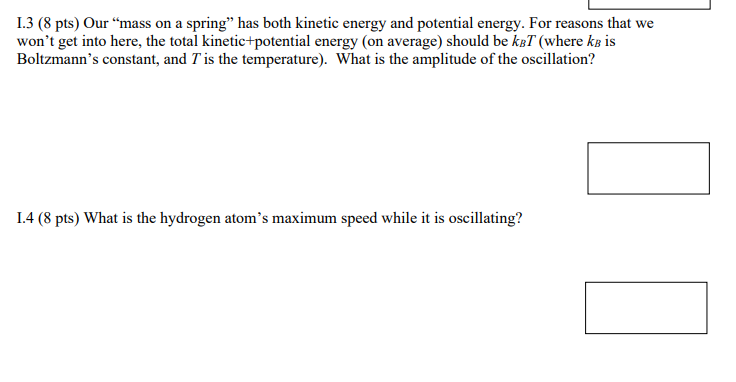
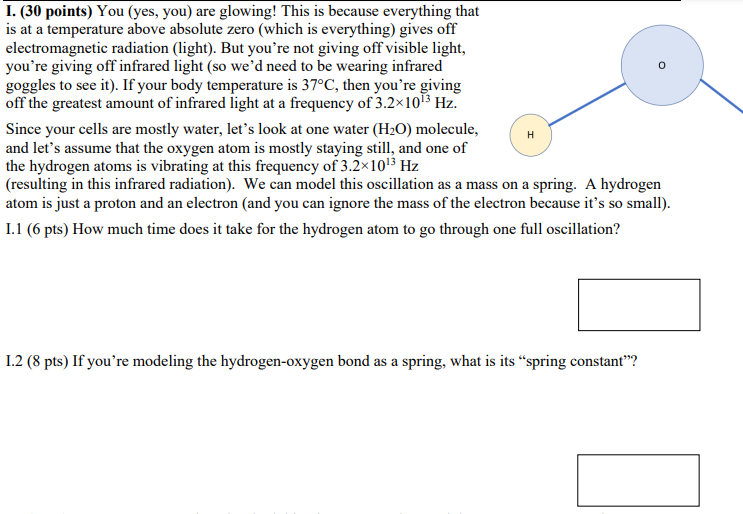
Il [.3 {3 pts) Our \"mass on a spring\" has both kinetic Enrgf and poteiitial energy. For reasons that we won't get into here, the total kinetic+potential energyr {on average) should be its?" (whetc kit is Boltzmann's constant, and Tie the temperature]. What is the amplitude of the oscillation? [.4 {8 pts) 1What: is the hydrogen atom's maximum speed while it is oscillating? I. {all points} You {yes1 you} are glowing! This is because everything that is at a temperature above absolute zero (which is everything) gives off electromagnetic radiation (light). But you're not giving off visible light, you're giving off infrared light {so we'd need to be wearing infrared goggles to see it]. If your body temperature is FPO, then you're giving off the greamst amount of infrared light at a frequency of 3.2km\" Hz. Since your cells are mostly water, let's look at one water (1-110) molecule, I H and let's assume that the oxygen atom is mostly staying still, and one of RE the hydrogen atoms is vibrating at this frequency of 3.2! l 0'3 Hz (resulting in this infrared radiation). We can model this oscillation as a mass on a spring. A hydrogen atom is just a pmton and an electron {and you can ignore the mass of the electron because it's so small]. [.1 { pts} How much time does it take for the hydrogen atom to go through one full oscillation? 1.2{8 pts} If you're modeling the hydrogen-oxygen bond as a spring, what is its \"spring constant\
Step by Step Solution
There are 3 Steps involved in it

Get step-by-step solutions from verified subject matter experts
 Study Help