







Question: Help! I am struggling with this code! It's for python When solving physics problems, you often need to convert from one unit to another. Create
Help! I am struggling with this code! It's for python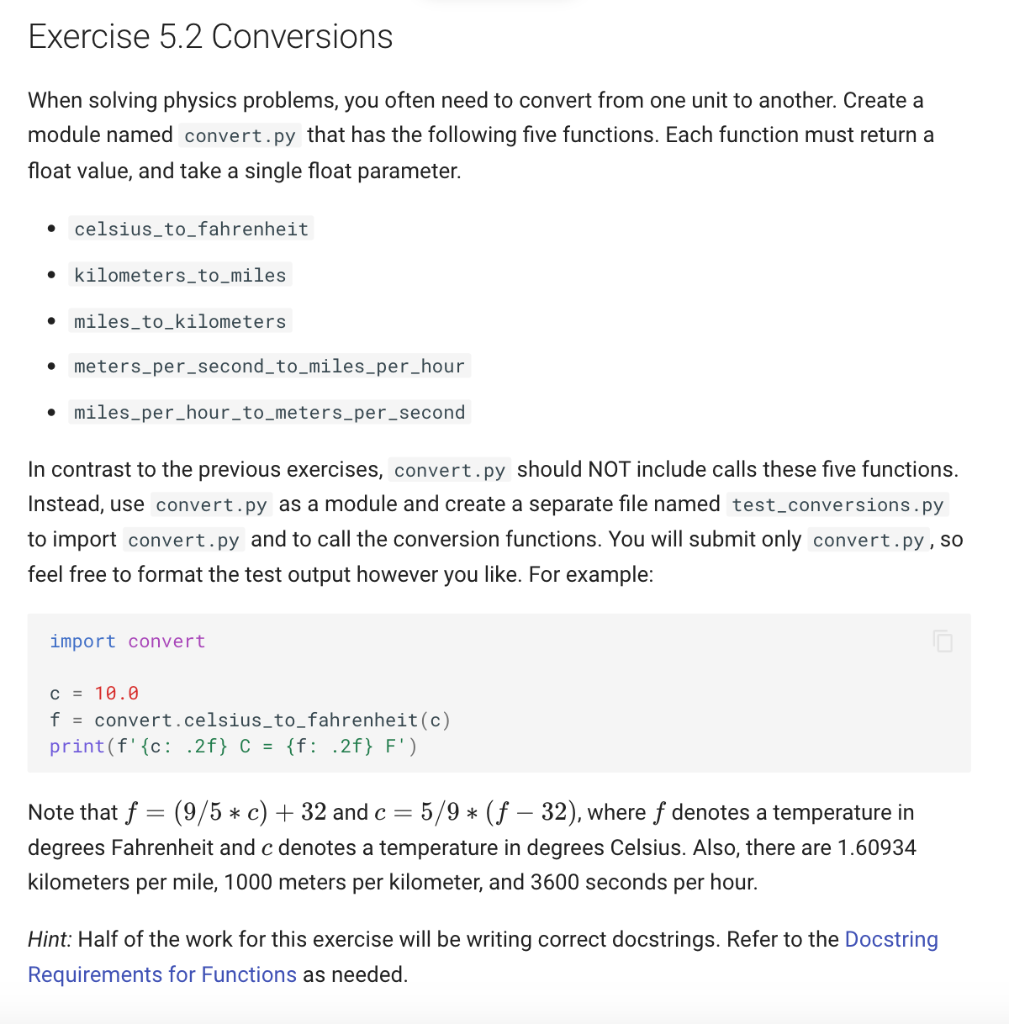
When solving physics problems, you often need to convert from one unit to another. Create a module named convert.py that has the following five functions. Each function must return a float value, and take a single float parameter.
celsius_to_fahrenheit
kilometers_to_miles
miles_to_kilometers
meters_per_second_to_miles_per_hour
miles_per_hour_to_meters_per_second
In contrast to the previous exercises, convert.py should NOT include calls these five functions. Instead, use convert.py as a module and create a separate file named test_conversions.py to import convert.py and to call the conversion functions. You will submit only convert.py, so feel free to format the test output however you like. For example:
import convert c = 10.0 f = convert.celsius_to_fahrenheit(c) print(f'{c: .2f} C = {f: .2f} F') Note that f=(9/5 c)+32 and c=5/9(f32), where F denotes a temperature in degrees Fahrenheit and C denotes a temperature in degrees Celsius. Also, there are 1.60934 kilometers per mile, 1000 meters per kilometer, and 3600 seconds per hour.
Hint: Half of the work for this exercise will be writing correct docstrings. Refer to the Docstring Requirements for Functions as needed.
When solving physics problems, you often need to convert from one unit to another. Create a module named convert.py that has the following five functions. Each function must return a float value, and take a single float parameter. - celsius_to_fahrenheit - - miles_to_kilometers - meters_per_second_to_miles_per_hour - miles_per_hour_to_meters_per_second In contrast to the previous exercises, convert.py should NOT include calls these five functions. Instead, use convert.py as a module and create a separate file named test_conversions.py to import convert.py and to call the conversion functions. You will submit only convert.py, so feel free to format the test output however you like. For example: import convert c=10.0 f= convert.celsius_to_fahrenheit (c) print (f{c:.2f}C={f:.2f}F) Note that f=(9/5c)+32 and c=5/9(f32), where f denotes a temperature in degrees Fahrenheit and c denotes a temperature in degrees Celsius. Also, there are 1.60934 kilometers per mile, 1000 meters per kilometer, and 3600 seconds per hour. Hint: Half of the work for this exercise will be writing correct docstrings. Refer to the Docstring Requirements for Functions as needed
Step by Step Solution
There are 3 Steps involved in it

Get step-by-step solutions from verified subject matter experts
 Study Help