







Question: :Help me answer the following. Suppose there are two types of used cars: peaches and lemons. A peach is worth $3000 to a buyer and
:Help me answer the following.
Suppose there are two types of used cars: peaches and lemons. A peach is worth $3000 to a buyer and $1900 to a seller. A lemon, on the other hand, is worth $1000 to a buyer and $500 to a seller. The fraction of used cars that are peaches is 1?4 and the fraction that are lemons is 3?4. All parties are risk neutral, and when buyers and sellers bargain, the agreed sale price is always the maximum that buyers willing to pay. Assume that buyers cannot tell if a car is a peach or a lemon. Sellers know which type of car they own. (i) What kind of cars will be sold in this market? (ii) Now assume that the fraction of lemons is now 1?2. What kind of cars will be sold in this market?
(1 bookmark)
Flag
A monopoly can produce at constant marginal and average cost of 5. The firm faces a market demand curve given by Q = 53 - P. Hint: Graphing the problem may be useful for parts c. and d.
a. What is the profit maximizing level of output? What is the price?
b. Compute the profits.
c. What output level would be produced by the industry under perfect competition?
d. Calculate the consumer surplus under monopoly and under perfect competition.
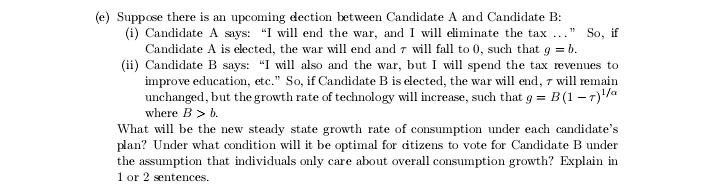

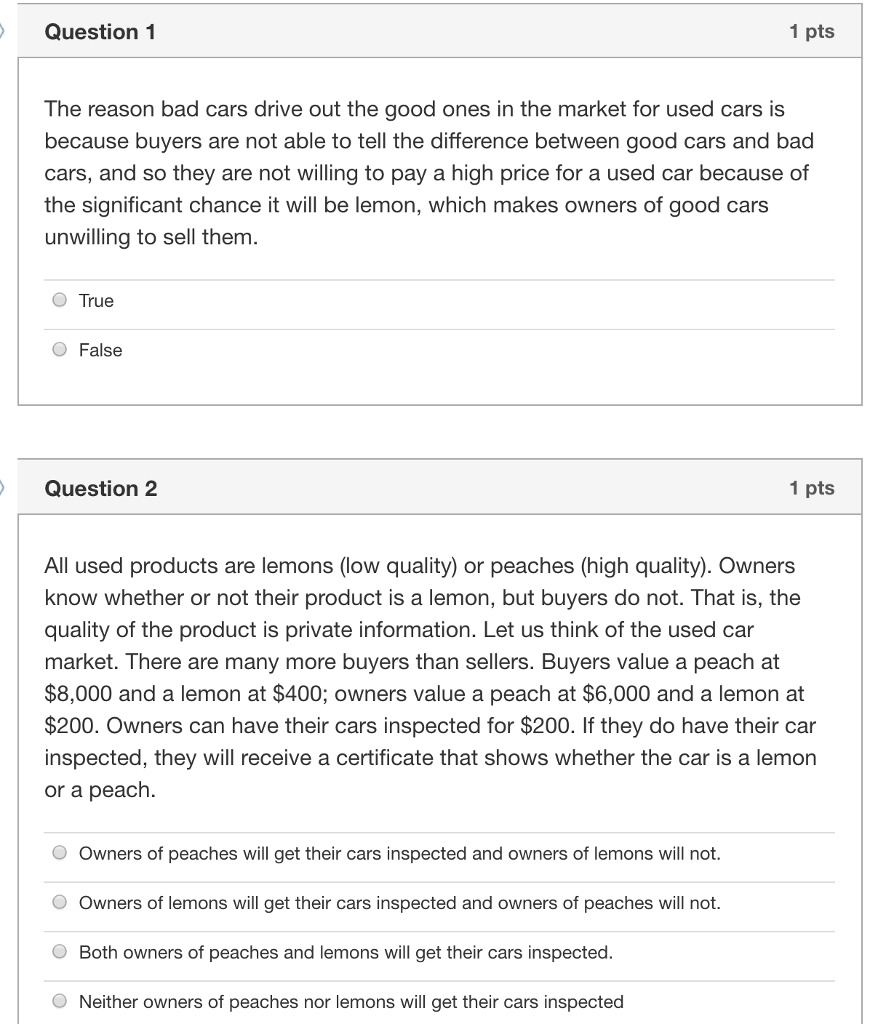
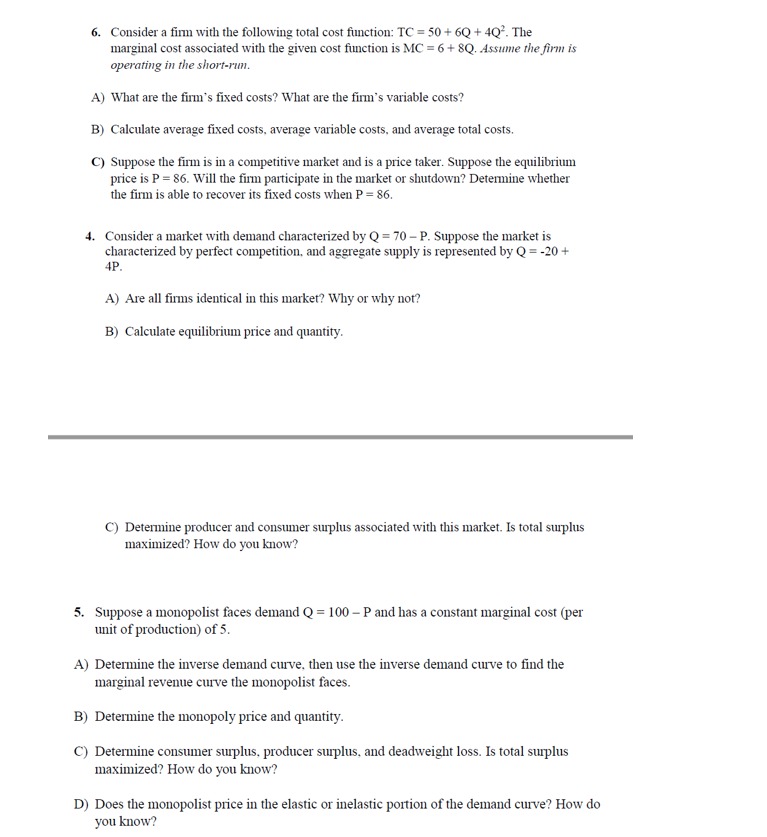
(e) Suppose there is an upcoming dection between Candidate A and Candidate B: (i) Candidate A says: "I will end the war, and I will eliminate the tax ..." So, if Candidate A is elected, the war will end and 7 will fall to 0, such that g = b. (ii) Candidate B says: "I will also and the war, but I will spend the tax revenues to improve education, etc." So, if Candidate B is elected, the war will end, 7 will remain unchanged, but the growth rate of technology will increase, such that ? = B (1 -7) /9 where B > b. What will be the new steady state growth rate of consumption under each candidate's plan? Under what condition will it be optimal for citizens to vote for Candidate B under the assumption that individuals only care about overall consumption growth? Explain in 1 or 2 sentences.(c) Suppose that the rule prohibiting the food stamps sale is difficult to enforce and William can trade each food stamp in black market for $0.50. Draw his budget set.Question 1 1 pts The reason bad cars drive out the good ones in the market for used cars is because buyers are not able to tell the difference between good cars and bad cars. and so they are not willing to pay a high price for a used car because of the significant chance it will be lemon. which makes owners of good cars unwilling to sell them. 0 True 0 False Question 2 1 pts All used products are lemons (low quality) or peaches (high quality). Owners know whether or not their product is a lemon, but buyers do not. That is, the quality of the product is private information. Let us think of the used car market. There are many more buyers than sellers. Buyers value a peach at $8,000 and a lemon at $400; owners value a peach at $6,000 and a lemon at $200. Owners can have their cars inspected for $200. If they do have their car inspected, they will receive a certificate that shows whether the car is a lemon or a peach. 0 Owners of peaches will get their cars inspected and owners of lemons will not. 0 Owners of lemons will get their cars inspected and owners of peaches will not. 0 Both owners of peaches and lemons will get their cars inspected. 0 Neither owners of peaches nor lemons will get their cars inspected 6. Consider a firm with the following total cost function: TC = 50 + 6Q + 4Q'. The marginal cost associated with the given cost function is MC = 6 + 8Q. Assume the firm is operating in the short-run. A) What are the firm's fixed costs? What are the firm's variable costs? B) Calculate average fixed costs, average variable costs, and average total costs. C) Suppose the firm is in a competitive market and is a price taker. Suppose the equilibrium price is P = 86. Will the firm participate in the market or shutdown? Determine whether the firm is able to recover its fixed costs when P = 86. 4. Consider a market with demand characterized by Q = 70 - P. Suppose the market is characterized by perfect competition, and aggregate supply is represented by Q = -20 + 4P. A) Are all firms identical in this market? Why or why not? B) Calculate equilibrium price and quantity. C) Determine producer and consumer surplus associated with this market. Is total surplus maximized? How do you know? 5. Suppose a monopolist faces demand Q = 100 - P and has a constant marginal cost (per unit of production) of 5. A) Determine the inverse demand curve, then use the inverse demand curve to find the marginal revenue curve the monopolist faces. B) Determine the monopoly price and quantity. ") Determine consumer surplus, producer surplus, and deadweight loss. Is total surplus maximized? How do you know? D) Does the monopolist price in the elastic or inelastic portion of the demand curve? How do you know
Step by Step Solution
There are 3 Steps involved in it

Get step-by-step solutions from verified subject matter experts
 Study Help