







Question: help me answer the question 9 and 12 u. Technical Debt & Refactoring (11 points) 9. list and describe two ways in which Separation of
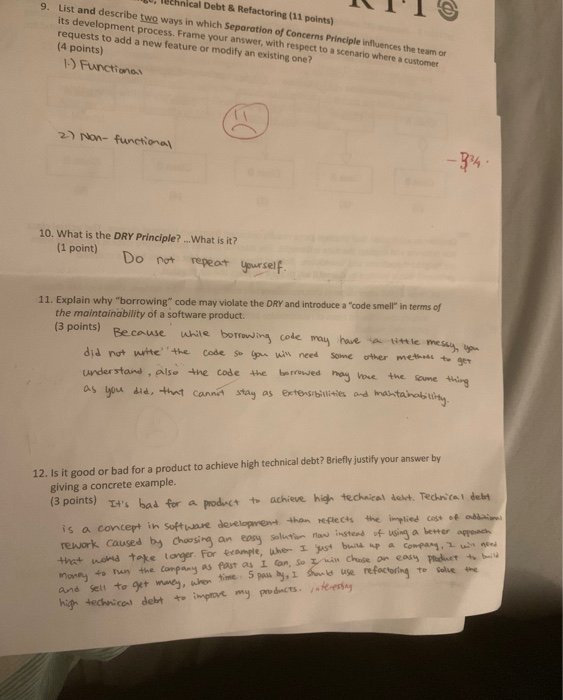
u. Technical Debt & Refactoring (11 points) 9. list and describe two ways in which Separation of Concerns Principle influences the team its development process. Frame your answer, with respect to a scenario where a customer requests to add a new feature or modify an existing one? (4 points) 1.) Functional 2) Non- functional 10. What is the DRY Principle? ...What is it? (1 point) Do not repeat yourself. 11. Explain why "borrowing" code may violate the DRY and introduce a "code smell" in terms of the maintainability of a software product. (3 points) Because we borrowing code mouwe n me did not witte the code so you will need some other methods to get understand also the code the borrowed may have the same thing as you did, that cannot stay as extensibillities and mantainability 12. Is it good or bad for a product to achieve high technical debt? Briefly justify your answer by giving a concrete example. (3 points) It's bad for a product to achieve high technical delt. Technical debt is a concept in software development than reflects the implied cost of additional rework caused by choosing an easy solution now instead of using a better appeach that word take longer. For example, who I just build up a company, I will nord money to run the company as fast as I can, so will chase an easy Product to build and sell to get money, when time. I pass by, I should use refactoring to solve the high technical debt to improve my products, interesting that womed the company as fast as pain by, I show
Step by Step Solution
There are 3 Steps involved in it

Get step-by-step solutions from verified subject matter experts
 Study Help