







Question: d. What is the length of the red segment at t = 3 seconds? The length of the red += 3 seconds segment at
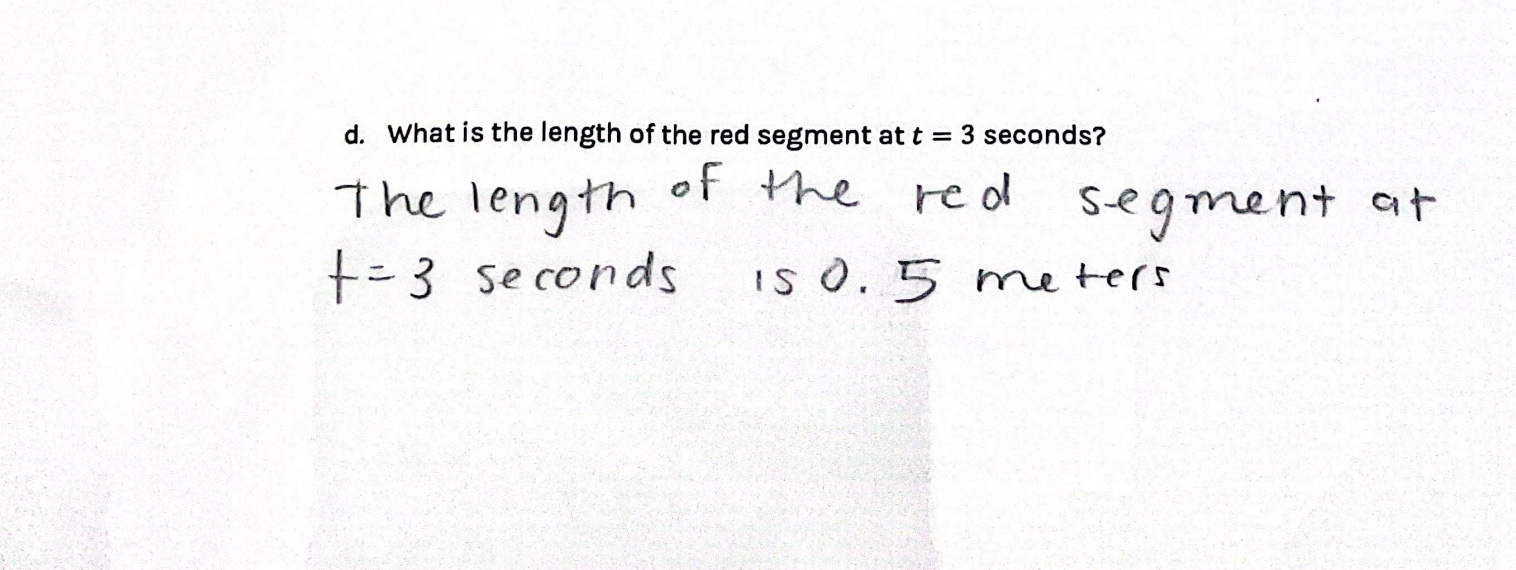
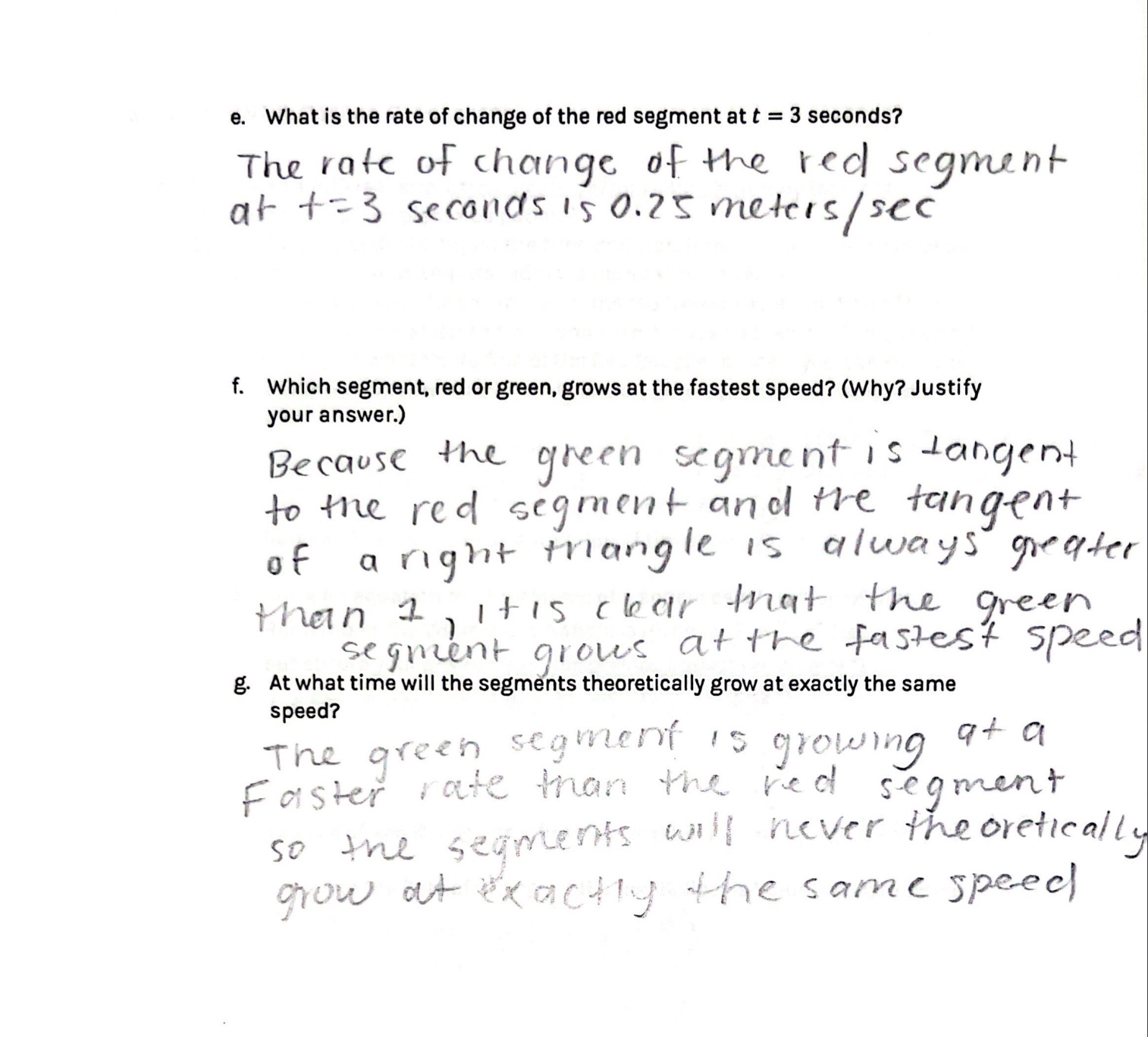
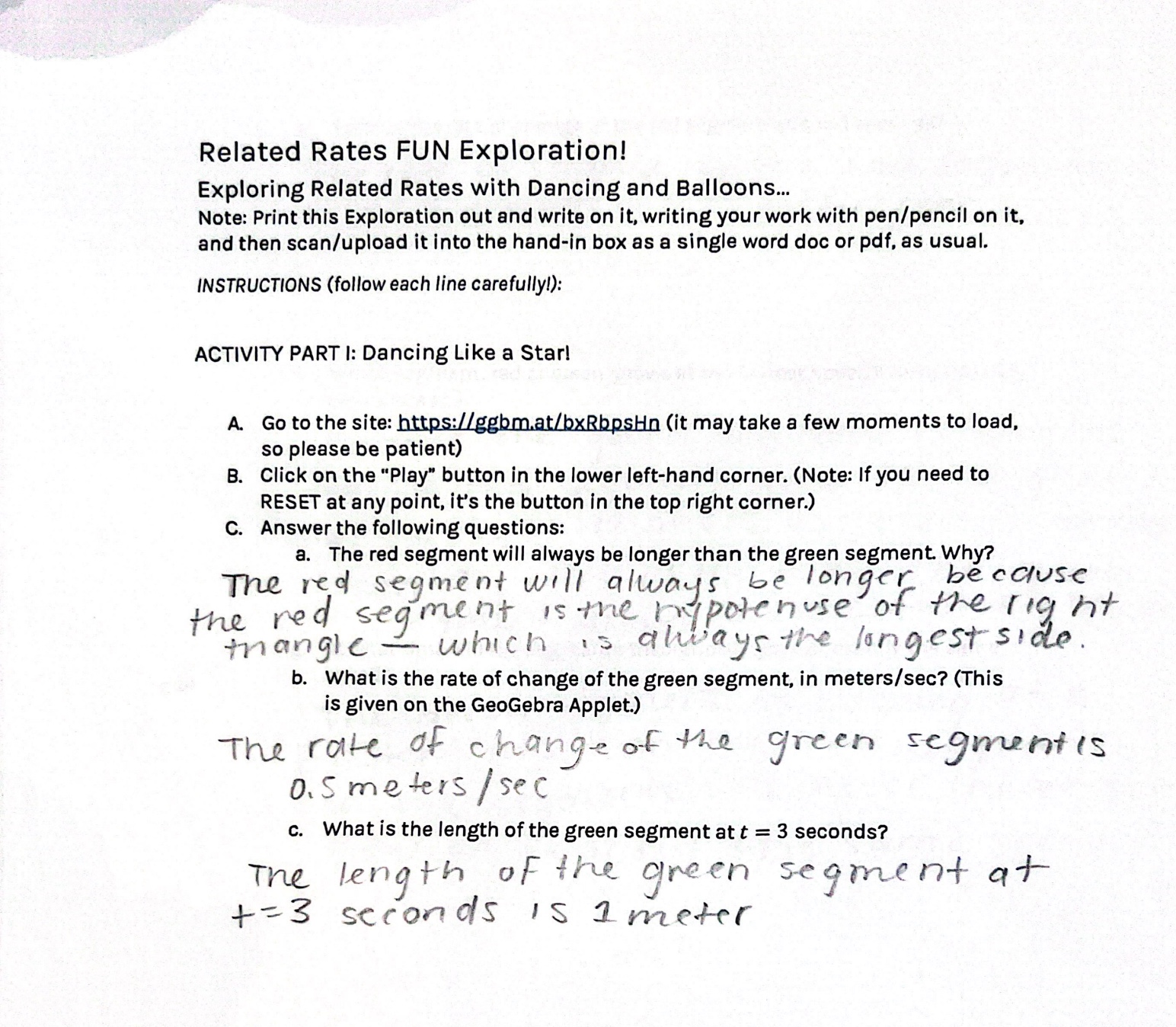
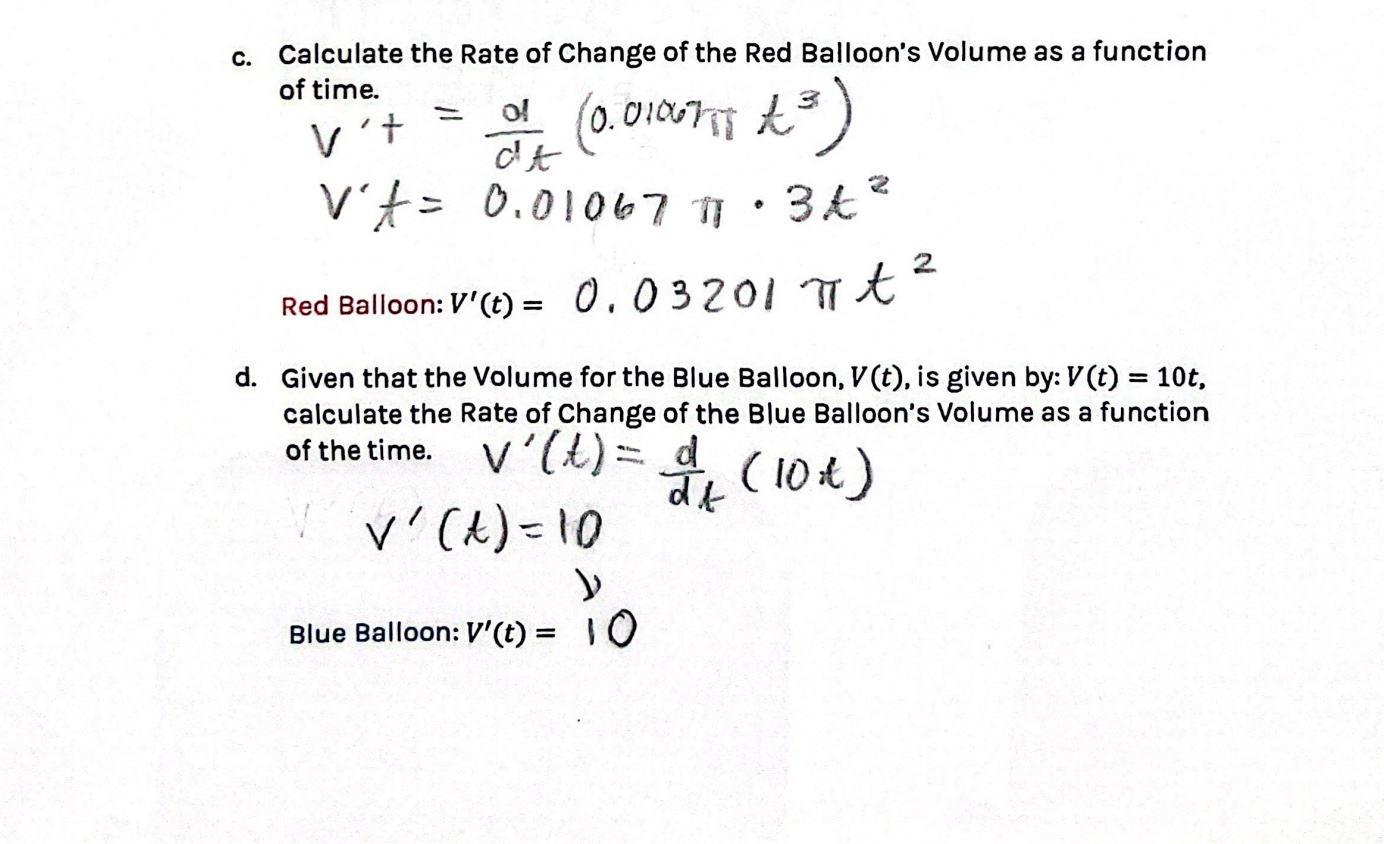
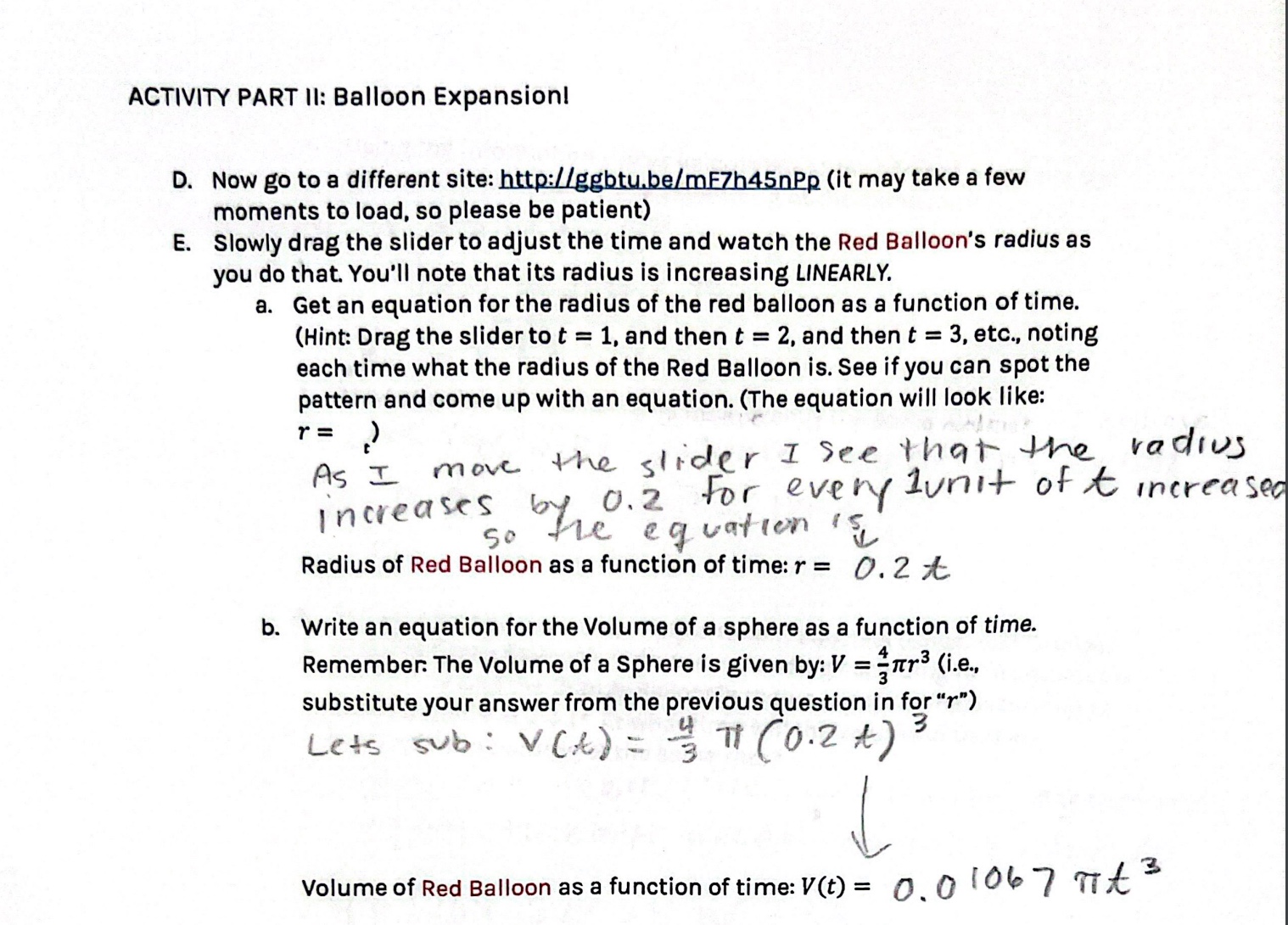
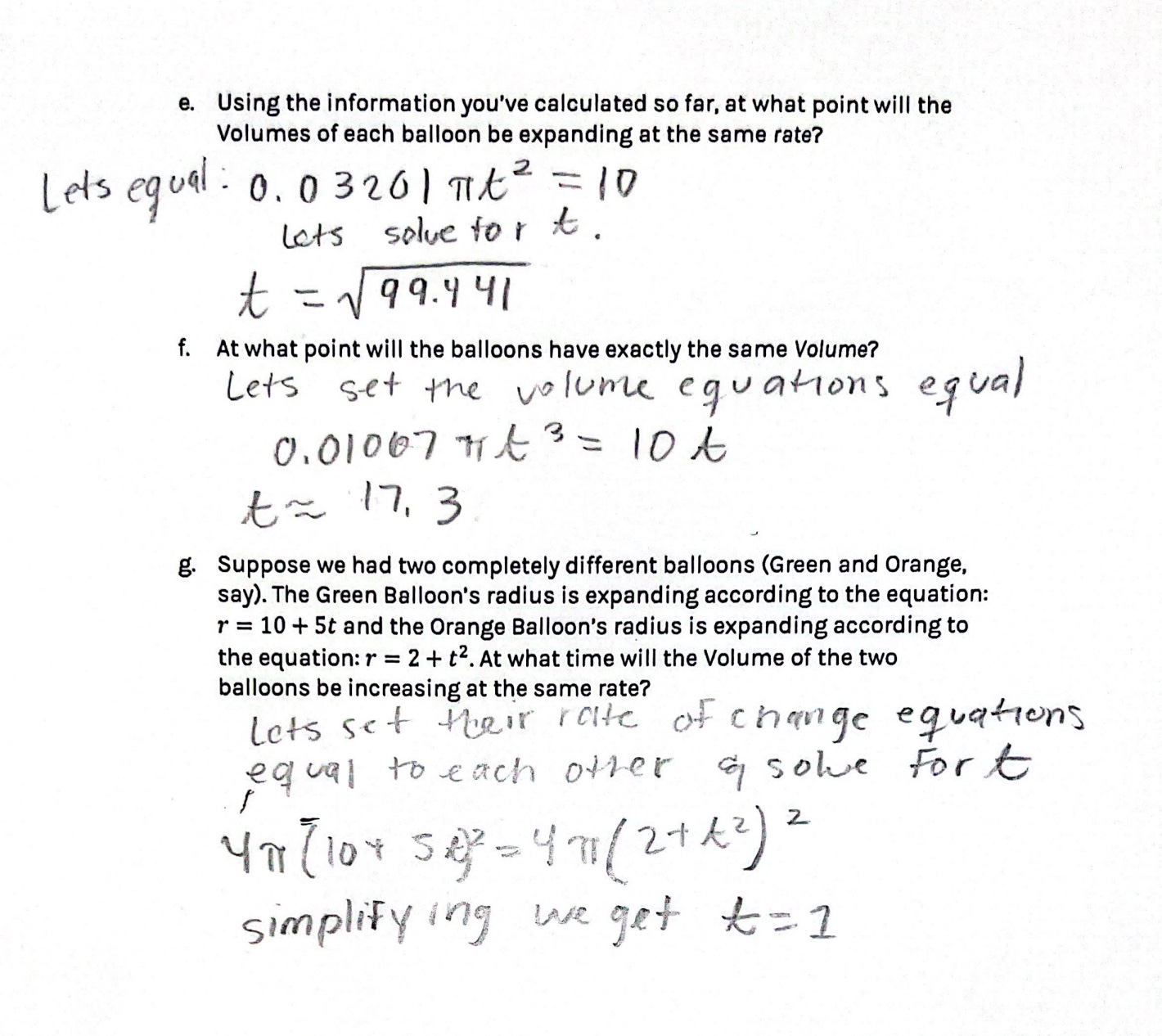
d. What is the length of the red segment at t = 3 seconds? The length of the red += 3 seconds segment at is 0.5 meters e. What is the rate of change of the red segment at t = 3 seconds? The rate of change of the red segment at += 3 seconds is 0.25 meters/sec f. Which segment, red or green, grows at the fastest speed? (Why? Justify your answer.) Because the green segment is tangent to the red segment and the tangent of right thangle is always greater than 1, it is clear that the green segment grows at the fastest speed g. At what time will the segments theoretically grow at exactly the same speed? at a The green segment is growing Faster rate than the red segment so the segments will never the oretically grow at exactly the same speed Related Rates FUN Exploration! Exploring Related Rates with Dancing and Balloons... Note: Print this Exploration out and write on it, writing your work with pen/pencil on it, and then scan/upload it into the hand-in box as a single word doc or pdf, as usual. INSTRUCTIONS (follow each line carefully!): ACTIVITY PART I: Dancing Like a Star! A. Go to the site: https://ggbm.at/bxRbpsHn (it may take a few moments to load, so please be patient) B. Click on the "Play" button in the lower left-hand corner. (Note: If you need to RESET at any point, it's the button in the top right corner.) C. Answer the following questions: a. The red segment will always be longer than the green segment. Why? rig ht The red segment will always be longer because the red segment is the hypotenuse of the always the longest side. thangle which - b. What is the rate of change of the green segment, in meters/sec? (This is given on the GeoGebra Applet.) The rate of change of the green segment is 0.5 meters/sec c. What is the length of the green segment at t = 3 seconds? The length of the green segment at +-3 seconds is 1 meter c. Calculate the Rate of Change of the Red Balloon's Volume as a function of time. Vit = o! dt (0.01067 ) 3* vt0.01067 2 Red Balloon: V' (t) = 0.03201 t d. Given that the Volume for the Blue Balloon, V(t), is given by: V(t) = 10t, calculate the Rate of Change of the Blue Balloon's Volume as a function of the time. v' (t) = 1/4 (10) V'(x)=10 Blue Balloon: V'(t) = 10 ACTIVITY PART II: Balloon Expansion! D. Now go to a different site: http://ggbtu.be/mF7h45nPp (it may take a few moments to load, so please be patient) E. Slowly drag the slider to adjust the time and watch the Red Balloon's radius as you do that. You'll note that its radius is increasing LINEARLY. a. Get an equation for the radius of the red balloon as a function of time. (Hint: Drag the slider to t = 1, and then t = 2, and then t = 3, etc., noting each time what the radius of the Red Balloon is. See if you can spot the pattern and come up with an equation. (The equation will look like: T = As I move the slider I see that the radius increases by 0.2 for every lunit of t increased vation is 50 the eg Radius of Red Balloon as a function of time: r = 0.2 t b. Write an equation for the Volume of a sphere as a function of time. Remember. The Volume of a Sphere is given by: V =r (i.e., substitute your answer from the previous question in for "r") Lets sub: V(t) = (0.2+) 3 3 Volume of Red Balloon as a function of time: V(t) = 0.01067 t 3 e. Using the information you've calculated so far, at what point will the Volumes of each balloon be expanding at the same rate? 2 Let's equal: 0.03201 t = 10 Lets solve fort. t = 99.441 f. At what point will the balloons have exactly the same Volume? Lets set the volume equations equal 0.0106743101 = t 17.3 g. Suppose we had two completely different balloons (Green and Orange, say). The Green Balloon's radius is expanding according to the equation: r = 10 + 5t and the Orange Balloon's radius is expanding according to the equation: r = 2 + t. At what time will the Volume of the two balloons be increasing at the same rate? Lets set their rate of change equations equal to each other & solve for t 4 (10+ Se - 411( 2+ A) 2 simplifying we get t=1
Step by Step Solution
There are 3 Steps involved in it
To ensure you find the correct answers lets go through the key issues and clarify the solutions 1 Le... View full answer

Get step-by-step solutions from verified subject matter experts
 Study Help