Question: Help me create annotated bibliography. Begin the research process by reviewing primary source materials. Your primary source is Season 1 episode 2 of the show
Help me create annotated bibliography. Begin the research process by reviewing primary source materials. Your primary source is Season 1 episode 2 of the show Mad Men. Using analytical strategies from class as a guide, help me create a substantial one-paragraph description of the primary source that you plan to analyze for your Analytical Research Argument. This is my paragraph. - Mad Men is an American style drama set in the 1960's focusing on the lives of advertising executives at Sterling Cooper in New York. In this episode "Ladies Room," (Season 1, Episode 2) Mad Men delves into the pervasive sexism of the 1960s workplace, highlighting the gender dynamics at Sterling Cooper. The episode centers around Betty Draper, a housewife married to Don Draper who struggles with her identity and the societal expectations placed on women. In "Ladies Room," Mad Men exposes the established sexism of the 1960s by illustrating how women are confined to domestic roles and are often dismissed in professional settings. A key scene is when Betty confides in her friend Francine about her anxiety and the pressure to maintain a perfect household, only to be advised to see a psychiatrist, who suggests that her dissatisfaction is a personal failing rather that a societal issue. This scene reflects how women were limited to roles & lacked agency, emphasizing the sexism of the time. Next, help me locate secondary source materials that will inform and enhance my understanding of my primary source materials and explain how these sources augment my understanding of my primary source. Then, help me write annotations for four secondary sources (at least two peer-reviewed sources and two popular sources). Each annotation should consist of three moves: 1 Correct MLA Works Cited citations. 2 A paragraph that summarizes the author's argument. This summary should incorporate significant quotes, key terms, and major claims from the source. Please make sure to interpret and explain those quotes and claims. 3 A paragraph that unpacks the source's relationship to your thesis and the primary source. In this paragraph, explain how this source fits into the larger conversation we have been having in class about our course topic. More importantly, explain how this secondary source is in conversation with your larger argument.
Here are my peered reviewed sources :
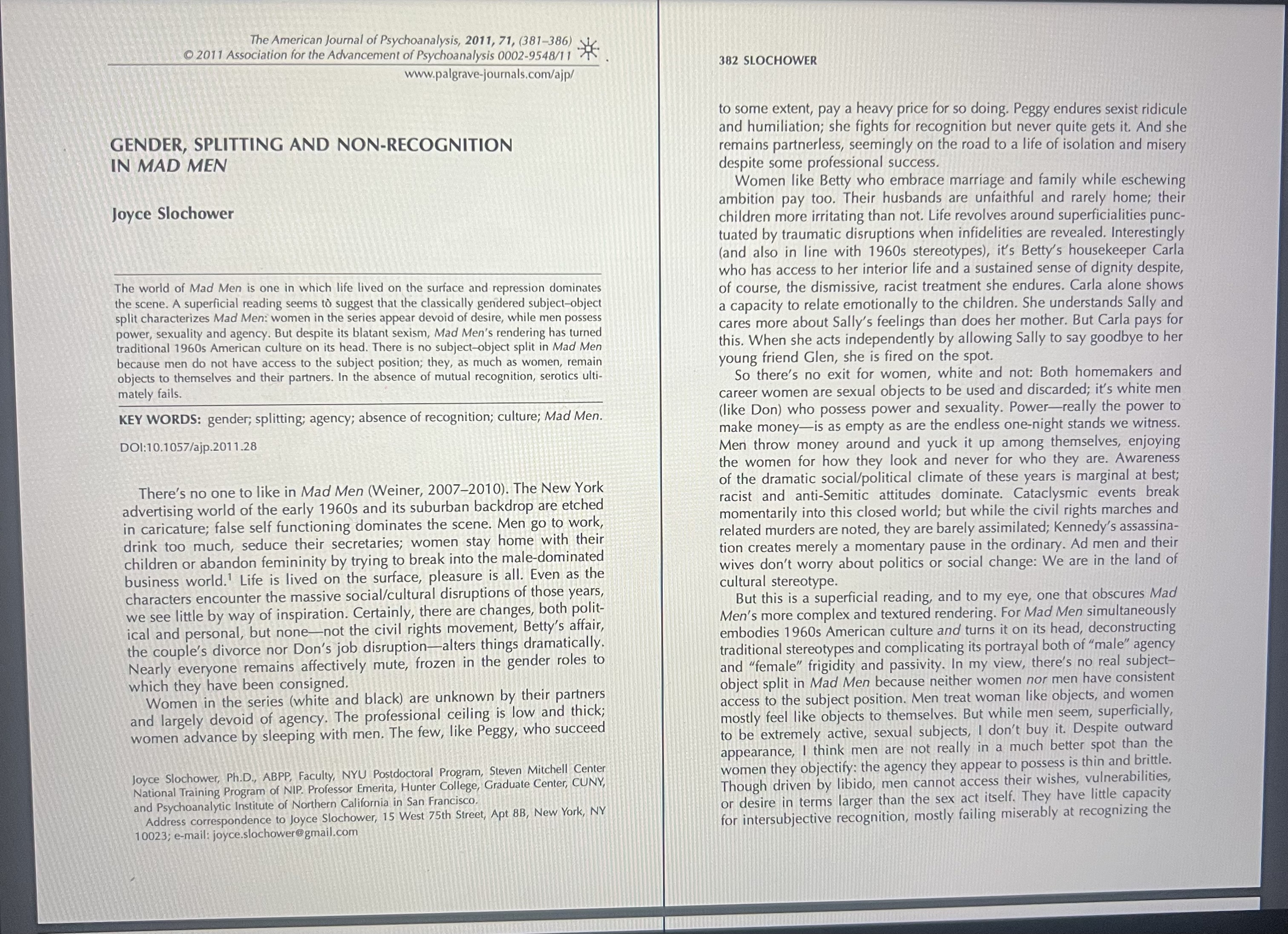
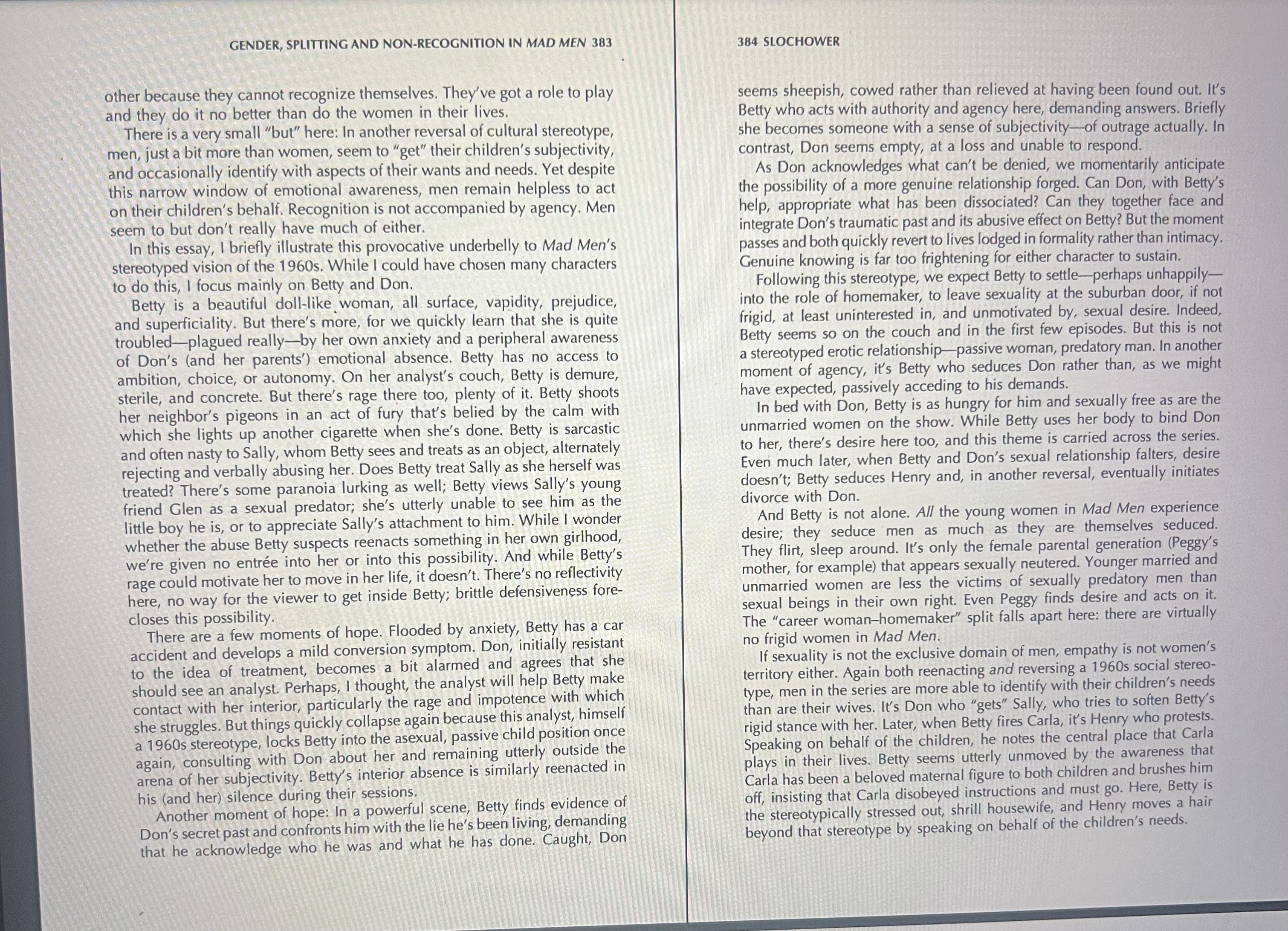
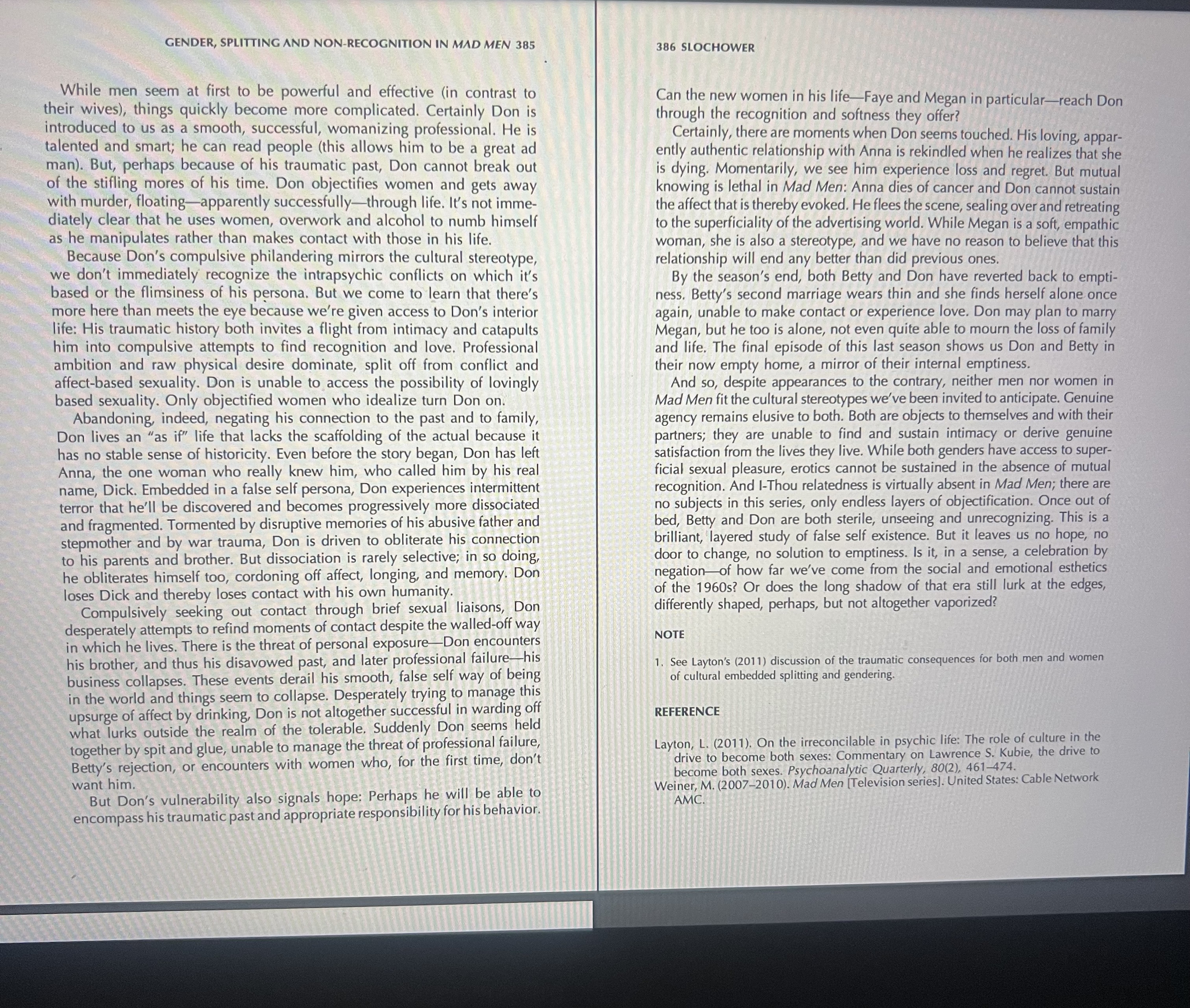
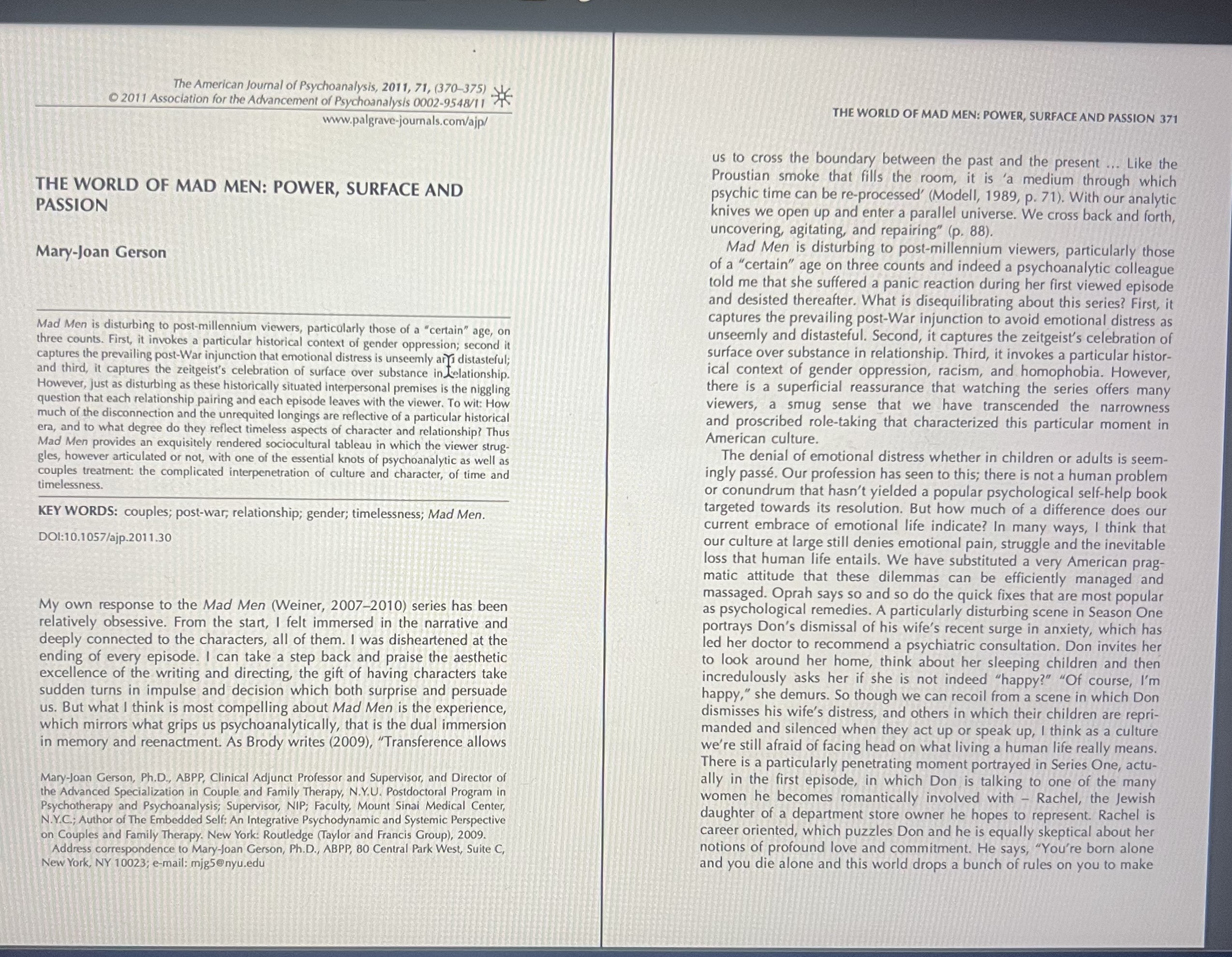
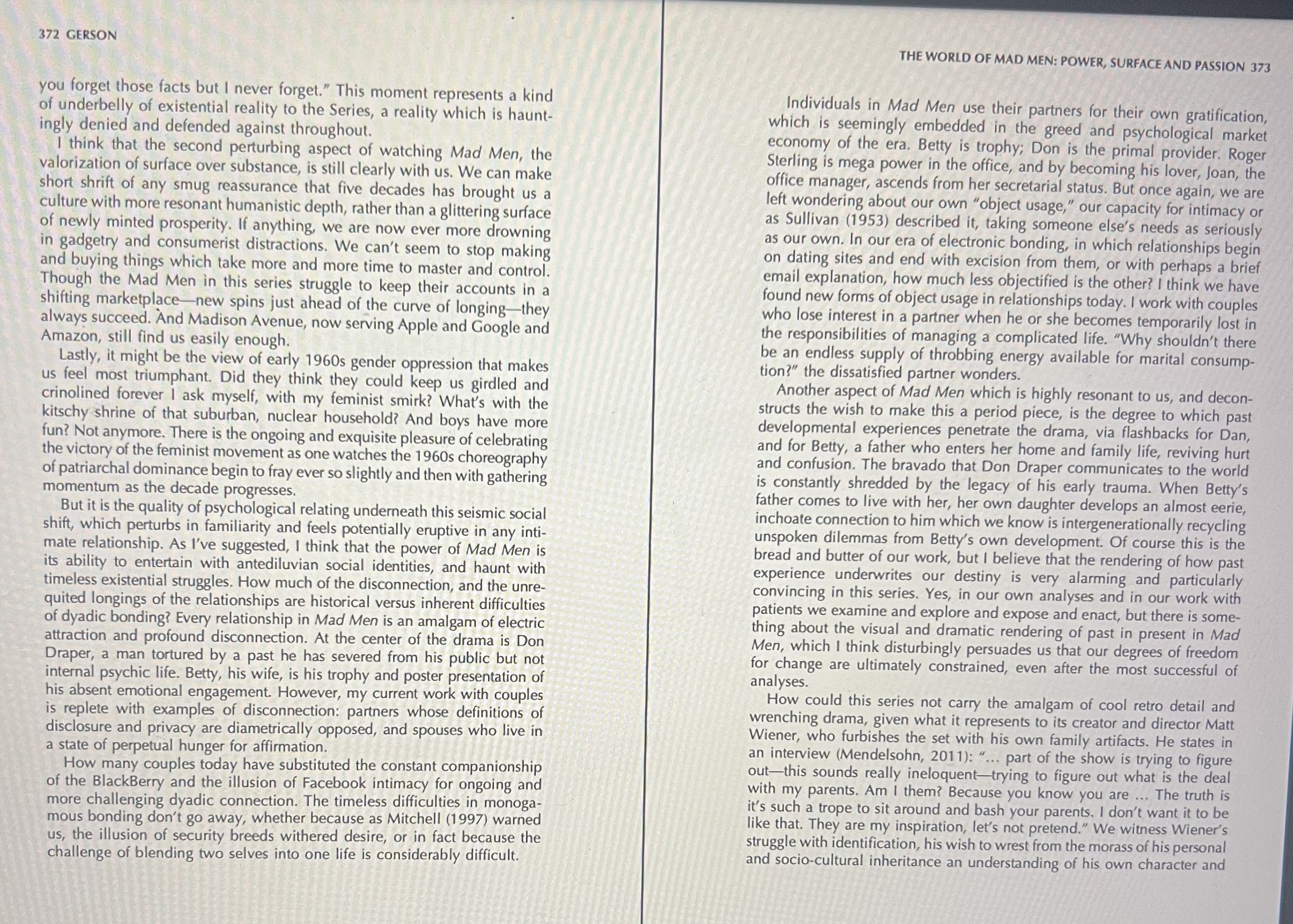
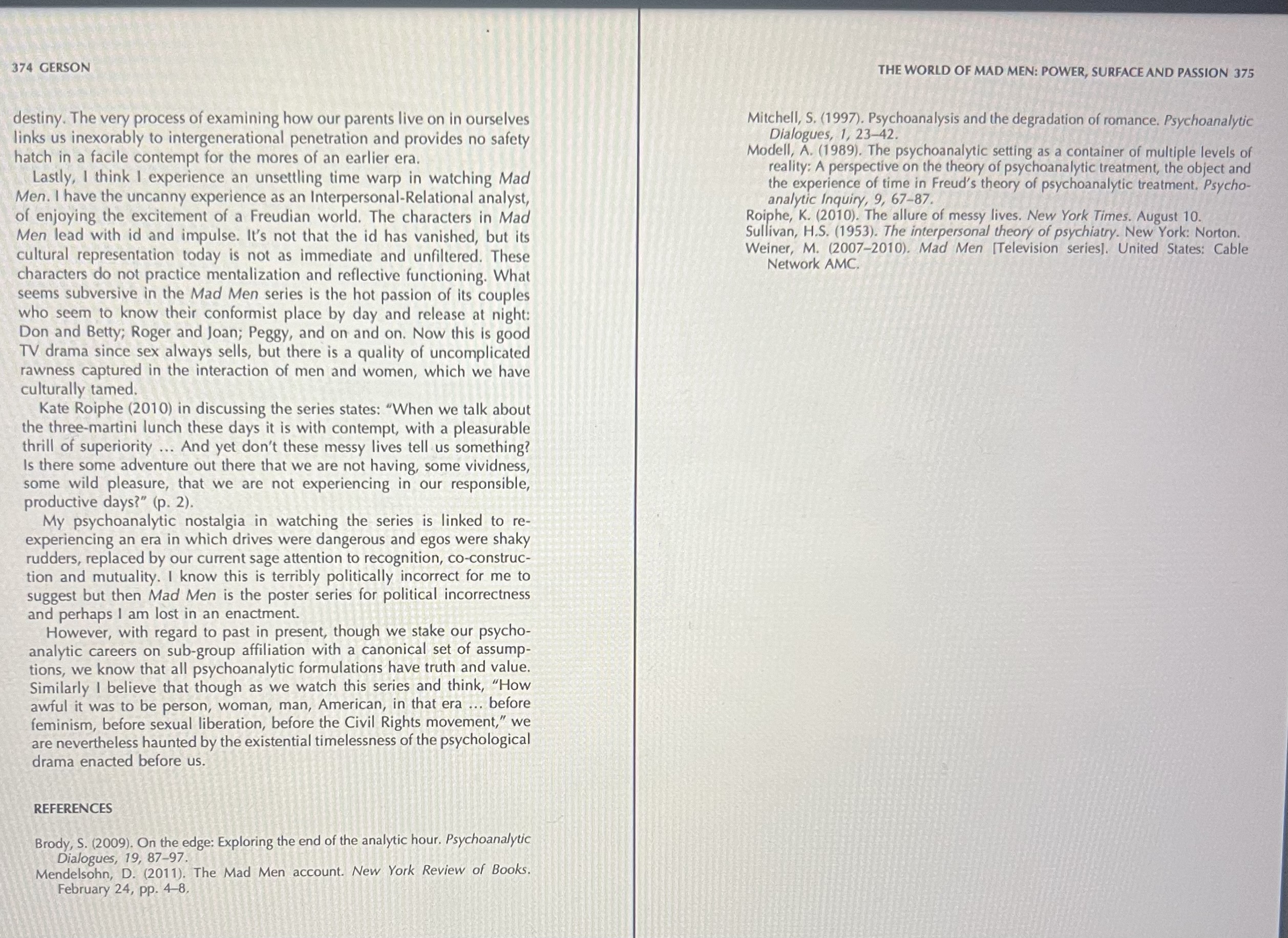
The American Journal of Psychoanalysis, 2011, 71, (381-386) 2011 Association for the Advancement of Psychoanalysis 0002-9548/1 1 www.palgrave-journals,com/ajp/ GENDER, SPLITTING AND NON-RECOGNITION IN MAD MEN Joyce Slochower The world of Mad Men is one in which life lived on the surface and repression dominates the scene. A superficial reading seems 10 suggest that the classically gendered subject-object split characterizes Mad Men: women in the series appear devoid of desire, while men possess power, sexuality and agency. But despite its blatant sexism, Mad Men's rendering has turned traditional 1960s American culture on its head. There is no subject-object split in Mad Men because men do not have access to the subject position; they, as much as women, remain objects to themselves and their partners. In the absence of mutual recognition, serotics ulti- mately fails. KEY WORDS: gender; splitting; agency; absence of recognition; culture; Mad Men. DOI:10.1057/ajp.2011.28 There's no one to like in Mad Men (Weiner, 2007-2010). The New York advertising world of the early 1960s and its suburban backdrop are etched in caricature; false self functioning dominates the scene. Men go to work, drink too much, seduce their secretaries; women stay home with their children or abandon femininity by trying to break into the male-dominated business world.! Life is lived on the surface, pleasure is all. Even as the characters encounter the massive social/cultural disruptions of those years, we see little by way of inspiration. Certainly, there are changes, both polit- ical and personal, but nonenot the civil rights movement, Betty's affair, the couple's divorce nor Don''s job disruptionalters things dramatically. Nearly everyone remains affectively mute, frozen in the gender roles to which they have been consigned. Women in the series (white and black) are unknown by their partners and largely devoid of agency. The professional ceiling is Jow and thick; women advance by sleeping with men. The few, like Peggy, who succeed Joyce Slochower, Ph.D., ABPP, Faculty, NYU Postdoctoral Program, Steven Mitchell Center National Training Program of NIP. Professor Emerita, Hunter College, Graduate Center, CUNY, and Psychoanalytic Institute of Northern California in San Francisco. Address correspondence to Joyce Slochower, 15 West 75th Street, Apt 88, New York, NY 10023; e-mail: joyce.slochower@gmail.com 382 SLOCHOWER to some extent, pay a heavy price for so doing. Peggy endures sexist ridicule and humrllat:on; she fights for recognition but never quite gets it. And she remains partnerless, seemingly on the road to a life of isolation and misery despite some professional success. Women like Betty who embrace marriage and family while eschewing ambition pay too. Their husbands are unfaithful and rarely home; their children more irritating than not. Life revolves around superficialities punc- tuated by traumatic disruptions when infidelities are revealed. Interestingly (and also in line with 1960s stereotypes), it's Betty's housekeeper Carla who has access to her interior life and a sustained sense of dignity despite, of course, the dismissive, racist treatment she endures. Carla alone shows a capacity to relate emotionally to the children. She understands Sally and cares more about Sally's feelings than does her mother. But Carla pays for this. When she acts independently by allowing Sally to say goodbye to her young friend Glen, she is fired on the spot. So there's no exit for women, white and not: Both homemakers and career women are sexual objects to be used and discarded; it's white men (like Don) who possess power and sexuality. Powerreally the power to make moneyis as empty as are the endless one-night stands we witness. Men throw money around and yuck it up among themselves, enjoying the women for how they look and never for who they are. Awareness of the dramatic social/political climate of these years is marginal at best; racist and anti-Semitic attitudes dominate. Cataclysmic events break momentarily into this closed world; but while the civil rights marches and related murders are noted, they are barely assimilated; Kennedy's assassina- tion creates merely a momentary pause in the ordinary. Ad men and their wives don't worry about politics or social change: We are in the land of cultural stereotype. But this is a superficial reading, and to my eye, one that obscures Mad Men's more complex and textured rendering. For Mad Men simultaneously embodies 1960s American culture and turns it on its head, deconstructing traditional stereotypes and complicating its portrayal both of \"male\" agency and \"female\" frigidity and passivity. In my view, there's no real subject object split in Mad Men because neither women nor men have consistent access to the subject position. Men treat woman like objects, and women mostly feel like objects to themselves. But while men seem, superficially, to be extremely active, sexual subjects, | don't buy it Despite outward appearance, | think men are not really in a much better spot than the women they objectify: the agency they appear to possess is thin and l?(itfle. Though driven by libido, men cannot access their wishes, vulnerabllmgs, or desire in terms larger than the sex act itself. They have little capacity for intersubjective recognition, mostly failing miserably at recognizing the / GENDER, SPLITTING AND NON-RECOGNITION IN MAD MEN 383 384 SLOCHOWER other because they cannot recognize themselves. They've got a role to play and they do it no better than do the women in their lives. seems sheepish, cowed rather than relieved at having been found out. It's Betty who acts with authority and agency here, demanding answers. Briefly There is a very small "but" here: In another reversal of cultural stereotype, she becomes someone with a sense of subjectivity- of outrage actually. In men, just a bit more than women, seem to "get" their children's subjectivity, contrast, Don seems empty, at a loss and unable to respond. and occasionally identify with aspects of their wants and needs. Yet despite As Don acknowledges what can't be denied, we momentarily anticipate this narrow window of emotional awareness, men remain helpless to act the possibility of a more genuine relationship forged. Can Don, with Betty's on their children's behalf. Recognition is not accompanied by agency. Men help, appropriate what has been dissociated? Can they together face and seem to but don't really have much of either. integrate Don's traumatic past and its abusive effect on Betty? But the moment In this essay, I briefly illustrate this provocative underbelly to Mad Men's passes and both quickly revert to lives lodged in formality rather than intimacy. stereotyped vision of the 1960s. While I could have chosen many characters Genuine knowing is far too frightening for either character to sustain. to do this, I focus mainly on Betty and Don. Following this stereotype, we expect Betty to settle-perhaps unhappily- Betty is a beautiful doll-like woman, all surface, vapidity, prejudice, into the role of homemaker, to leave sexuality at the suburban door, if not and superficiality. But there's more, for we quickly learn that she is quite frigid, at least uninterested in, and unmotivated by, sexual desire. Indeed, troubled-plagued really-by her own anxiety and a peripheral awareness Betty seems so on the couch and in the first few episodes. But this is not of Don's (and her parents') emotional absence. Betty has no access to a stereotyped erotic relationship-passive woman, predatory man. In another ambition, choice, or autonomy. On her analyst's couch, Betty is demure, moment of agency, it's Betty who seduces Don rather than, as we might sterile, and concrete. But there's rage there too, plenty of it. Betty shoots have expected, passively acceding to his demands. her neighbor's pigeons in an act of fury that's belied by the calm with In bed with Don, Betty is as hungry for him and sexually free as are the which she lights up another cigarette when she's done. Betty is sarcastic unmarried women on the show. While Betty uses her body to bind Don and often nasty to Sally, whom Betty sees and treats as an object, alternately to her, there's desire here too, and this theme is carried across the series. rejecting and verbally abusing her. Does Betty treat Sally as she herself was Even much later, when Betty and Don's sexual relationship falters, desire treated? There's some paranoia lurking as well; Betty views Sally's young doesn't; Betty seduces Henry and, in another reversal, eventually initiates friend Glen as a sexual predator; she's utterly unable to see him as the divorce with Don. little boy he is, or to appreciate Sally's attachment to him. While I wonder And Betty is not alone. All the young women in Mad Men experience whether the abuse Betty suspects reenacts something in her own girlhood, desire; they seduce men as much as they are themselves seduced. we're given no entree into her or into this possibility. And while Betty's They flirt, sleep around. It's only the female parental generation (Peggy's rage could motivate her to move in her life, it doesn't. There's no reflectivity mother, for example) that appears sexually neutered. Younger married and here, no way for the viewer to get inside Betty; brittle defensiveness fore- unmarried women are less the victims of sexually predatory men than closes this possibility. sexual beings in their own right. Even Peggy finds desire and acts on it. There are a few moments of hope. Flooded by anxiety, Betty has a car The "career woman-homemaker" split falls apart here: there are virtually accident and develops a mild conversion symptom. Don, initially resistant no frigid women in Mad Men. to the idea of treatment, becomes a bit alarmed and agrees that she If sexuality is not the exclusive domain of men, empathy is not women's should see an analyst. Perhaps, I thought, the analyst will help Betty make territory either. Again both reenacting and reversing a 1960s social stereo- contact with her interior, particularly the rage and impotence with which type, men in the series are more able to identify with their children's needs she struggles. But things quickly collapse again because this analyst, himself than are their wives. It's Don who "gets" Sally, who tries to soften Betty's a 1960s stereotype, locks Betty into the asexual, passive child position once rigid stance with her. Later, when Betty fires Carla, it's Henry who protests. again, consulting with Don about her and remaining utterly outside the Speaking on behalf of the children, he notes the central place that Carla arena of her subjectivity. Betty's interior absence is similarly reenacted in plays in their lives. Betty seems utterly unmoved by the awareness that his (and her) silence during their sessions. Carla has been a beloved maternal figure to both children and brushes him Another moment of hope: In a powerful scene, Betty finds evidence of off, insisting that Carla disobeyed instructions and must go. Here, Betty is Don's secret past and confronts him with the lie he's been living, demanding the stereotypically stressed out, shrill housewife, and Henry moves a hair that he acknowledge who he was and what he has done. Caught, Don beyond that stereotype by speaking on behalf of the children's needs.GENDER, SPLITTING AND NON-RECOGNITION IN MAD MEN 385 \\(Vhil_e men seem at first to be powerful and effective (in contrast to t.helr wives), things quickly become more complicated. Certainly Don is introduced to us as a smooth, successful, womanizing professional. He is talented and smart; he can read people (this allows him to be a great ad man). BL!t, perhaps because of his traumatic past, Don cannot break out of. the stifling mores of his time. Don objectifies women and gets away with murder, floatingapparently successfullythrough life. It's not imme- diately clear that he uses women, overwork and alcohol to numb himself as he manipulates rather than makes contact with those in his life. Because Don's compulsive philandering mirrors the cultural stereotype, we don't immediately recognize the intrapsychic conflicts on which it's based or the flimsiness of his persona. But we come to learn that there's more here than meets the eye because we're given access to Don's interior life: His traumatic history both invites a flight from intimacy and catapults him into compulsive attempts to find recognition and love. Professional ambition and raw physical desire dominate, split off from conflict and affect-based sexuality. Don is unable to access the possibility of lovingly based sexuality. Only objectified women who idealize turn Don on. Abandoning, indeed, negating his connection to the past and to family, Don lives an \"as if\" life that lacks the scaffolding of the actual because it has no stable sense of historicity. Even before the story began, Don has left Anna, the one woman who really knew him, who called him by his real name, Dick. Embedded in a false self persona, Don experiences intermittent terror that he'll be discovered and becomes progressively more dissociated and fragmented. Tormented by disruptive memories of his abusive father and stepmother and by war trauma, Don is driven to obliterate his connection to his parents and brother. But dissociation is rarely selective; in so doing, he obliterates himself too, cordoning off affect, longing, and memory. Don loses Dick and thereby loses contact with his own humanity. Compulsively seeking out contact through brief sexual liaisons, Don desperately attempts to refind moments of contact despite the walled-off way in which he lives. There is the threat of personal exposureDon encounters his brother, and thus his disavowed past, and later professional failurehis business collapses. These events derail his smooth, false self way of bein.g in the world and things seem to collapse. Desperately trying to manage this upsurge of affect by drinking, Don is not altogether successful in warding off what lurks outside the realm of the tolerable. Suddenly Don seems held together by spit and glue, unable to manage the threat of profc?ssiorla! failurtf, Betty's rejection, or encounters with women who, for the first time, don't want him. But Don's vulnerability also signals hope: Perhaps he will.be able_ to encompass his traumatic past and appropriate responsibility for his behavior. 386 SLOCHOWER Can the new women in his lifeFaye and Megan in particularreach Don through the recognition and softness they offer? Certainly, l_here are mo'menfs when Don seems touched. His loving, appar- fen(ly'aulhentlc relat!onshlp with Anna is rekindled when he realizes that she is dy|{1g. Momentgrlly, we see him experience loss and regret. But mutual knowing is Iet'hal in Mad Men: Anna dies of cancer and Don cannot sustain the affect thatis thereby evoked. He flees the scene, sealing overand retreating to the superficiality of the advertising world. While Megan is a soft, empathic woman, she is also a stereotype, and we have no reason to believe that this relationship will end any better than did previous ones, By the season's end, both Betty and Don have reverted back to empti- ness. Betty's second marriage wears thin and she finds herself alone once again, unable to make contact or experience love. Don may plan to marry Megan, but he too is alone, not even quite able to mourn the loss of family and life. The final episode of this last season shows us Don and Betty in their now empty home, a mirror of their internal emptiness. And so, despite appearances to the contrary, neither men nor women in Mad Men fit the cultural stereotypes we've been invited to anticipate. Genuine agency remains elusive to both. Both are objects to themselves and with their partners; they are unable to find and sustain intimacy or derive genuine satisfaction from the lives they live. While both genders have access to super- ficial sexual pleasure, erotics cannot be sustained in the absence of mutual recognition. And I-Thou relatedness is virtually absent in Mad Men; there are no subjects in this series, only endless layers of objectification. Once out of bed, Betty and Don are both sterile, unseeing and unrecognizing. This is a brilliant, 'layered study of false self existence. But it leaves us no hope, no door to change, no solution to emptiness. Is it, in a sense, a celebration by negationof how far we've come from the social and emotional esthetics of the 1960s? Or does the long shadow of that era still lurk at the edges, differently shaped, perhaps, but not altogether vaporized? NOTE 1. See Layton's (2011) discussion of the traumatic consequences for both men and women of cultural embedded splitting and gendering. REFERENCE Layton, L. (2011). On the irreconcilable in psychic life: The role of culture in the drive to become both sexes: Commentary on Lawrence S. Kubie, the drive to become both sexes. Psychoanalytic Quarterly, 80(2), 461-474. Weiner, M. (2007-2010). Mad Men [Television series]. United States: Cable Network AMC. The American Journal of Psychoanalysis, 2011, 71, (370-375) 20171 Association for the Advancement of Ps ychoanalysis 0002-9548/11 www.palgrave-journals.com/ajp/ THE WORLD OF MAD MEN: POWER, SURFACE AND PASSION Mary-Joan Gerson Mad Men is disturbing to post-millennium viewers, partictlarly those of a \"certain\" age, on three counts. First, it invokes a particular historical context of gender oppression; second it captures the prevailing post-War injunction that emotional distress is unseemly afi distasteful; and third, it captures the zeitgeist's celebration of surface over substance inXelationship. However, just as disturbing as these historically situated Interpersonal premises Is the niggling question that each relationship pairing and each episode leaves with the viewer, To wit: How much of the disconnection and the unrequited longings are reflective of a particular historical era, and to what degree do they reflect timeless aspects of character and relationship? Thus Mad Men provides an exquisitely rendered sociocultural tableau in which the viewer strug- gles, however articulated or not, with one of the essential knots of psychoanalytic as well as couples treatment: the complicated interpenetration of culture and character, of time and timelessness. KEY WORDS: couples; post-war; relationship; gender; timelessness; Mad Men. DOI:10.1057/ajp.2011.30 My own response to the Mad Men (Weiner, 2007-2010) series has been relatively obsessive. From the start, | felt immersed in the narrative and deeply connected to the characters, all of them. | was disheartened at the ending of every episode. | can take a step back and praise the aesthetic excellence of the writing and directing, the gift of having characters take sudden turns in impulse and decision which both surprise and persuade us. But what I think is most compelling about Mad Men is the experience, which mirrors what grips us psychoanalytically, that is the dual immersion in memory and reenactment. As Brody writes (2009), \"Transference allows Mary-Joan Gerson, Ph.D., ABPP, Clinical Adjunct Professor and Supervisor, and Director of the Advanced Specialization in Couple and Family Therapy, N.Y.U. Postdoctoral Program in Psychotherapy and Psychoanalysis; Supervisor, NIP; Faculty, Mount Sinai Medical Center, N.Y.C.; Author of The Embedded Self: An Integrative Psychodynamic and Systemic Perspective on Couples and Family Therapy. New York: Routledge (Taylor and Francis Group), 2009. Address correspondence to Mary-Joan Gerson, Ph.D., ABPP, 80 Central Park West, Suite C, New York, NY 10023; e-mail: mjg5@nyu.edu THE WORLD OF MAD MEN: POWER, SURFACE AND PASSION 37 us to cross the boundary between the past and the present ... Like the Proustian smoke that fills the room, it is 'a medium through which psychic time can be re-processed\" (Modell, 1989, p. 71). With our analytic knives we open up and enter a parallel universe. We cross back and forth, uncovering, agitating, and repairing\" (p. 88). Mad Men is disturbing to post-millennium viewers, particularly those of a \"certain\" age on three counts and indeed a psychoanalytic colleague told me that she suffered a panic reaction during her first viewed episode and desisted thereafter. What is disequilibrating about this series? First, it captures the prevailing post-War injunction to avoid emotional distress as unseemly and distasteful. Second, it captures the zeitgeist's celebration of: surface over substance in relationship. Third, it invokes a particular histor- ical context of gender oppression, racism, and homophobia. However, there is a superficial reassurance that watching the series offers many viewers, a smug sense that we have transcended the narrowness and proscribed role-taking that characterized this particular moment in American culture. The denial of emotional distress whether in children or adults is seem- ingly pass. Our profession has seen to this; there is not a human problem or conundrum that hasn't yielded a popular psychological self-help book targeted towards its resolution. But how much of a difference does our current embrace of emotional life indicate? In many ways, | think that our culture at large still denies emotional pain, struggle and the inevitable loss that human life entails. We have substituted a very American prag- matic attitude that these dilemmas can be efficiently managed and massaged. Oprah says so and so do the quick fixes that are most popular as psychological remedies. A particularly disturbing scene in Season One portrays Don's dismissal of his wife's recent surge in anxiety, which has led her doctor to recommend a psychiatric consultation. Don invites her to look around her home, think about her sleeping children and then incredulously asks her if she is not indeed \"happy?\" \"Of course, I'm happy,\" she demurs. So though we can recoil from a scene in which Don dismisses his wife's distress, and others in which their children are repri- manded and silenced when they act up or speak up, | think as a culture we're still afraid of facing head on what living a human life really means. There is a particularly penetrating moment portrayed in Series One, actu- ally in the first episode, in which Don is talking to one of the many women he becomes romantically involved with Rachel, the Jewish daughter of a department store owner he hopes to represent. Rachel is career oriented, which puzzles Don and he is equally skeptical about her notions of profound love and commitment. He says, \"You're born alone and you die alone and this world drops a bunch of rules on you to make 372 GERSON THE WORLD OF MAD MEN: POWER, SURFACE AND PASSION 373 you forget those facts but I never forget." This moment represents a kind Individuals in Mad Men use their partners for their own gratification, of underbelly of existential reality to the Series, a reality which is haunt- which is seemingly embedded in the greed and psychological market ingly denied and defended against throughout. economy of the era. Betty is trophy; Don is the primal provider. Roger I think that the second perturbing aspect of watching Mad Men, the Sterling is mega power in the office, and by becoming his lover, Joan, the valorization of surface over substance, is still clearly with us. We can make office manager, ascends from her secretarial status. But once again, we are short shrift of any smug reassurance that five decades has brought us a left wondering about our own "object usage," our capacity for intimacy or culture with more resonant humanistic depth, rather than a glittering surface as Sullivan (1953) described it, taking someone else's needs as seriously of newly minted prosperity. If anything, we are now ever more drowning as our own. In our era of electronic bonding, in which relationships begin in gadgetry and consumerist distractions. We can't seem to stop making on dating sites and end with excision from them, or with perhaps a brief and buying things which take more and more time to master and control. email explanation, how much less objectified is the other? I think we have Though the Mad Men in this series struggle to keep their accounts in a found new forms of object usage in relationships today. I work with couples shifting marketplace-new spins just ahead of the curve of longing they who lose interest in a partner when he or she becomes temporarily lost in always succeed. And Madison Avenue, now serving Apple and Google and the responsibilities of managing a complicated life. "Why shouldn't there Amazon, still find us easily enough. be an endless supply of throbbing energy available for marital consump- Lastly, it might be the view of early 1960s gender oppression that makes tion?" the dissatisfied partner wonders. us feel most triumphant. Did they think they could keep us girdled and Another aspect of Mad Men which is highly resonant to us, and decon- crinolined forever I ask myself, with my feminist smirk? What's with the structs the wish to make this a period piece, is the degree to which past kitschy shrine of that suburban, nuclear household? And boys have more developmental experiences penetrate the drama, via flashbacks for Dan, fun? Not anymore. There is the ongoing and exquisite pleasure of celebrating and for Betty, a father who enters her home and family life, reviving hurt the victory of the feminist movement as one watches the 1960s choreography and confusion. The bravado that Don Draper communicates to the world of patriarchal dominance begin to fray ever so slightly and then with gathering is constantly shredded by the legacy of his early trauma. When Betty's momentum as the decade progresses. father comes to live with her, her own daughter develops an almost eerie, But it is the quality of psychological relating underneath this seismic social inchoate connection to him which we know is intergenerationally recycling shift, which perturbs in familiarity and feels potentially eruptive in any inti- unspoken dilemmas from Betty's own development. Of course this is the mate relationship. As I've suggested, I think that the power of Mad Men is bread and butter of our work, but I believe that the rendering of how past its ability to entertain with antediluvian social identities, and haunt with experience underwrites our destiny is very alarming and particularly timeless existential struggles. How much of the disconnection, and the unre- convincing in this series. Yes, in our own analyses and in our work with quited longings of the relationships are historical versus inherent difficulties patients we examine and explore and expose and enact, but there is some- of dyadic bonding? Every relationship in Mad Men is an amalgam of electric thing about the visual and dramatic rendering of past in present in Mad attraction and profound disconnection. At the center of the drama is Don Men, which I think disturbingly persuades us that our degrees of freedom Draper, a man tortured by a past he has severed from his public but not for change are ultimately constrained, even after the most successful of internal psychic life. Betty, his wife, is his trophy and poster presentation of analyses. his absent emotional engagement. However, my current work with couples How could this series not carry the amalgam of cool retro detail and is replete with examples of disconnection: partners whose definitions of wrenching drama, given what it represents to its creator and director Matt disclosure and privacy are diametrically opposed, and spouses who live in Wiener, who furbishes the set with his own family artifacts. He states in a state of perpetual hunger for affirmation. an interview (Mendelsohn, 2011): "... part of the show is trying to figure How many couples today have substituted the constant companionship out-this sounds really ineloquent-trying to figure out what is the deal of the BlackBerry and the illusion of Facebook intimacy for ongoing and with my parents. Am I them? Because you know you are ... The truth is more challenging dyadic connection. The timeless difficulties in monoga- it's such a trope to sit around and bash your parents. I don't want it to be mous bonding don't go away, whether because as Mitchell (1997) warned like that. They are my inspiration, let's not pretend." We witness Wiener's us, the illusion of security breeds withered desire, or in fact because the struggle with identification, his wish to wrest from the morass of his personal challenge of blending two selves into one life is considerably difficult. and socio-cultural inheritance an understanding of his own character and374 GERSON THE WORLD OF MAD MEN: POWER, SURFACE AND PASSION 375 destiny. The very process of examining how our parents live on in ourselves Mitchell, S. (1997). Psychoanalysis and the degradation of romance. Psychoanalytic links us inexorably to intergenerational penetration and provides no safety Dialogues, 1, 23-42. hatch in a facile contempt for the mores of an earlier era. Modell, A. (1989). The psychoanalytic setting as a container of multiple levels of Lastly, I think I experience an unsettling time warp in watching Mad reality: A perspective on the theory of psychoanalytic treatment, the object and the experience of time in Freud's theory of psychoanalytic treatment. Psycho- Men. I have the uncanny experience as an Interpersonal-Relational analyst, analytic Inquiry, 9, 67-87. of enjoying the excitement of a Freudian world. The characters in Mad Roiphe, K. (2010). The allure of messy lives. New York Times. August 10. Men lead with id and impulse. It's not that the id has vanished, but its Sullivan, H.S. (1953). The interpersonal theory of psychiatry. New York: Norton. cultural representation today is not as immediate and unfiltered. These Weiner, M. (2007-2010). Mad Men [Television series]. United States: Cable Network AMC. characters do not practice mentalization and reflective functioning. What seems subversive in the Mad Men series is the hot passion of its couples who seem to know their conformist place by day and release at night: Don and Betty; Roger and Joan; Peggy, and on and on. Now this is good TV drama since sex always sells, but there is a quality of uncomplicated rawness captured in the interaction of men and women, which we have culturally tamed. Kate Roiphe (2010) in discussing the series states: "When we talk about the three-martini lunch these days it is with contempt, with a pleasurable thrill of superiority ... And yet don't these messy lives tell us something? Is there some adventure out there that we are not having, some vividness, some wild pleasure, that we are not experiencing in our responsible, productive days?" (p. 2). My psychoanalytic nostalgia in watching the series is linked to re- experiencing an era in which drives were dangerous and egos were shaky rudders, replaced by our current sage attention to recognition, co-construct tion and mutuality. I know this is terribly politically incorrect for me to suggest but then Mad Men is the poster series for political incorrectness and perhaps I am lost in an enactment. However, with regard to past in present, though we stake our psycho- analytic careers on sub-group affiliation with a canonical set of assump tions, we know that all psychoanalytic formulations have truth and value. Similarly I believe that though as we watch this series and think, "How awful it was to be person, woman, man, American, in that era ... before feminism, before sexual liberation, before the Civil Rights movement," we are nevertheless haunted by the existential timelessness of the psychological drama enacted before us. REFERENCES Brody, S. (2009). On the edge: Exploring the end of the analytic hour. Psychoanalytic Dialogues, 19, 87-97. Mendelsohn, D. (2011). The Mad Men account. New York Review of Books. February 24, pp. 4 8
Step by Step Solution
There are 3 Steps involved in it
1 Expert Approved Answer
Step: 1 Unlock
Question Has Been Solved by an Expert!
Get step-by-step solutions from verified subject matter experts
Step: 2 Unlock
Step: 3 Unlock
Students Have Also Explored These Related Business Writing Questions!









 Study Help