







Question: Help me do this live case study For Domino's pizza Company LIVE CASE STUDY III. Stockholder Analysis Objective: To identify the average and marginal investors
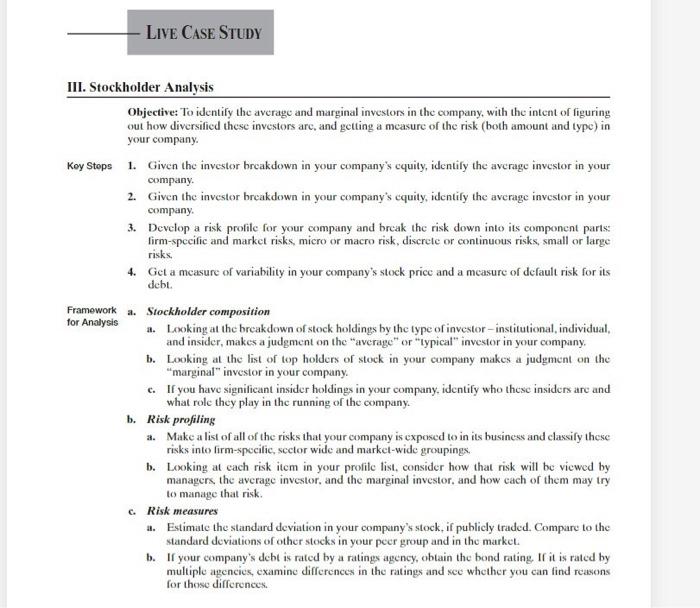
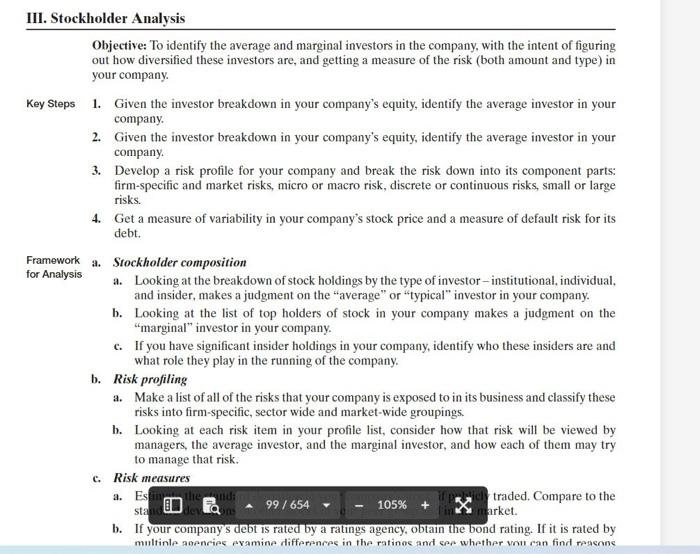
LIVE CASE STUDY III. Stockholder Analysis Objective: To identify the average and marginal investors in the company, with the intent of figuring out how diversified these investors arc, and getting a mcasure of the risk (both amount and type) in your company. Koy Steps 1. Given the investor breakdown in your company's equity, identify the average investor in your company 2. Given the investor breakdown in your company's equity, identify the average investor in your company 3. Develop a risk profile for your company and break the risk down into its component parts: firm-specific and market risks, micro or macro risk, discrete or continuous risks, small or large risks. 4. Get a measure of variability in your company's stock price and a measure of default risk for its debl. Framework a. Stockholder composition for Analysis a. Looking at the breakdown of stock holdings by the type of investor-institutional individual, and insider, makes a judgment on the "average" or "lypical investor in your company, b. Looking at the list of top holders of stock in your company makes a judgment on the "marginal" investor in your company. c. If you have significant insider holdings in your company, identify who these insiders are and what role they play in the running of the company. b. Risk profiling a. Make a list of all of the risks that your company is exposed to in its business and classify these risks into firm-specilic sector wide and market-wide groupings, b. Looking at cach risk itcm in your profile list, consider how that risk will be viewed by managers, the average investor, and the marginal investor, and how cach of them may try to manage that risk 6. Risk measures a. Estimate the standard deviation in your company's stock, if publicly traded. Compare to the standard deviations of other stocks in your peer group and in the market. b. If your company's debt is rated by a ratings agency, obtain the bond rating If it is rated by multiple agencies, examine differences in the ratings and see whether you can find reasons for those differences III. Stockholder Analysis Objective: To identify the average and marginal investors in the company, with the intent of figuring out how diversified these investors are, and getting a measure of the risk (both amount and type) in your company. Key Steps 1. Given the investor breakdown in your company's equity, identify the average investor in your company. 2. Given the investor breakdown in your company's equity, identify the average investor in your company. 3. Develop a risk profile for your company and break the risk down into its component parts: firm-specific and market risks, micro or macro risk, discrete or continuous risks, small or large risks. 4. Get a measure of variability in your company's stock price and a measure of default risk for its debt. Framework a. Stockholder composition for Analysis a. Looking at the breakdown of stock holdings by the type of investor-institutional, individual. and insider, makes a judgment on the average" or "typical" investor in your company. b. Looking at the list of top holders of stock in your company makes a judgment on the marginal" investor in your company. c. If you have significant insider holdings in your company, identify who these insiders are and what role they play in the running of the company. b. Risk profiling a. Make a list of all of the risks that your company is exposed to in its business and classify these risks into firm-specific, sector wide and market-wide groupings. b. Looking at each risk item in your profile list, consider how that risk will be viewed by managers, the average investor, and the marginal investor, and how each of them may try to manage that risk. C. Risk measures a. Estate traded. Compare to the sta 99 / 654 b. If your company's debt is rated by a ratings agency, obtain the bond rating. If it is rated by multinle agencies avamine differences in the ratings and spe whether you can find reasons 105% + Xarket. LIVE CASE STUDY III. Stockholder Analysis Objective: To identify the average and marginal investors in the company, with the intent of figuring out how diversified these investors arc, and getting a mcasure of the risk (both amount and type) in your company. Koy Steps 1. Given the investor breakdown in your company's equity, identify the average investor in your company 2. Given the investor breakdown in your company's equity, identify the average investor in your company 3. Develop a risk profile for your company and break the risk down into its component parts: firm-specific and market risks, micro or macro risk, discrete or continuous risks, small or large risks. 4. Get a measure of variability in your company's stock price and a measure of default risk for its debl. Framework a. Stockholder composition for Analysis a. Looking at the breakdown of stock holdings by the type of investor-institutional individual, and insider, makes a judgment on the "average" or "lypical investor in your company, b. Looking at the list of top holders of stock in your company makes a judgment on the "marginal" investor in your company. c. If you have significant insider holdings in your company, identify who these insiders are and what role they play in the running of the company. b. Risk profiling a. Make a list of all of the risks that your company is exposed to in its business and classify these risks into firm-specilic sector wide and market-wide groupings, b. Looking at cach risk itcm in your profile list, consider how that risk will be viewed by managers, the average investor, and the marginal investor, and how cach of them may try to manage that risk 6. Risk measures a. Estimate the standard deviation in your company's stock, if publicly traded. Compare to the standard deviations of other stocks in your peer group and in the market. b. If your company's debt is rated by a ratings agency, obtain the bond rating If it is rated by multiple agencies, examine differences in the ratings and see whether you can find reasons for those differences III. Stockholder Analysis Objective: To identify the average and marginal investors in the company, with the intent of figuring out how diversified these investors are, and getting a measure of the risk (both amount and type) in your company. Key Steps 1. Given the investor breakdown in your company's equity, identify the average investor in your company. 2. Given the investor breakdown in your company's equity, identify the average investor in your company. 3. Develop a risk profile for your company and break the risk down into its component parts: firm-specific and market risks, micro or macro risk, discrete or continuous risks, small or large risks. 4. Get a measure of variability in your company's stock price and a measure of default risk for its debt. Framework a. Stockholder composition for Analysis a. Looking at the breakdown of stock holdings by the type of investor-institutional, individual. and insider, makes a judgment on the average" or "typical" investor in your company. b. Looking at the list of top holders of stock in your company makes a judgment on the marginal" investor in your company. c. If you have significant insider holdings in your company, identify who these insiders are and what role they play in the running of the company. b. Risk profiling a. Make a list of all of the risks that your company is exposed to in its business and classify these risks into firm-specific, sector wide and market-wide groupings. b. Looking at each risk item in your profile list, consider how that risk will be viewed by managers, the average investor, and the marginal investor, and how each of them may try to manage that risk. C. Risk measures a. Estate traded. Compare to the sta 99 / 654 b. If your company's debt is rated by a ratings agency, obtain the bond rating. If it is rated by multinle agencies avamine differences in the ratings and spe whether you can find reasons 105% + Xarket
Step by Step Solution
There are 3 Steps involved in it

Get step-by-step solutions from verified subject matter experts
 Study Help