Question: Help me in solving these questions. 1 Technical analysis is the study of chart patterns of various asset prices. Explain whether this can be used

Help me in solving these questions.
Help me in solving these questions. 1 TechnicalHelp me in solving these questions. 1 Technical
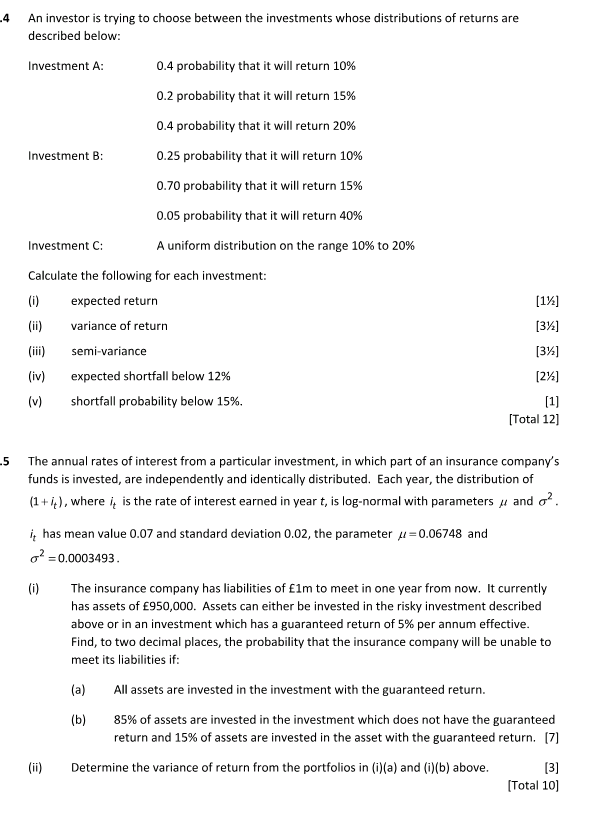
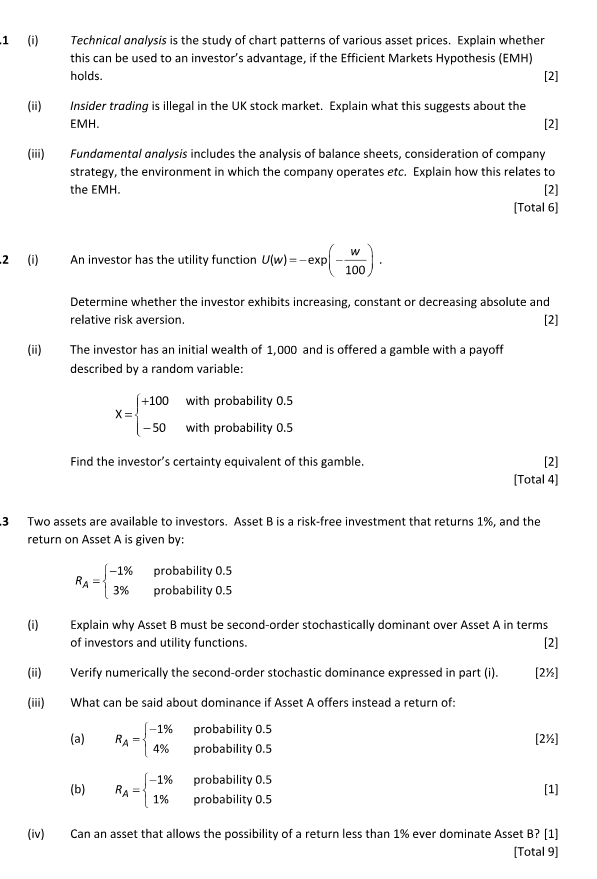
1 Technical analysis is the study of chart patterns of various asset prices. Explain whether this can be used to an investor's advantage, if the Efficient Markets Hypothesis (EMH) holds. [2] (ii) Insider trading is illegal in the UK stock market. Explain what this suggests about the EMH. [2] (Wi) Fundamental analysis includes the analysis of balance sheets, consideration of company strategy, the environment in which the company operates etc. Explain how this relates to the EMH. [2] [Total 6] 2 (0) W An investor has the utility function U(w) =-exp 100 Determine whether the investor exhibits increasing, constant or decreasing absolute and relative risk aversion. [2] (ii) The investor has an initial wealth of 1,000 and is offered a gamble with a payoff described by a random variable: +100 with probability 0.5 X = -50 with probability 0.5 Find the investor's certainty equivalent of this gamble. [2] [Total 4] .3 Two assets are available to investors. Asset B is a risk-free investment that returns 1%, and the return on Asset A is given by: [-1% probability 0.5 RA 3% probability 0.5 Explain why Asset B must be second-order stochastically dominant over Asset A in terms of investors and utility functions. [2] (ii) Verify numerically the second-order stochastic dominance expressed in part (i). [2%2] (mii) What can be said about dominance if Asset A offers instead a return of: -1% (a) probability 0.5 RA = [2%2] 4% probability 0.5 -1% probability 0.5 (b) RA [1] 1% probability 0.5 (iv) Can an asset that allows the possibility of a return less than 1% ever dominate Asset B? [1] [Total 9]An investor is trying to choose between the investments whose distributions of returns are described below: Investment A: 0.4 probability that it will return 10% 0.2 probability that it will return 15% 0.4 probability that it will return 20% Investment B: 0.25 probability that it will return 10% 0.70 probability that it will return 15% 0.05 probability that it will return 40% Investment C: A uniform distribution on the range 10% to 20% Calculate the following for each investment: (1) expected return [174] (ii) variance of return [3%] (iii) semi-variance [374] (N) expected shortfall below 12% [274] (v) shortfall probability below 15%. [1] [Total 12] 5 The annual rates of interest from a particular investment, in which part of an insurance company's funds is invested, are independently and identically distributed. Each year, the distribution of (1+ it), where it is the rate of interest earned in year t, is log-normal with parameters , and of. it has mean value 0.07 and standard deviation 0.02, the parameter / =0.06748 and of =0.0003493. (i) The insurance company has liabilities of Elm to meet in one year from now. It currently has assets of $950,000. Assets can either be invested in the risky investment described above or in an investment which has a guaranteed return of 5% per annum effective. Find, to two decimal places, the probability that the insurance company will be unable to meet its liabilities if: (a) All assets are invested in the investment with the guaranteed return. (b) 85% of assets are invested in the investment which does not have the guaranteed return and 15% of assets are invested in the asset with the guaranteed return. [7] (ii) Determine the variance of return from the portfolios in (i)(a) and (i)(b) above. [3] [Total 10]

Step by Step Solution

There are 3 Steps involved in it

1 Expert Approved Answer
Step: 1 Unlock blur-text-image

Question Has Been Solved by an Expert!

Get step-by-step solutions from verified subject matter experts

Step: 2 Unlock
Step: 3 Unlock

Students Have Also Explored These Related Accounting Questions!