







Question: Help me make a strategic plan on the case attached below. Star Appliance Company (B): January 1985 In 1932 Star Appliance expanded its business by
Help me make a strategic plan on the case attached below.
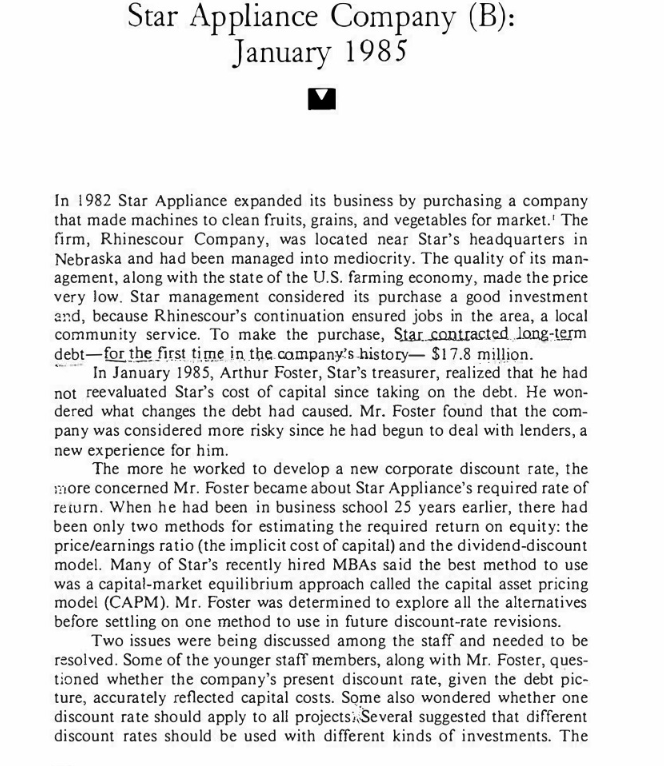
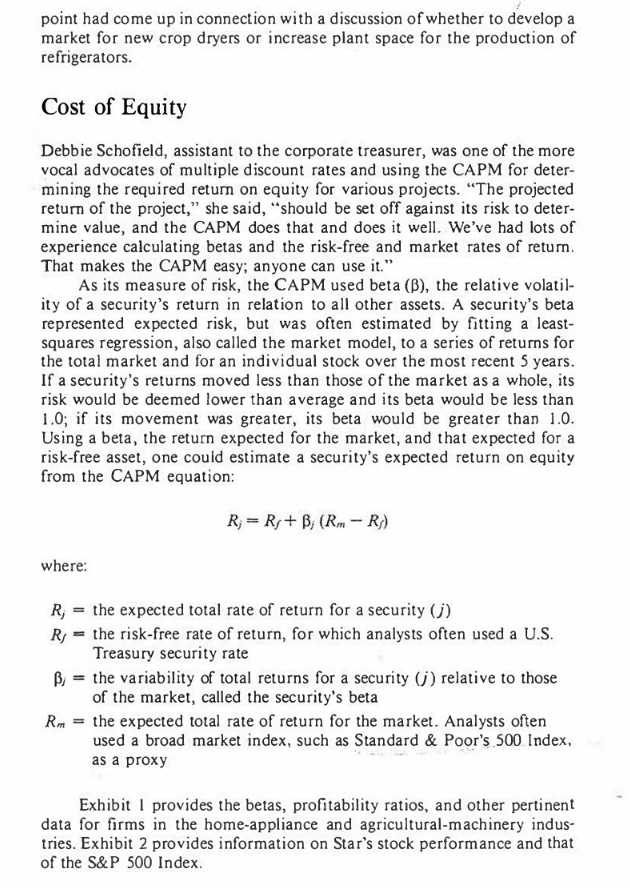
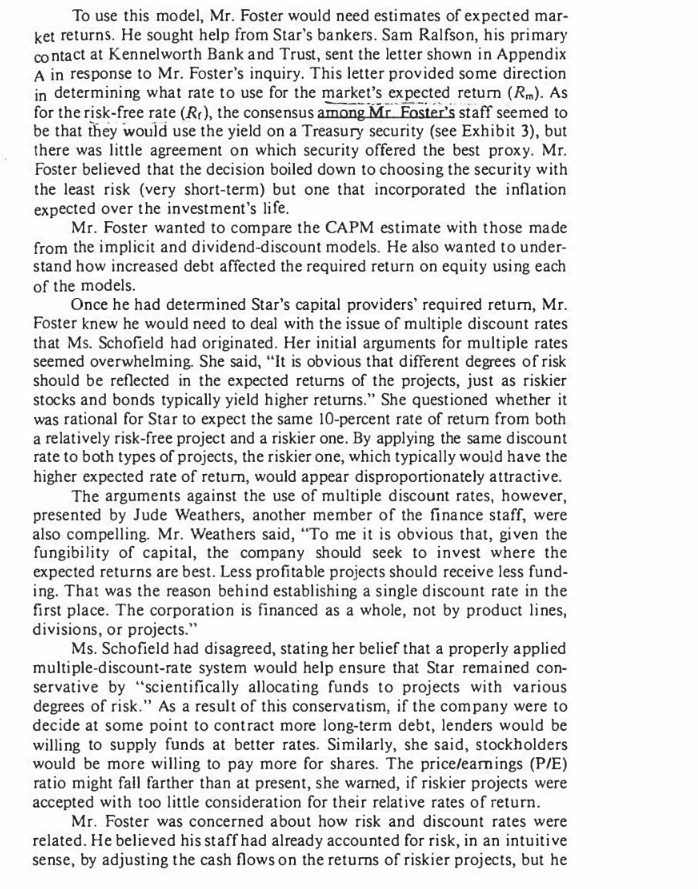
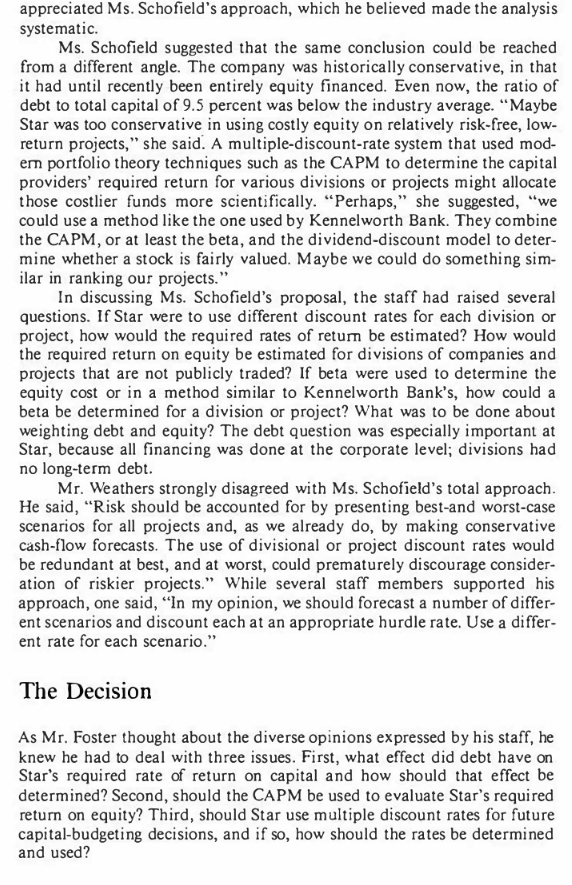
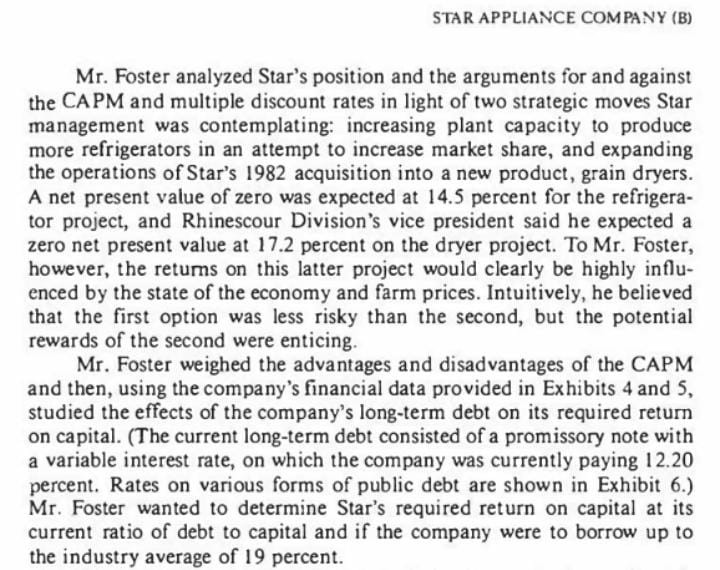
Star Appliance Company (B): January 1985 In 1932 Star Appliance expanded its business by purchasing a company that made machines to clean fruits, grains, and vegetables for market.' The rm: Rhinescour Company, was located near Star's headquarters in Nebraska and had been managed into mediocrity. The quality of its man- agement, along with the state of the US. farming economy, made the price very low. Star management considered its purchase a good investment and, because Rhinescour's continuation ensured jobs in the area, a local community service. To make the purchase. Minoltactc..long-tt;nn debtforthcrst time in the.companyis.history $0.3 million. _ In January 1985, Arthur Foster, Star's treasurer, realized that he had not reevaluated Star's cost of capital since taking on the debt. He won- dered what changes the debt had caused. Mr. Foster found that the com- pany was considered more risky since he had begun to deal with lenders. a new experience for him. The more he worked to develop a new corporate discount rate, the more concerned Mr. Foster became about Star Appliance's required rate of return. When he had been in business school 25 years earlier. there had been only two methods for estimating the required return on equity: the pricefearnings ratio {the implicitcostof capital}and the dividend-discount model. Many of Star's recently hired MBAs said the best method to use was a capital-market equilibrium approach called the capital asset pricing model (CAPM). Mr. Foster was determined to explore all the alternatives before settling on one method to use in future discount-rate revisions. Two issues were being discussed among the staff and needed to be resolved. Some of the younger staff members, along with Mr. Foster, ques- tioned whether the company's present discount rate, given the debt pic- ture, accurately reected capital costs. Some also wondered whether one discount rate should apply to all projectsi.Several suggested that different discount rates should be used with different kinds of investments. The point had corne up in connection with a disaussion ofwhether to develop a market for new crop dryers or increase plant space for the production of refrigerators. Cost of Equity Debbie Schoeld, assistant to the corporate treasurer, was one of the more vocal advocates of multiple discount rates and using the CAPM for deter- mining the required return on equity for various projects. \"The projected return of the project," she said, \"should he set off against its risk to deter- mine value, and the CAPM does that and does it well. We've had lots of experience catsulating betas and the risk-free and market rates of return. That makes the CAPM easy; anyone can use it." As its measure of risk, the CAPM used beta ([3], the relative volatild ity of a security's return in relation to all other assets. A security's beta represented expected risk, but was often estimated by tting a least squares regression, also called the market model, to a senes of returns for the total market and for an individual stock over the most recent 5 years. If a security's returns moved less than those of the market asa whole, its risk would be deemed lower than average and its beta would be less than LO; if its movement was greater, its beta would be greater than 1.0. Using a beta, the return expected for the market> and that expected for a riskfree asset, one could estimate a security's expected return on equity from the CAPM equation: R, = Ry+ By (R... - Ry] where: R; R, u the risk-free rate of return, for which analysts often used a US. Treasury security rate 11. == the variability of total returns for a security (1') relative to those of the market, called the security's beta R... =- the expected total rate of return for the market. Analysts often used a broad market index. such as Standard 8:. Poor's 500 Index. as a proxy the expected total rate of return for a security [j] Exhibit 1 provides the betas, protability ratios. and other pertinent data for rms in the home-appliance and agrieultural-maehinery indus- tries. Exhibit 2 provides information on Star's stock performance and that of the SdrP 500 index. To use this model, Mr. Foster would need estimates of expected mar- ket returns. He sought help from Star's bankers. 5am Ralfson, his primary contact at Kennelworth Bank and Trust, sent the letter shown in Appendix A in response to Mr. Foster's inquiry. This letter provided some direction in determining what rate to use for the market' 3 expected return (Rm). As I_.._-....-... For the risk- free rate (Rt), the consensusamongMcstesstaff seemed to be that they would use the yield on a Treasury security {see Exhibit 3), but there was little agreement on which security offered the best proxy Mr. Foster believed that the decision boiled down to choosing the security with the least risk (very short~term) but one that incorporated the ination xptcltd over the investment's life. Mr. Foster wanted to compare the CAPM estimate with those made from the implicit and dividendudiscount models. He also wanted to under- stand how increased debt affected the required return on equity using each of the models. Once he had determined Star's capital providers' required return, Mr. Foster knew he would need to deal with the issue of multiple discount rates that Ms. Schoeld had originated. Her initial arguments for multiple rates seemed overwhelming. She said, \"It is obvious that different degrees ofrisk should be reflected in the expected returns of the projects, just as riskier stocks and bonds typically yield higher returns.\" She questioned whether it was rational for Star to expect the same till-percent rate of return from both a relatively risk-free project and a riskier one. By applying the same discount rate to both types ot'projects, the riskier one, which typically would have the higher expected rate of return, would appear disproportionately attractive. The arguments against the use of multiple discount rates, however, presented by Jude Weathers, another member of the nance staff, were also compelling Mr. Weathers said. "To me it is obvious that, given the fungibility of capital, the company should seek to invest where the expected returns are best. Less protable projects should receive less fund- ing. That was the reason behind establishing a single discount rate in the first place. The corporation is nanced as a whole, not by product lines. divisions, or projects.\" Ms. Schoi'ield had disagreed, stating her beliefthat a properly applied multiple-discount-rate system would help ensure that Star remained con- servative by \"scientifically allocating funds to projects with various degrees of risk." As a result of this conservatism, if the company were to decide at some point to contract more long~term debt, lenders would be willing to supply funds at better rates. Similarly, she said, stockholders would be more willing to pay more for shares. The priceteamings {PIE} ratio might fall farther than at present. she wanted, if riskier projects were accepted with too little consideration for their relative rates ofreturn. Mr. Foster was concerned about how risk and discount rates were related. He believed his staffhad already accounted for risk, in an intuitive senSe, by adjusting the cash owson the returns of riskier projects, but he appreciated Ms. Schoeld's approach, which he believed made the analysis systematic. Ms. Schoeld suggested that the same conclusion could be reached from a different angle. The company was historically conservative, in that it had until recently been entirely equity nanced. Even now, the ratio of debt to total capital of9.5 percent was below the industry average. \"Maybe Star was too conservative in using costly equity on relatively risk-free. low- return projects," she said. A multiplediscount-rate system that used mod- ern portfolio theory techniques such as the CAPM to determine the capital providers' required return for various divisions or projects might allocate those costlier funds more scientically. \"Perhaps," she suggested, "we cOuId use a method like the one used by Kennelworth Bank. They combine the CAPM, or at least the beta, and the dividend-discount model to deter mine whether a stock is fairly valued. Maybe we could do something simv ilar in ranking our projects." in discussing Ms. Schoeld's proposal, the staff had raised several questions. If Star were to use different discount rates for each division or project, how would the required rates of return be estimated? How would the required return on equity be estimated for divisions of companies and projects that are not publicly traded? If beta were used to determine the equity cost or in a method similar to Kennelworth Bank's. how could a beta be determined for a division or project? What was to be done about weighting debt and equity? The debt question was especially important at Star, because all nancing was done at the corporate level; divisions had no long~tcrm debt. Mr. weathers strongly disagreed with Ms. Scholield's total approach. He saidI \"Risk should be accounted for by presenting best-and worst-case scenarios for all projects and, as we already do, by making. conservative cash-flow forecasts. The use ofdivisional or project discount rates would be redundant at best. and at worst, could prematurely discourage consider- ation of riskier projects." While several staff members supported his approach, one said, \"In my opinion, we should forecast a number ofdiffer entscenarios and discount each at an appropriate hurdle rate. Use a differ- ent rate for each scenario." The Decision As Mr. Foster thought about the diverse opinions expressed by his staff. he knew he had to deal with three issues. First. what effect did debt have on Star's required rate of return on capital and how should that effect be determined? Second, should the CAPM be used to evaluate Star's required return on equity? Thirdl should Star use multiple discount rates for future capital-budgeting decisions, and if so, how should the rates be determined and used? STAR APPLIANCE CUMFHH'I" {3} Mr. Foster analyzed Star's position and the arguments for and against the CAPM and multiple discount rates in light of two strategic moves Star management was contemplating: increasing plant capacity to produce more refrigerators in an attempt to increase market share1 and expanding the operations ofStar's 1982 acquisition into a new product. grain dryers. A net present value of zero was expected at [4.5 peroent for the refrigera- tor project, and Rhinescour Division's vice president said he expected a zero net present value at 1?.2 percent on the dryer project. To Mr. Foster, however. the returns on this latter project would clearly be highly inu enced by the state of the economy and farm prices. lntuitively. he believed that the rst option was less risky than the second, but the potential rewards of the second were enticing. Mr. Foster weighed the advantages and disadvantages of the CAPM and then. using the company's nancial data provided in Exhibits 4 and 5. studied the effects of the company's long-term debt on its required return on capital. (1' he current longtemt debt consisted of a promissory note with a variable interest rate, on which the company was currently paying l2.20 percent. Rates on various forms of public debt are shown in Exhibit 6.) Mr. Foster wanted to determine Star's required return on capital at its current ratio of debt to capital and if the company were to borrow up to the industry average of l9 percent
Step by Step Solution
There are 3 Steps involved in it

Get step-by-step solutions from verified subject matter experts
 Study Help