Question: HELP ME OUT PLEASE! CASE STUDY Pipelines, NGOs, and First Nations 13.1 PIPELINES, NGOS, AND FIRST NATIONS The construction of petroleum pipelines is a controversial
HELP ME OUT PLEASE!
CASE STUDY "Pipelines, NGOs, and First Nations"
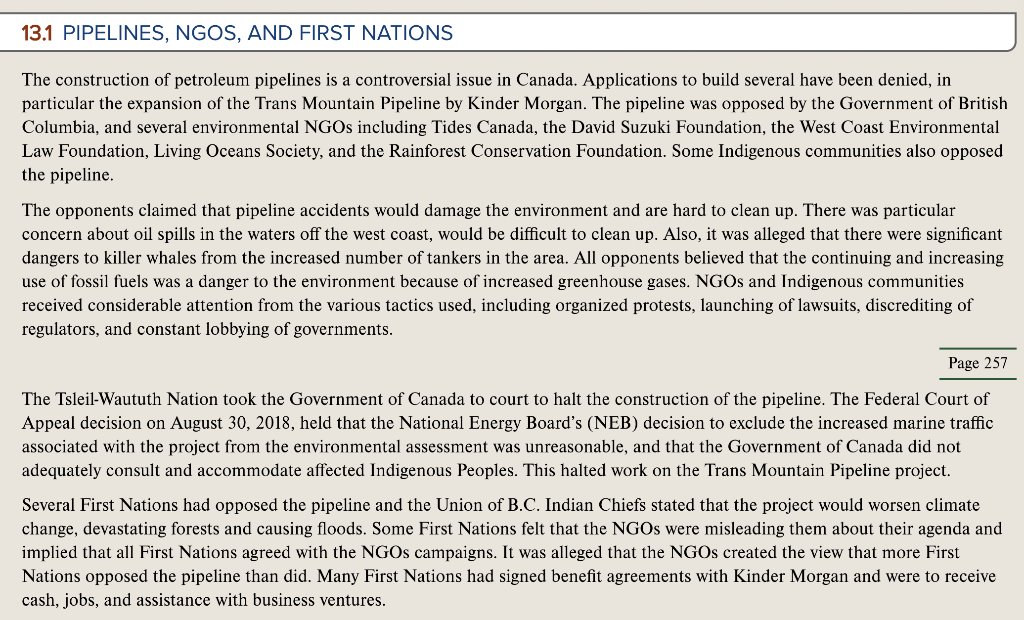
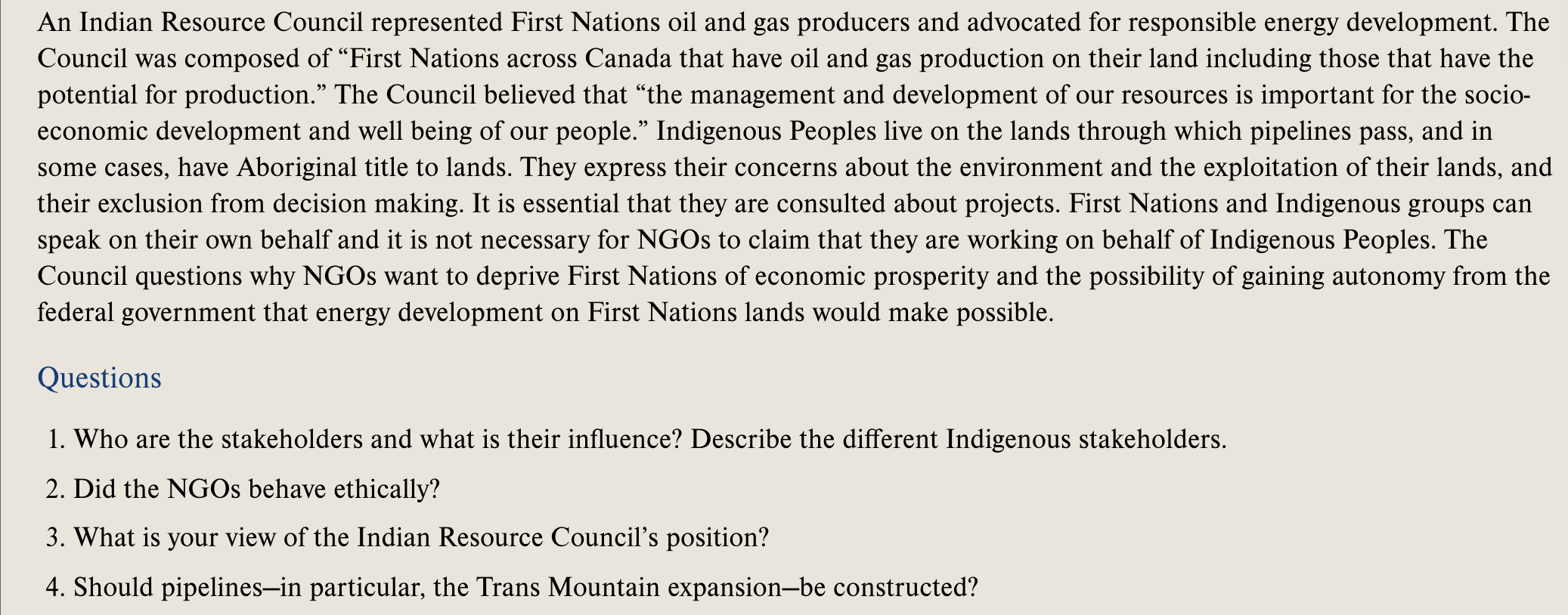
13.1 PIPELINES, NGOS, AND FIRST NATIONS The construction of petroleum pipelines is a controversial issue in Canada. Applications to build several have been denied, in particular the expansion of the Trans Mountain Pipeline by Kinder Morgan. The pipeline was opposed by the Government of British Columbia, and several environmental NGOs including Tides Canada, the David Suzuki Foundation, the West Coast Environmental Law Foundation, Living Oceans Society, and the Rainforest Conservation Foundation. Some Indigenous communities also opposed the pipeline. The opponents claimed that pipeline accidents would damage the environment and are hard to clean up. There was particular concern about oil spills in the waters off the west coast, would be difficult to clean up. Also, it was alleged that there were significant dangers to killer whales from the increased number of tankers in the area. All opponents believed that the continuing and increasing use of fossil fuels was a danger to the environment because of increased greenhouse gases. NGOs and Indigenous communities received considerable attention from the various tactics used, including organized protests, launching of lawsuits, discrediting of regulators, and constant lobbying of governments. Page 257 The Tsleil-Waututh Nation took the Government of Canada to court to halt the construction of the pipeline. The Federal Court of Appeal decision on August 30, 2018, held that the National Energy Board's (NEB) decision to exclude the increased marine traffic associated with the project from the environmental assessment was unreasonable, and that the Government of Canada did not adequately consult and accommodate affected Indigenous Peoples. This halted work on the Trans Mountain Pipeline project. Several First Nations had opposed the pipeline and the Union of B.C. Indian Chiefs stated that the project would worsen climate change, devastating forests and causing floods. Some First Nations felt that the NGOs were misleading them about their agenda and implied that all First Nations agreed with the NGOs campaigns. It was alleged that the NGOs created the view that more First Nations opposed the pipeline than did. Many First Nations had signed benefit agreements with Kinder Morgan and were to receive cash, jobs, and assistance with business ventures. An Indian Resource Council represented First Nations oil and gas producers and advocated for responsible energy development. The Council was composed of First Nations across Canada that have oil and gas production on their land including those that have the potential for production. The Council believed that the management and development of our resources is important for the socio- economic development and well being of our people. Indigenous Peoples live on the lands through which pipelines pass, and in some cases, have Aboriginal title to lands. They express their concerns about the environment and the exploitation of their lands, and their exclusion from decision making. It is essential that they are consulted about projects. First Nations and Indigenous groups can speak on their own behalf and it is not necessary for NGOs to claim that they are working on behalf of Indigenous Peoples. The Council questions why NGOs want to deprive First Nations of economic prosperity and the possibility of gaining autonomy from the federal government that energy development on First Nations lands would make possible. Questions 1. Who are the stakeholders and what is their influence? Describe the different Indigenous stakeholders. 2. Did the NGOs behave ethically? 3. What is your view of the Indian Resource Council's position? 4. Should pipelinesin particular, the Trans Mountain expansion-be constructed









 Study Help