







Question: Help me please This week we are continuing our discussion of entrepreneurship, specifically chapter 2 of the textbook Entrepreneurial Finance (there is a link under
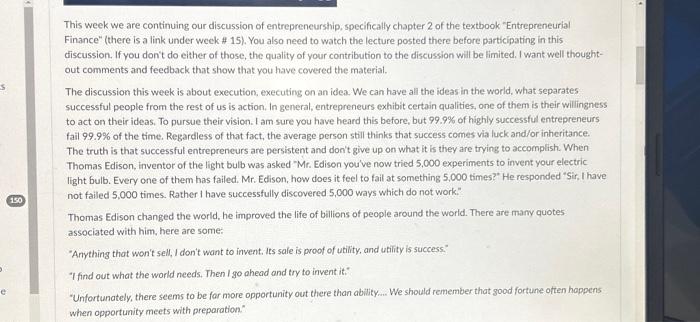
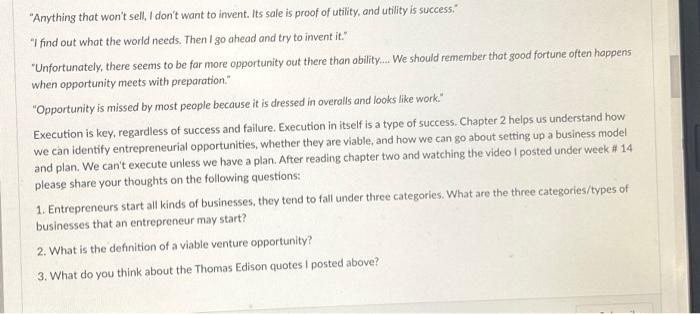
This week we are continuing our discussion of entrepreneurship, specifically chapter 2 of the textbook "Entrepreneurial Finance" (there is a link under week \# 15). You also need to watch the lecture posted there before participating in this discussion. If you don't do either of those, the quality of your contribution to the discussion will be limited. I want well thoughtout comments and feedback that show that you have covered the material. The discussion this week is about execution, executing on an idea. We can have all the ideas in the world, what separates successful people from the rest of us is action, In general, entrepreneurs exhibit certain qualities, one of them is their willingness to act on their ideas. To pursue their vision. I am sure you have heard this before, but 99.9% of highly successful entrepreneurs fail 99.9% of the time. Regardless of that fact, the average person still thinks that success comes via luck and/or inheritance. The truth is that successful entrepreneurs are persistent and don't give up on what it is they are trying to accomplish. When Thomas Edison, inventor of the light bulb was asked "Mr. Edison you've now tried 5,000 experiments to invent your electric light bulb. Every one of them has failed. Mr. Edison, how does it feel to fail at something 5,000 times?' He responded 'Sir, I have not failed 5,000 times. Rather I have successfully discovered 5,000 ways which do not work" Thomas Edison changed the world, he improved the life of billions of people around the world. There are many quotes associated with him, here are some: "Anything that won't sell, I don't want to invent. Its sale is proof of utility, and utility is success." If find out what the world needs. Then I go ahead and try to invent it:" Unfortunately, there seems to be far more opportunity out there than ability... We should remember that good fortune often hoppens when opportunity meets with preparation." "Anything that won't sell, I don't want to invent. Its sale is proof of utility, and utility is success." "I find out what the world needs. Then I go ahead and try to invent it." "Unfortunately, there seems to be far more opportunity out there than ability... We should remember that good fortune often happens when opportunity meets with preparation." "Opportunity is missed by most people because it is dressed in overalls and looks like work." Execution is key, regardless of success and failure. Execution in itself is a type of success. Chapter 2 helps us understand how we can identify entrepreneurial opportunities, whether they are viable, and how we can go about setting up a business model and plan. We can't execute unless we have a plan. After reading chapter two and watching the video I posted under week \# 14 please share your thoughts on the following questions: 1. Entrepreneurs start all kinds of businesses, they tend to fall under three categories. What are the three categories/types of businesses that an entrepreneur may start? 2. What is the definition of a viable venture opportunity? 3. What do you think about the Thomas Edison quotes I posted above
Step by Step Solution
There are 3 Steps involved in it

Get step-by-step solutions from verified subject matter experts
 Study Help