







Question: HELP ME SOLVE THESE QUESTIONS, ONLY DO IF YOU WILL ANSWER ALL, AND BE FAST PLEASE. THANK YOU An insurance company issues a $100000 one-year
HELP ME SOLVE THESE QUESTIONS, ONLY DO IF YOU WILL ANSWER ALL, AND BE FAST PLEASE. THANK YOU
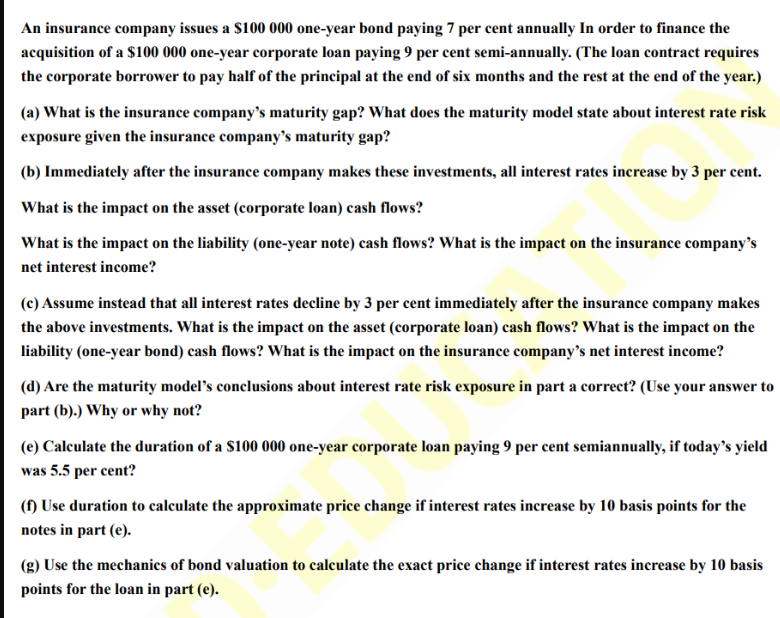
An insurance company issues a $100000 one-year bond paying 7 per cent annually In order to finance the acquisition of a $100000 one-year corporate loan paying 9 per cent semi-annually. (The loan contract requires the corporate borrower to pay half of the principal at the end of six months and the rest at the end of the year.) (a) What is the insurance company's maturity gap? What does the maturity model state about interest rate risk exposure given the insurance company's maturity gap? (b) Immediately after the insurance company makes these investments, all interest rates increase by 3 per cent. What is the impact on the asset (corporate loan) cash flows? What is the impact on the liability (one-year note) cash flows? What is the impact on the insurance company's net interest income? (c) Assume instead that all interest rates decline by 3 per cent immediately after the insurance company makes the above investments. What is the impact on the asset (corporate loan) cash flows? What is the impact on the liability (one-year bond) cash flows? What is the impact on the insurance company's net interest income? (d) Are the maturity model's conclusions about interest rate risk exposure in part a correct? (Use your answer to part (b).) Why or why not? (e) Calculate the duration of a $100000 one-year corporate loan paying 9 per cent semiannually, if today's yield was 5.5 per cent? (f) Use duration to calculate the approximate price change if interest rates increase by 10 basis points for the notes in part (e). (g) Use the mechanics of bond valuation to calculate the exact price change if interest rates increase by 10 basis points for the loan in part (e). An insurance company issues a $100000 one-year bond paying 7 per cent annually In order to finance the acquisition of a $100000 one-year corporate loan paying 9 per cent semi-annually. (The loan contract requires the corporate borrower to pay half of the principal at the end of six months and the rest at the end of the year.) (a) What is the insurance company's maturity gap? What does the maturity model state about interest rate risk exposure given the insurance company's maturity gap? (b) Immediately after the insurance company makes these investments, all interest rates increase by 3 per cent. What is the impact on the asset (corporate loan) cash flows? What is the impact on the liability (one-year note) cash flows? What is the impact on the insurance company's net interest income? (c) Assume instead that all interest rates decline by 3 per cent immediately after the insurance company makes the above investments. What is the impact on the asset (corporate loan) cash flows? What is the impact on the liability (one-year bond) cash flows? What is the impact on the insurance company's net interest income? (d) Are the maturity model's conclusions about interest rate risk exposure in part a correct? (Use your answer to part (b).) Why or why not? (e) Calculate the duration of a $100000 one-year corporate loan paying 9 per cent semiannually, if today's yield was 5.5 per cent? (f) Use duration to calculate the approximate price change if interest rates increase by 10 basis points for the notes in part (e). (g) Use the mechanics of bond valuation to calculate the exact price change if interest rates increase by 10 basis points for the loan in part (e)
Step by Step Solution
There are 3 Steps involved in it

Get step-by-step solutions from verified subject matter experts
 Study Help