



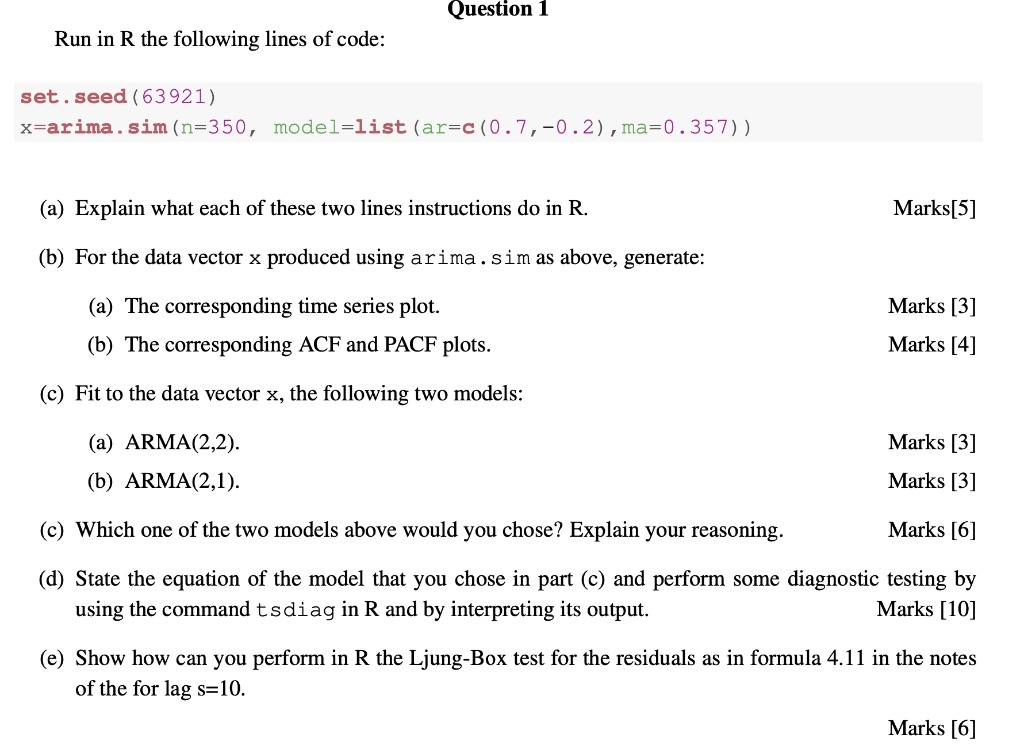
Question: .Help me solve these questions. Question 1 Run in R the following lines of code: set.seed{63921) x=arima.sim(n=350, model=1ist{ar=c {0 . 7, O .2) ,ma=0. 357)]
.Help me solve these questions.
![357)] (a) Explain what each of theSe two lines instructions do in](https://s3.amazonaws.com/si.experts.images/answers/2024/07/6685dbbeeb41b_5746685dbbec9cbb.jpg)
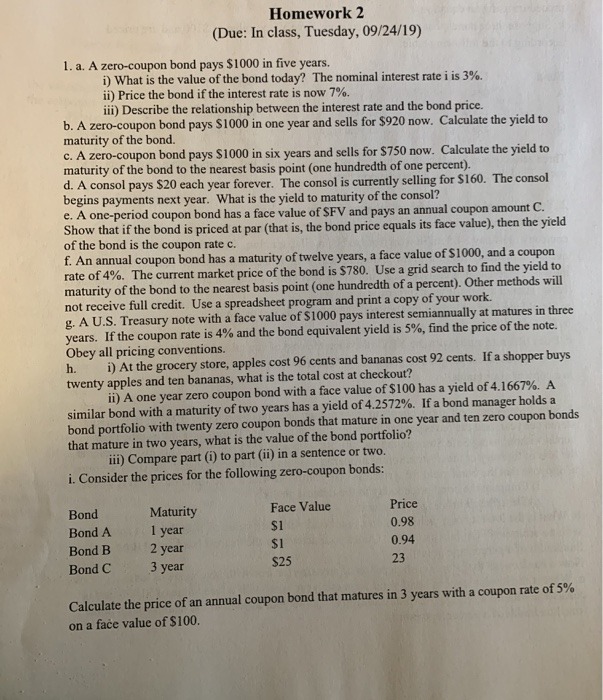
Question 1 Run in R the following lines of code: set.seed{63921) x=arima.sim(n=350, model=1ist{ar=c {0 . 7", O .2) ,ma=0. 357)] (a) Explain what each of theSe two lines instructions do in R. MarksES] (b) For the data vector x produced using arima . 3 im as above, generate: (a) The corresponding time series plot. Marks [3] (b) The corresponding ACF and PACF plots. Marks {4] (0) Fit to the data vector x, the following two models: (a) ARMA(2,2). Marks [3] (b) ARMA(2,1). Marks [3] {c} Which one of the two models above would you chose? Explain your reasoning. Marks [6] ((1) State the equation of the model that you chose in part (c) and perform some diagnostic testing by using the command t sdiag in R and by interpreting its output. Marks [10] (e) Show how can you perform in R the Ljung-Box test for the residuals as in formula 4.11 in the notes of the for lag 5:10. Marks {6] Homework 2 (Due: In class, Tuesday, 09/24/19) 1. a. A zero-coupon bond pays $1000 in five years. i) What is the value of the bond today? The nominal interest rate i is 3%. ii) Price the bond if the interest rate is now 7%. ili) Describe the relationship between the interest rate and the bond price. b. A zero-coupon bond pays $1000 in one year and sells for $920 now. Calculate the yield to maturity of the bond. c. A zero-coupon bond pays $1000 in six years and sells for $750 now. Calculate the yield to maturity of the bond to the nearest basis point (one hundredth of one percent). d. A consol pays $20 each year forever. The consol is currently selling for $160. The consol begins payments next year. What is the yield to maturity of the consol? e. A one-period coupon bond has a face value of SFV and pays an annual coupon amount C. Show that if the bond is priced at par (that is, the bond price equals its face value), then the yield of the bond is the coupon rate c. f. An annual coupon bond has a maturity of twelve years, a face value of $1000, and a coupon rate of 4%. The current market price of the bond is $780. Use a grid search to find the yield to maturity of the bond to the nearest basis point (one hundredth of a percent). Other methods will not receive full credit. Use a spreadsheet program and print a copy of your work. g. A U.S. Treasury note with a face value of $1000 pays interest semiannually at matures in three years. If the coupon rate is 4% and the bond equivalent yield is 5%, find the price of the note. Obey all pricing conventions. h. i) At the grocery store, apples cost 96 cents and bananas cost 92 cents. If a shopper buys twenty apples and ten bananas, what is the total cost at checkout? ii) A one year zero coupon bond with a face value of $100 has a yield of 4.1667%. A similar bond with a maturity of two years has a yield of 4.2572%. If a bond manager holds a bond portfolio with twenty zero coupon bonds that mature in one year and ten zero coupon bonds that mature in two years, what is the value of the bond portfolio? iii) Compare part (i) to part (ii) in a sentence or two. i. Consider the prices for the following zero-coupon bonds: Bond Maturity Face Value Price Bond A 1 year $1 0.98 Bond B 2 year $1 0.94 Bond C 3 year $25 23 Calculate the price of an annual coupon bond that matures in 3 years with a coupon rate of 5% on a face value of $100.3. To slow down transmissions of the viral disea 'lockdown" hence ordering business to shut and the citizens to adhere to limiting physical distancing, but leaving the timing of the lockdown to be decided by the two regional governments of Krona. Assume that both regions have roughly the same population size of 10 million citizens. Region 1 entered lockdown at the beginning of month 3, region 2 entered lockdown at the beginning of month 2. See Next Page The following table shows the cumulative infections and fatalities due to the viral disease over time and the time of the lockdown in each region at the end of each month. Month 1 Month 2 Month 3 Month 4 cases fatalities cases fatalities cases fatalities cases fatalities Region 1 100 3 5000 300 9000 540 15000 900 Region 2 100 5 2200 130 4500 270 5500 330 a) The minister for the economy argues that after both regions entered lockdown, in month 3 the number of cases in region 2 more than doubled, whereas the growth rate is lower in region 1 arguing that the lockdown was not effective in preventing the spread of the disease. Do you agree? Can you provide a better estimate using your knowledge of empirical methods introduced in the module? [word limit 250 words; 8 marks]. b) What kind of data would you prefer to have to estimate the full impact of the lockdowns on infections and fatalities? Explain how this would help to improve your estimate from the previous question. [word limit 200 words; 4 marks]. c) In response to the lockdown the economy in region 1 contracted by $1.1bn, and $1.114bn in region 2. What can we learn from these figures about the statistical value of life? [word limit 100 words; 3 marks]. d) Suppose a vaccine against the disease was available at the beginning of month 1 (and assume it works immediately by protecting the citizens from the disease). 60% of population require the vaccine to stop the disease from spreading. The vaccine is available for $20. Should the government introduce the vaccine? State any assumptions you implicitly make underlying your advice and briefly discuss the limitation of your advice. [word limit 250 words; 5 marks]
Step by Step Solution
There are 3 Steps involved in it

Get step-by-step solutions from verified subject matter experts