







Question: help me to write c code UPLOAD FILE UPLOAD FROM GITHUB A UPLOA Big Big Numbers Addition 1 void add(char a[], char b[], char res[]){
![A UPLOA Big Big Numbers Addition 1 void add(char a[], char b[],](https://dsd5zvtm8ll6.cloudfront.net/si.experts.images/questions/2024/09/66f32c1b76a06_57166f32c1b1c502.jpg)
![char res[]){ 2 Hard AC Ratio: 13.9% (334/2401) 3} #String #Loop #Array](https://dsd5zvtm8ll6.cloudfront.net/si.experts.images/questions/2024/09/66f32c1c0fd81_57166f32c1bb4b15.jpg)
help me to write c code
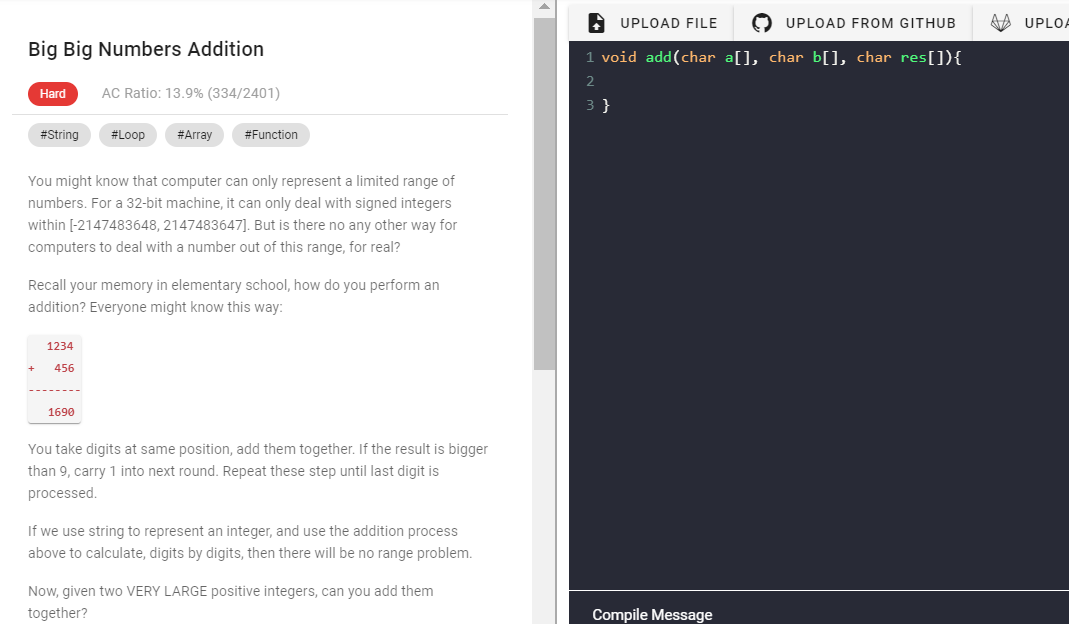
UPLOAD FILE UPLOAD FROM GITHUB A UPLOA Big Big Numbers Addition 1 void add(char a[], char b[], char res[]){ 2 Hard AC Ratio: 13.9% (334/2401) 3} #String #Loop #Array #Function You might know that computer can only represent a limited range of numbers. For a 32-bit machine, it can only deal with signed integers within (-2147483648, 2147483647]. But is there no any other way for computers to deal with a number out of this range, for real? Recall your memory in elementary school, how do you perform an addition? Everyone might know this way: 1234 456 1690 You take digits at same position, add them together. If the result is bigger than 9, carry 1 into next round. Repeat these step until last digit is processed. If we use string to represent an integer, and use the addition process above to calculate, digits by digits, then there will be no range problem. Now, given two VERY LARGE positive integers, can you add them together? Compile Message Loader Your code will be verified by the main file below #include
Step by Step Solution
There are 3 Steps involved in it

Get step-by-step solutions from verified subject matter experts
 Study Help