







Question: Help Name Date AP Statistics - Chapter Four - Test Perlod 14 MC (84 points), 1 FAQ (16 points) - 100 points - Formal Assessment
Help
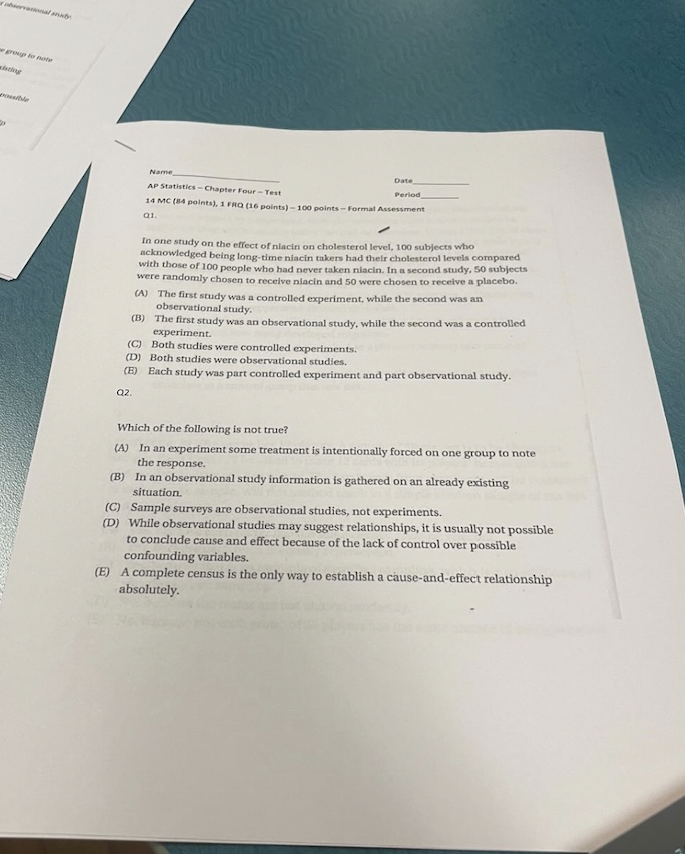
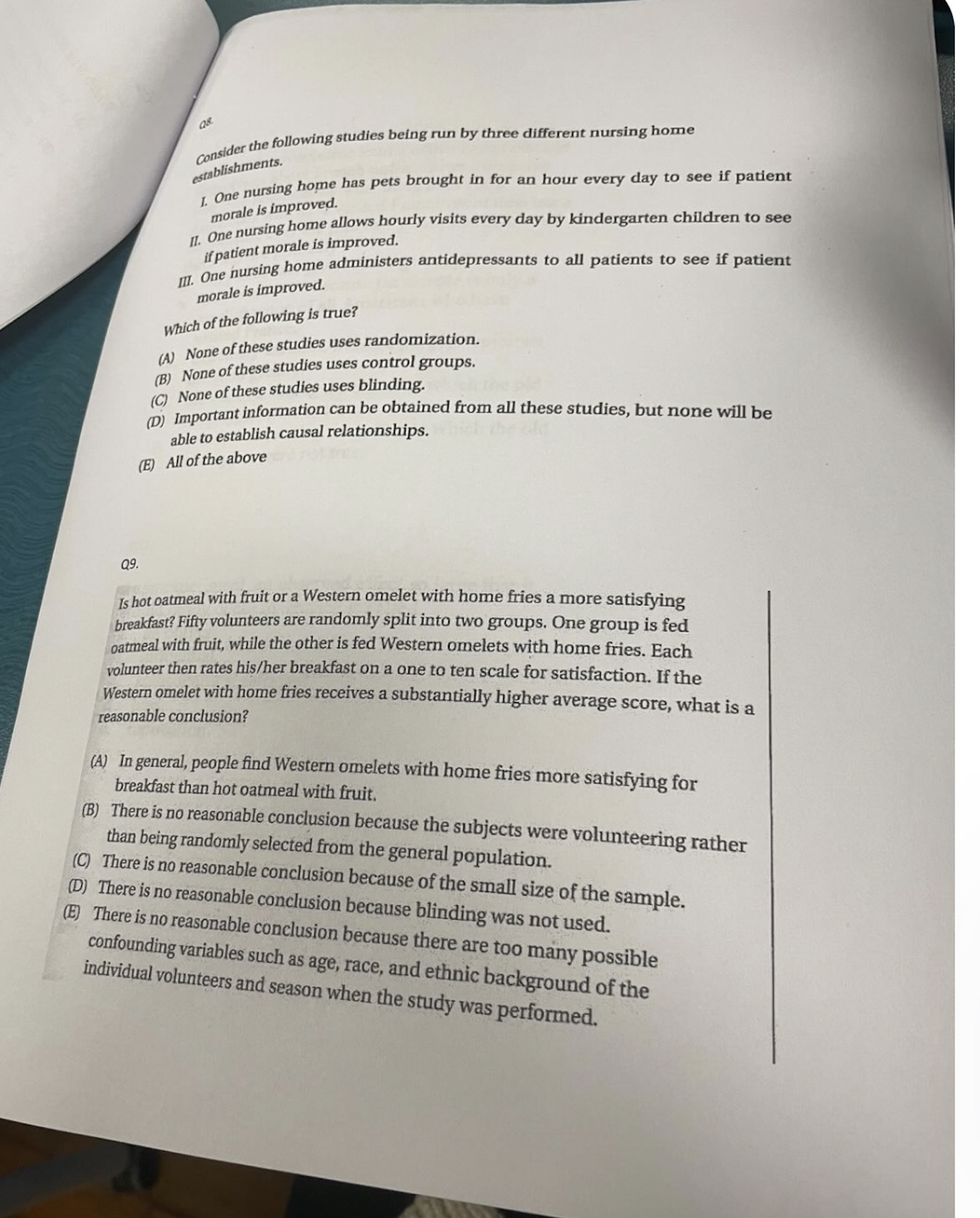
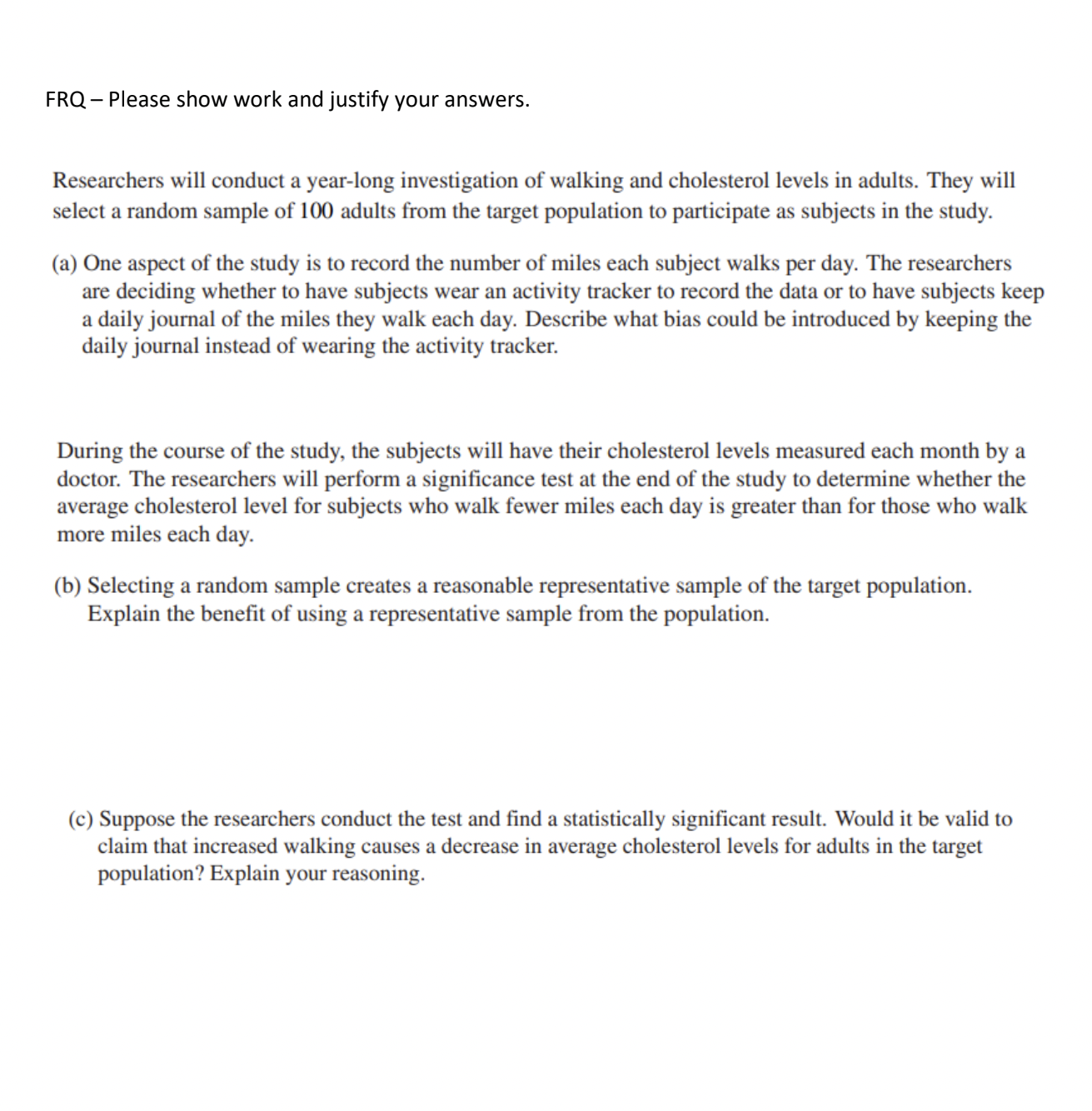
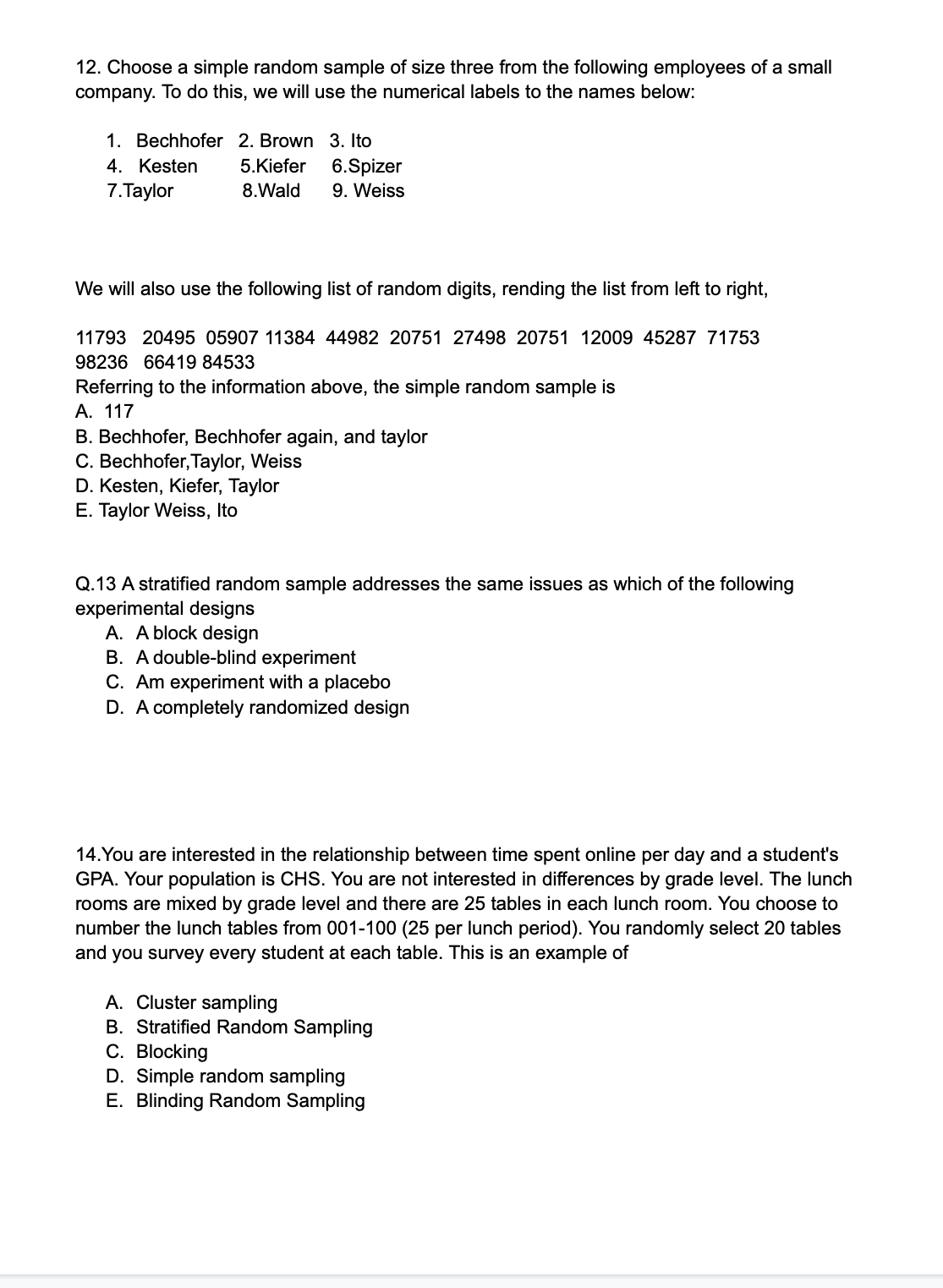
Name Date AP Statistics - Chapter Four - Test Perlod 14 MC (84 points), 1 FAQ (16 points) - 100 points - Formal Assessment 01. In one study on the effect of niacin on cholesterol level, 100 subjects who acknowledged being long-time niacin takers had their cholesterol levels compared with those of 100 people who had never taken niacin. In a second study, 50 subjects were randomly chosen to receive niacin and 50 were chosen to receive a placebo. (A) The first study was a controlled experiment, while the second was an observational study. (B) The first study was an observational study, while the second was a controlled experiment. (C) Both studies were controlled experiments. (D) Both studies were observational studies. (E) Each study was part controlled experiment and part observational study. Q2. Which of the following is not true? (A) In an experiment some treatment is intentionally forced on one group to note the response. (B) In an observational study information is gathered on an already existing situation. (C) Sample surveys are observational studies, not experiments. (D) While observational studies may suggest relationships, it is usually not possible to conclude cause and effect because of the lack of control over possible confounding variables. (E) A complete census is the only way to establish a cause-and-effect relationship absolutely.28 Consider the following studies being run by three different nursing home establishments. 1. One nursing home has pets brought in for an hour every day to see if patient morale is improved. 17. One nursing home allows hourly visits every day by kindergarten children to see if patient morale is improved. 171. One nursing home administers antidepressants to all patients to see if patient morale is improved. Which of the following is true? (A) None of these studies uses randomization. (B) None of these studies uses control groups. C) None of these studies uses blinding. (D) Important information can be obtained from all these studies, but none will be able to establish causal relationships. (E) All of the above Q9. Is hot oatmeal with fruit or a Western omelet with home fries a more satisfying breakfast? Fifty volunteers are randomly split into two groups. One group is fed oatmeal with fruit, while the other is fed Western omelets with home fries. Each volunteer then rates his/her breakfast on a one to ten scale for satisfaction. If the Western omelet with home fries receives a substantially higher average score, what is a reasonable conclusion? (A) In general, people find Western omelets with home fries more satisfying for breakfast than hot oatmeal with fruit. (B) There is no reasonable conclusion because the subjects were volunteering rather than being randomly selected from the general population. (C) There is no reasonable conclusion because of the small size of the sample. (D) There is no reasonable conclusion because blinding was not used. (E) There is no reasonable conclusion because there are too many possible confounding variables such as age, race, and ethnic background of the individual volunteers and season when the study was performed.FRQ Please show work and justify your answers. Researchers will conduct a year-long investigation of walking and cholesterol levels in adults. They will select a random sample of 100 adults from the target population to participate as subjects in the study. (a) One aspect of the study is to record the number of miles each subject walks per day. The researchers are deciding whether to have subjects wear an activity tracker to record the data or to have subjects keep a daily journal of the miles they walk each day. Describe what bias could be introduced by keeping the daily journal instead of wearing the activity tracker. During the course of the study. the subjects will have their cholesterol levels measured each month by a doctor. The researchers will perform a signicance test at the end of the study to determine whether the average cholesterol level for subjects who walk fewer miles each day is greater than for those who walk more miles each day. (b) Selecting a random sample creates a reasonable representative sample of the target population. Explain the benet of using a representative sample from the population. (c) Suppose the researchers conduct the test and nd a statistically signicant result. Would it be valid to claim that increased walking causes a decrease in average cholesterol levels for adults in the target population? Explain your reasoning. 12. Choose a simple random sample of size three from the following employees of a small company. To do this, we will use the numerical labels to the names below: 1. Bechhofer 2. Brown 3. Ito 4. Kesten 5.Kiefer 6.Spizer 7. Taylor 8.Wald 9. Weiss We will also use the following list of random digits, rending the list from left to right, 11793 20495 05907 11384 44982 20751 27498 20751 12009 45287 71753 98236 66419 84533 Referring to the information above, the simple random sample is A. 117 B. Bechhofer, Bechhofer again, and taylor C. Bechhofer, Taylor, Weiss D. Kesten, Kiefer, Taylor E. Taylor Weiss, Ito Q. 13 A stratified random sample addresses the same issues as which of the following experimental designs A. A block design B. A double-blind experiment C. Am experiment with a placebo D. A completely randomized design 14. You are interested in the relationship between time spent online per day and a student's GPA. Your population is CHS. You are not interested in differences by grade level. The lunch rooms are mixed by grade level and there are 25 tables in each lunch room. You choose to number the lunch tables from 001-100 (25 per lunch period). You randomly select 20 tables and you survey every student at each table. This is an example of A. Cluster sampling B. Stratified Random Sampling C. Blocking D. Simple random sampling E. Blinding Random Sampling
Step by Step Solution
There are 3 Steps involved in it

Get step-by-step solutions from verified subject matter experts
 Study Help