







Question: help needed 2. (22 points) Pikachu! Pikachu's preferences for ketchup and apples can be represented as U = 1,31 Back a, while his budget constraint
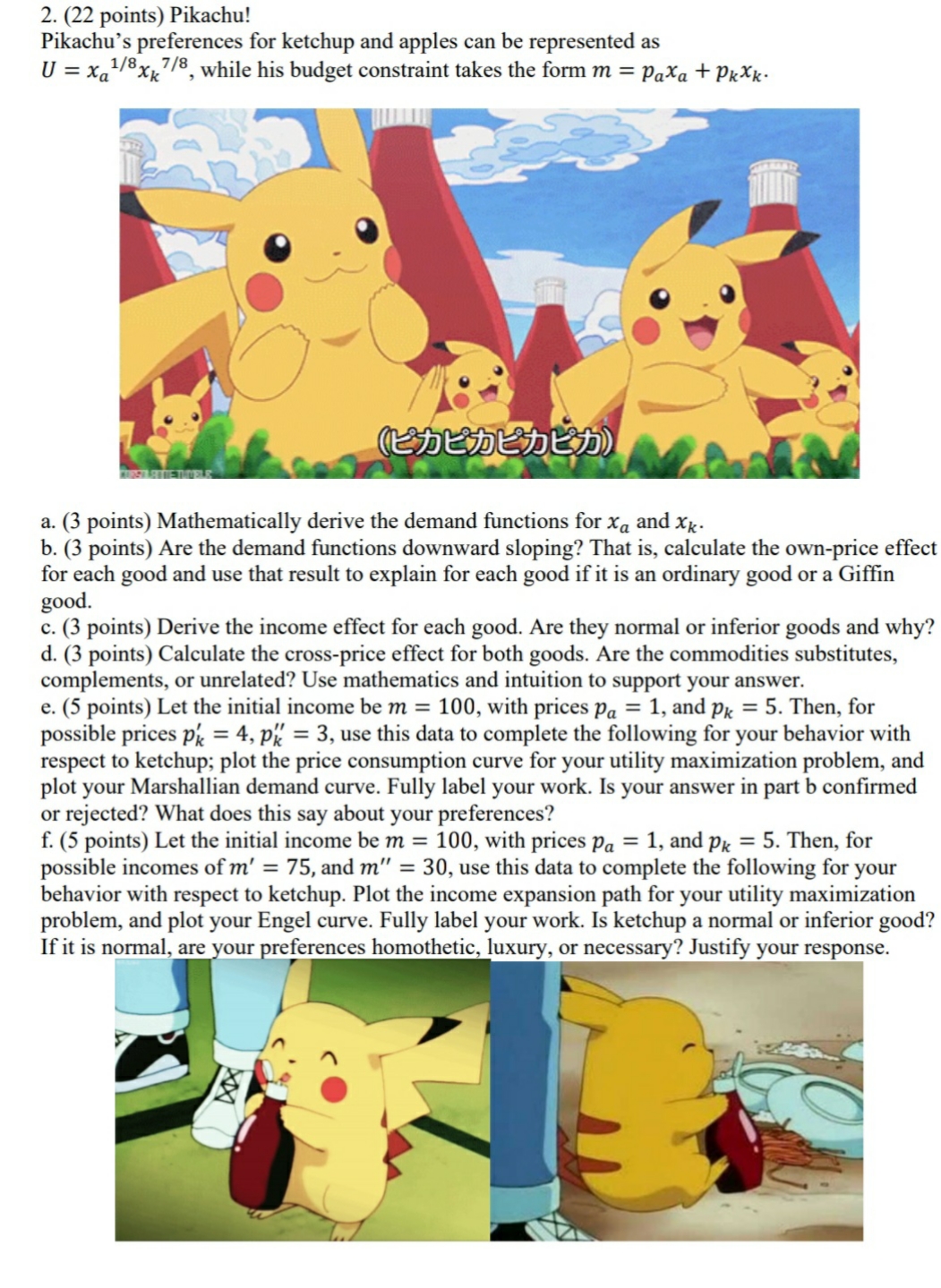
help needed
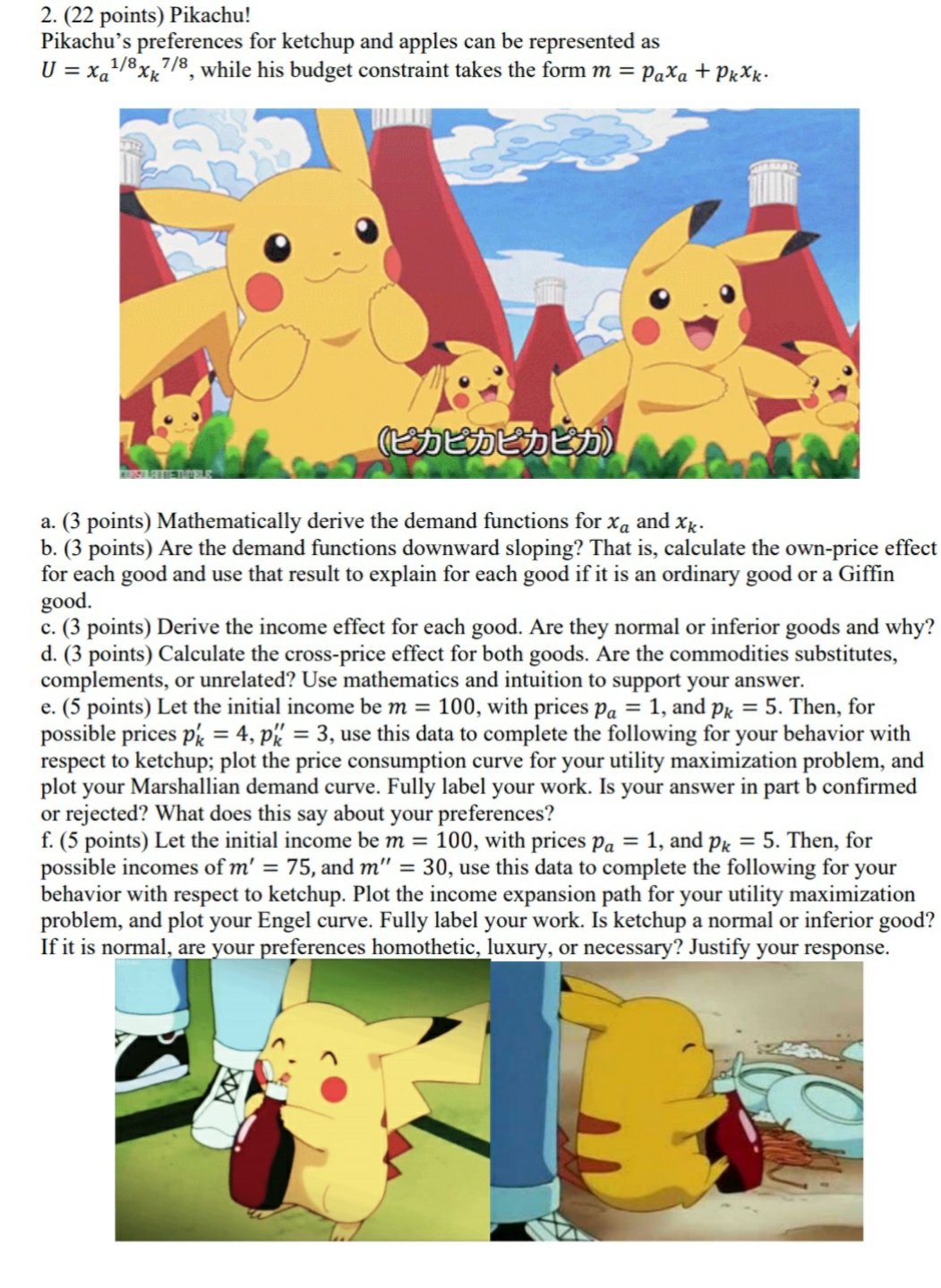
2. (22 points) Pikachu! Pikachu's preferences for ketchup and apples can be represented as U = 1,31" Back" a, while his budget constraint takes the form 111 = para + pkxk. ~g:_ HM ___. 3% _:_g. ngff- thttbbbv a. (3 points) Mathematically derive the demand functions for x,I and xk. b. (3 points) Are the demand functions downward sloping? That is, calculate the own-price effect for each good and use that result to explain for each good if it is an ordinary good or a Gifn good. c. (3 points) Derive the income effect for each good. Are they normal or inferior goods and why? d. (3 points) Calculate the cross-price effect for both goods. Are the commodities substitutes, complements, or unrelated? Use mathematics and intuition to support your answer. e. (5 points) Let the initial income be m = 100, with prices pa = 1. and pk = 5. Then, for possible prices p}, = 4, p: = 3, use this data to complete the following for your behavior with respect to ketchup; plot the price consumption curve for your utility maximization problem, and plot your Marshallian demand curve. Fully label your work. Is your answer in part b connned or rejected? What does this say about your preferences? f. (5 points) Let the initial income be m = 100, with prices pa = 1, and pk = 5. Then, for possible incomes of m' = 75, and m" = 30, use this data to complete the following for your behavior with respect to ketchup. Plot the income expansion path for your utility maximization problem, and plot your Engel curve. Fully label your work. Is ketchup a normal or inferior good? If it is normal, are our references homothetic, luxury, or necessary? Justify your response
Step by Step Solution
There are 3 Steps involved in it

Get step-by-step solutions from verified subject matter experts
 Study Help