







Question: help, please! 1) A IEEE 754 single precision number uses 1 bit for the sign, 8 bits for the exponent and 23 bits for the
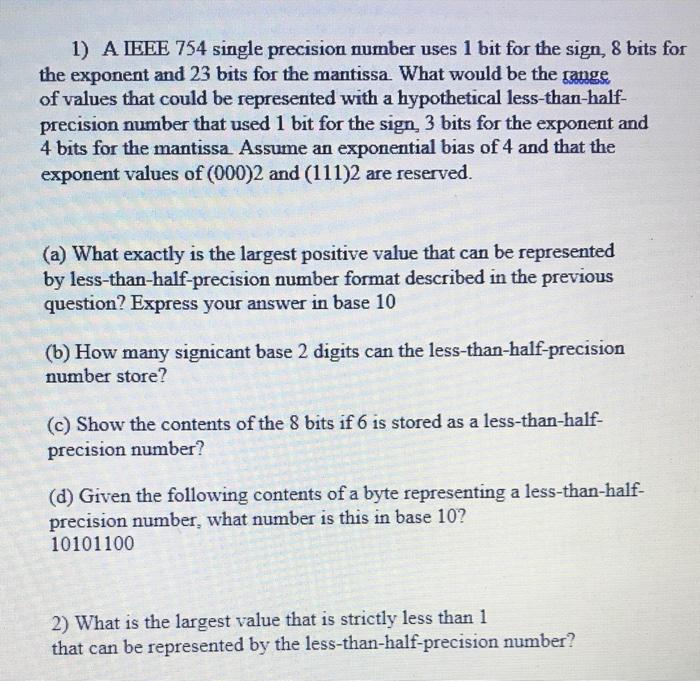
1) A IEEE 754 single precision number uses 1 bit for the sign, 8 bits for the exponent and 23 bits for the mantissa. What would be the range of values that could be represented with a hypothetical less-than-half- precision number that used 1 bit for the sign 3 bits for the exponent and 4 bits for the mantissa. Assume an exponential bias of 4 and that the exponent values of (000)2 and (111)2 are reserved. (a) What exactly is the largest positive value that can be represented by less-than-half-precision number format described in the previous question? Express your answer in base 10 (b) How many signicant base 2 digits can the less-than-half-precision number store? (c) Show the contents of the 8 bits if 6 is stored as a less-than-half- precision number? (d) Given the following contents of a byte representing a less-than-half- precision number, what number is this in base 10? 10101100 2) What is the largest value that is strictly less than 1 that can be represented by the less-than-half-precision number? 1) A IEEE 754 single precision number uses 1 bit for the sign, 8 bits for the exponent and 23 bits for the mantissa. What would be the range of values that could be represented with a hypothetical less-than-half- precision number that used 1 bit for the sign 3 bits for the exponent and 4 bits for the mantissa. Assume an exponential bias of 4 and that the exponent values of (000)2 and (111)2 are reserved. (a) What exactly is the largest positive value that can be represented by less-than-half-precision number format described in the previous question? Express your answer in base 10 (b) How many signicant base 2 digits can the less-than-half-precision number store? (c) Show the contents of the 8 bits if 6 is stored as a less-than-half- precision number? (d) Given the following contents of a byte representing a less-than-half- precision number, what number is this in base 10? 10101100 2) What is the largest value that is strictly less than 1 that can be represented by the less-than-half-precision number
Step by Step Solution
There are 3 Steps involved in it

Get step-by-step solutions from verified subject matter experts
 Study Help