







Question: Help please :( 1. Apply What You've Learned - Real Estate and High-Risk Investments Scenario: You are considering investing in real estate-both for the short-term
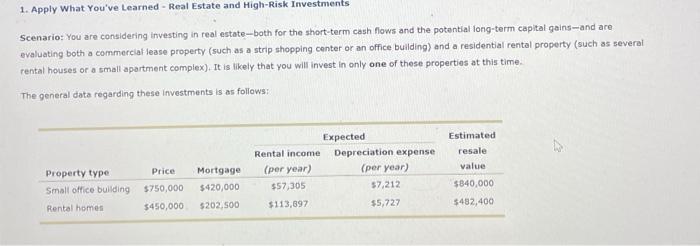
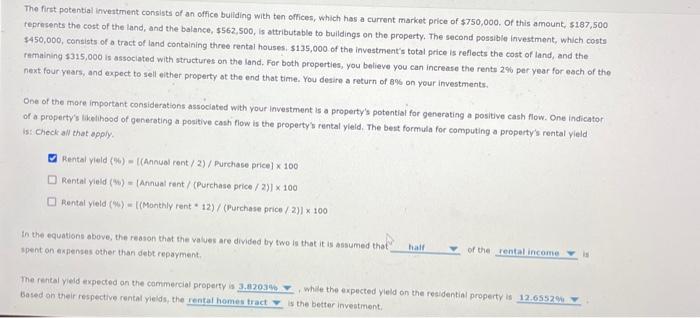
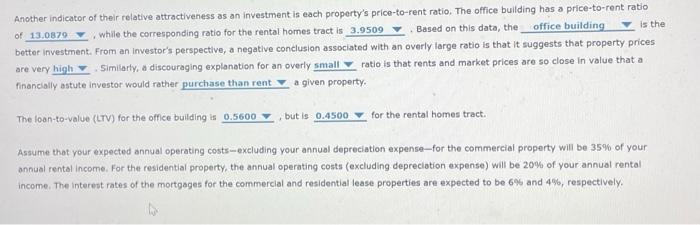
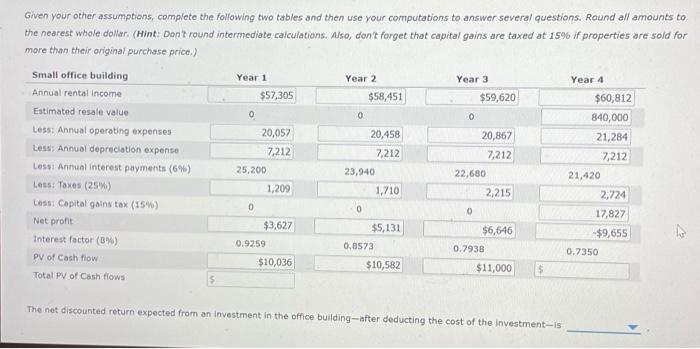
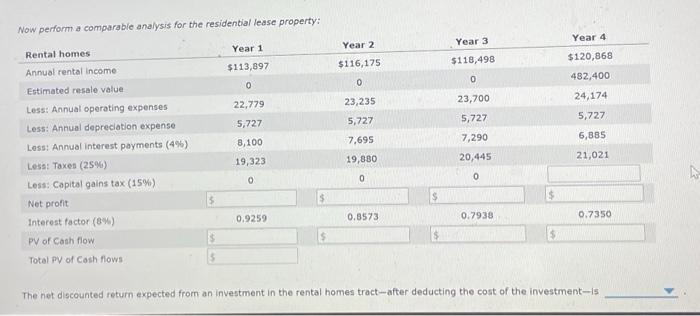
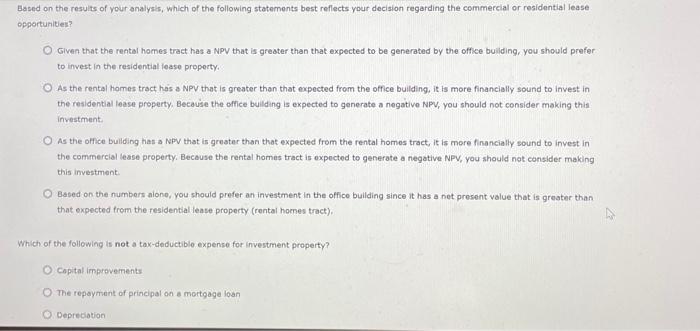
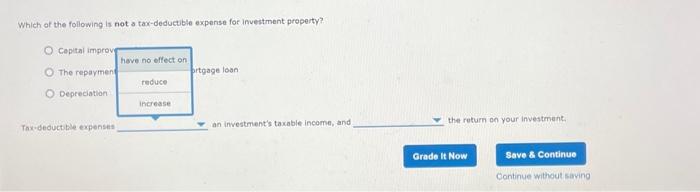
1. Apply What You've Learned - Real Estate and High-Risk Investments Scenario: You are considering investing in real estate-both for the short-term cash flows and the potential long-term capital gains-and are evaluating both a commercial lease property (such as a strip shopping center or an office buliding) and a residential rental property (such as several rental houses or a small apartment complex), It is likely that you will invest in only one of these propertios at this time. The general data regarding these investments is as follows: The first potential investment consists of an office buliding with ten offices, which has a current market price of $750,000.0 this amount, $187,500 tepresents the cost of the land, and the balance, $562,500, is attributable to buildings on the property, The second possible investment, which costs $450,000, consists of a tract of land containing three rental houses, $135,000 of the investment's total price is reflects the cost of land, and the remaining $315,000 is associated with structures on the land. Far both proporties, you believe you can increase the rents 2% per year for each of the next four years, and expect to sell either property at the end that time. You desire a return of 8% on your investments. One of the more important considerations associated with your investment is a property's potential for generating a positive cash flow. One indicator of a property's tikelihood of generating a positive cash flow is the property's rental yileid, The best formula for computing a property's rental yield is: Check all that epply. Rental vield (96)=[( Annual rent /2)/ Purchase price ]100 Rental yield (w)=[ Annual tent / (Purchase prico /2)]100 Rental yeld ()=[( Monthly rent * 12)/( Purchase price /2)]100 In the equations above, the reason that the values are divided by two is that it is assumed the spent on expenses other than debt repayment. of the The rental yeld expected on the cammercial property is based on their respective rental yields, the , whele the expected yleid on the residential property is is the better investment, Another indicator of their relative attractiveness as an investment is each property's price-to-rent ratio. The office building has a price-to-rent ratio of 1. while the corresponding ratio for the rental homes tract is . Based on this data, the is the better investment. From an investor's perspective, a negative conclusion associated with an overly large ratio is that it suggests that property prices are very - Similarly, a discouraging explanation for an overly ratio is that rents and market prices are so close in value that a financlally astute investor would rather. a given property. The loon-to-value (LTV) for the offlce building is , but is for the rental homes tract. Assume that your expected annual operating costs-excluding your annual depreciation expense-for the commercial property will be 35% of your annual rental income. For the residential property, the annual operating costs (excluding depreciotion expense) will be 20% of your annual rental income. The interent rates of the mortgages for the commercial and residential lease properties are expected to be 69% and 4%, respectively. Given your other assumptions, complete the following two tables and then use your computations to answer several questions. Round all amounts to the nearest whole dollar. (Hint: Dont round intermediate calculations. Also, don't forget that capital gains are taxed at 15% if properties are sold for more than their original purchase price.) The net discounted return expected from an investment in the office building-after deducting the cost of the investment-is Based on the results of your analysls, which of the following statements best reflects your decision regarding the commercial or residential lease opportunitieis? Given that the rental homes tract has a NPV that is grester than that expected to be generated by the office building, you should prefer to invest in the residential lease property. As the rental homes tract has a NPV that is greater than that expected from the office building, it is more financially sound to invest in the residential lease property, Because the office bullding is expected to generate a negative NPV, you should not consider making this investment. As the office bullding has a NPV that is greater than that expected from the rental homos tract, it is more financially sound to invest in the commercial lease property. Beceuse the rental homes tract is expected to generate a negative NPV, you should not consider making this investment. Based on the numbers alone, you should prefer an investment in the office building since it has a net present value that is greater than that expected from the residential lease property (rental homes tract). Which of the following is not a tax-deductiblo expense for investment property? Copital improvements The repoyment of principal on a mortgage loan oopretation Which of the following is not a tax-deductible expense for investment property? Captal impro The reparine tgage loan Depreciation Tax-deductible expenses an investment's taxable income, and the return on your investment. 1. Apply What You've Learned - Real Estate and High-Risk Investments Scenario: You are considering investing in real estate-both for the short-term cash flows and the potential long-term capital gains-and are evaluating both a commercial lease property (such as a strip shopping center or an office buliding) and a residential rental property (such as several rental houses or a small apartment complex), It is likely that you will invest in only one of these propertios at this time. The general data regarding these investments is as follows: The first potential investment consists of an office buliding with ten offices, which has a current market price of $750,000.0 this amount, $187,500 tepresents the cost of the land, and the balance, $562,500, is attributable to buildings on the property, The second possible investment, which costs $450,000, consists of a tract of land containing three rental houses, $135,000 of the investment's total price is reflects the cost of land, and the remaining $315,000 is associated with structures on the land. Far both proporties, you believe you can increase the rents 2% per year for each of the next four years, and expect to sell either property at the end that time. You desire a return of 8% on your investments. One of the more important considerations associated with your investment is a property's potential for generating a positive cash flow. One indicator of a property's tikelihood of generating a positive cash flow is the property's rental yileid, The best formula for computing a property's rental yield is: Check all that epply. Rental vield (96)=[( Annual rent /2)/ Purchase price ]100 Rental yield (w)=[ Annual tent / (Purchase prico /2)]100 Rental yeld ()=[( Monthly rent * 12)/( Purchase price /2)]100 In the equations above, the reason that the values are divided by two is that it is assumed the spent on expenses other than debt repayment. of the The rental yeld expected on the cammercial property is based on their respective rental yields, the , whele the expected yleid on the residential property is is the better investment, Another indicator of their relative attractiveness as an investment is each property's price-to-rent ratio. The office building has a price-to-rent ratio of 1. while the corresponding ratio for the rental homes tract is . Based on this data, the is the better investment. From an investor's perspective, a negative conclusion associated with an overly large ratio is that it suggests that property prices are very - Similarly, a discouraging explanation for an overly ratio is that rents and market prices are so close in value that a financlally astute investor would rather. a given property. The loon-to-value (LTV) for the offlce building is , but is for the rental homes tract. Assume that your expected annual operating costs-excluding your annual depreciation expense-for the commercial property will be 35% of your annual rental income. For the residential property, the annual operating costs (excluding depreciotion expense) will be 20% of your annual rental income. The interent rates of the mortgages for the commercial and residential lease properties are expected to be 69% and 4%, respectively. Given your other assumptions, complete the following two tables and then use your computations to answer several questions. Round all amounts to the nearest whole dollar. (Hint: Dont round intermediate calculations. Also, don't forget that capital gains are taxed at 15% if properties are sold for more than their original purchase price.) The net discounted return expected from an investment in the office building-after deducting the cost of the investment-is Based on the results of your analysls, which of the following statements best reflects your decision regarding the commercial or residential lease opportunitieis? Given that the rental homes tract has a NPV that is grester than that expected to be generated by the office building, you should prefer to invest in the residential lease property. As the rental homes tract has a NPV that is greater than that expected from the office building, it is more financially sound to invest in the residential lease property, Because the office bullding is expected to generate a negative NPV, you should not consider making this investment. As the office bullding has a NPV that is greater than that expected from the rental homos tract, it is more financially sound to invest in the commercial lease property. Beceuse the rental homes tract is expected to generate a negative NPV, you should not consider making this investment. Based on the numbers alone, you should prefer an investment in the office building since it has a net present value that is greater than that expected from the residential lease property (rental homes tract). Which of the following is not a tax-deductiblo expense for investment property? Copital improvements The repoyment of principal on a mortgage loan oopretation Which of the following is not a tax-deductible expense for investment property? Captal impro The reparine tgage loan Depreciation Tax-deductible expenses an investment's taxable income, and the return on your investment
Step by Step Solution
There are 3 Steps involved in it

Get step-by-step solutions from verified subject matter experts
 Study Help