







Question: help please 1 pts Question 7 $38 $36 $34 $32 $30 $28 S = MC $26 $24 $22 $20 $18 $16 $14 $12 D =
help please
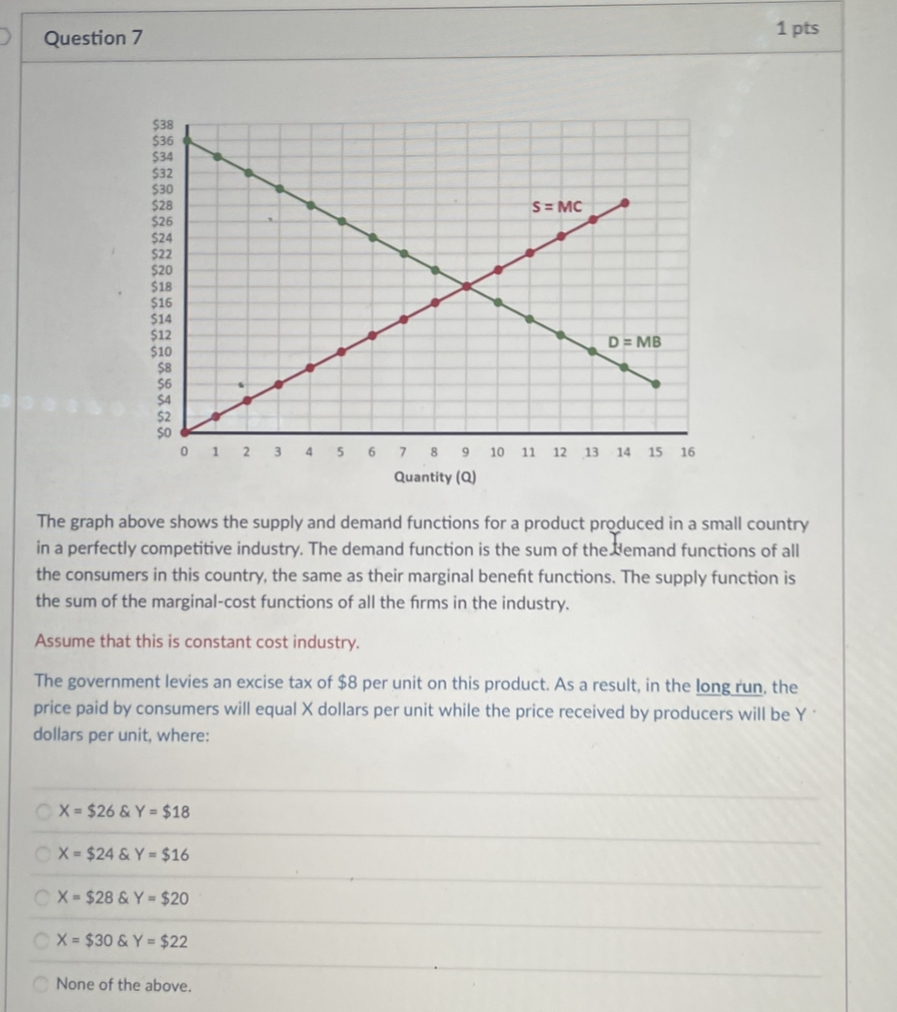
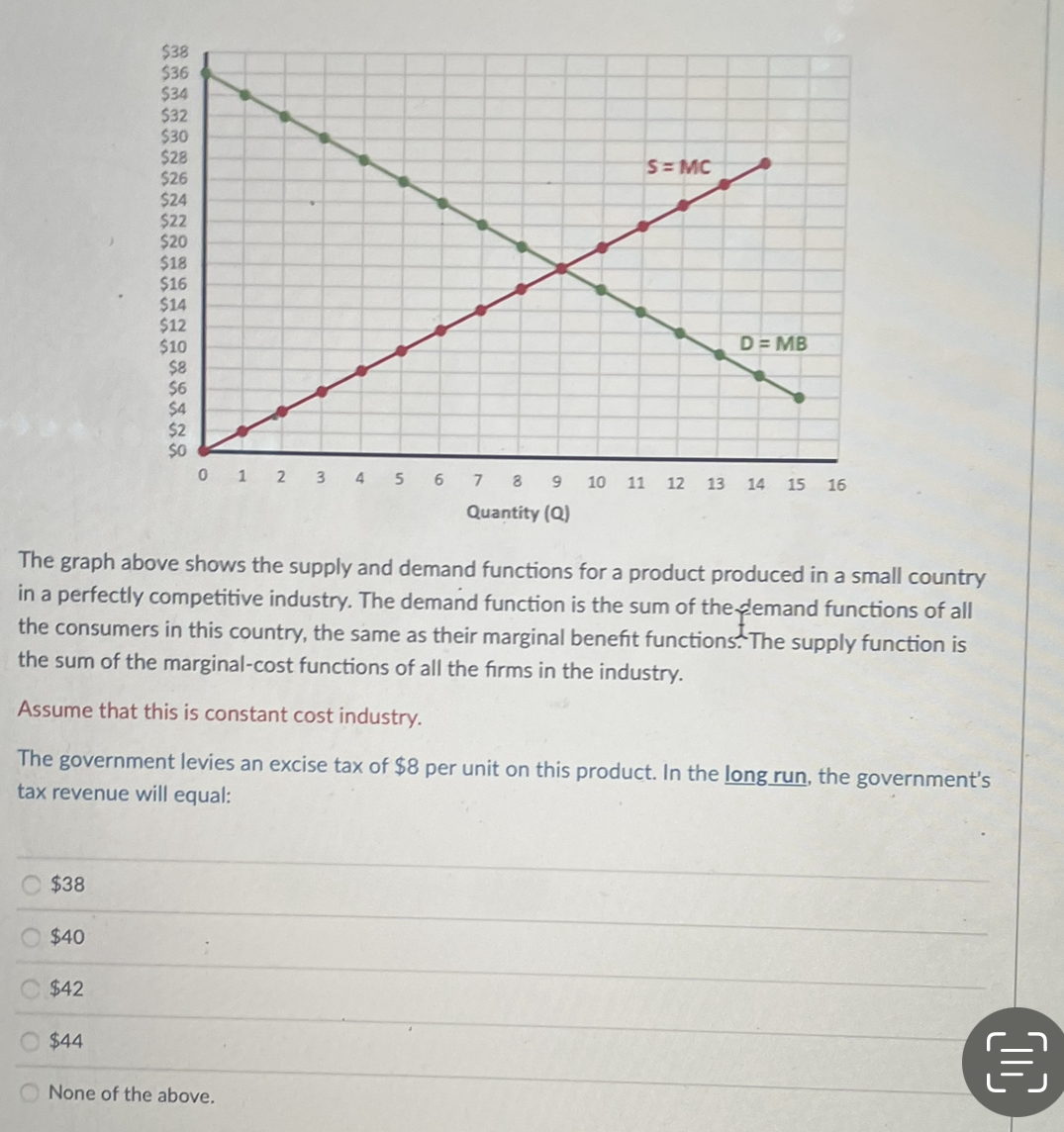
1 pts Question 7 $38 $36 $34 $32 $30 $28 S = MC $26 $24 $22 $20 $18 $16 $14 $12 D = MB $10 0 6 7 9 10 11 12 13 14 15 16 Quantity (Q) The graph above shows the supply and demand functions for a product produced in a small country in a perfectly competitive industry. The demand function is the sum of the demand functions of all the consumers in this country, the same as their marginal benefit functions. The supply function is the sum of the marginal-cost functions of all the firms in the industry. Assume that this is constant cost industry. The government levies an excise tax of $8 per unit on this product. As a result, in the long run, the price paid by consumers will equal X dollars per unit while the price received by producers will be Y . dollars per unit, where: X = $26 & Y = $18 O X = $24 & Y = $16 CX = $28 & Y = $20 CX = $30 & Y = $22 None of the above.$38 $36 $34 $32 $30 $28 S = MC $26 $24 $22 $20 $18 $16 $14 $12 D = MB $10 $8 56 $4 $2 So 0 2 5 6 7 8 9 10 11 12 13 14 15 16 Quantity (Q) The graph above shows the supply and demand functions for a product produced in a small country in a perfectly competitive industry. The demand function is the sum of the demand functions of all the consumers in this country, the same as their marginal benefit functions. The supply function is the sum of the marginal-cost functions of all the firms in the industry. Assume that this is constant cost industry. The government levies an excise tax of $8 per unit on this product. In the long run, the government's tax revenue will equal: $38 O $40 C $42 O $44 None of the above
Step by Step Solution
There are 3 Steps involved in it

Get step-by-step solutions from verified subject matter experts
 Study Help