





Question: Help, please As we learn in chapter 13, working in a team often involves recognizing and resolving conflict. In this assignment, you'll recall a situation
Help, please
As we learn in chapter 13, working in a team often involves recognizing and resolving conflict. In this assignment, you'll recall a situation and analyze it in terms of what we know about conflict.
Instructions:
- Identify and describe a situation where group conflict occurred. It can be work, social, or academic in nature.
- Identify - was it functional or dysfunctional? Explain your decision.
- Using one of the five styles from chapter 13 page 527, describe how you would have handled the conflict if you were in charge. Explain why the style you chose would be effective.
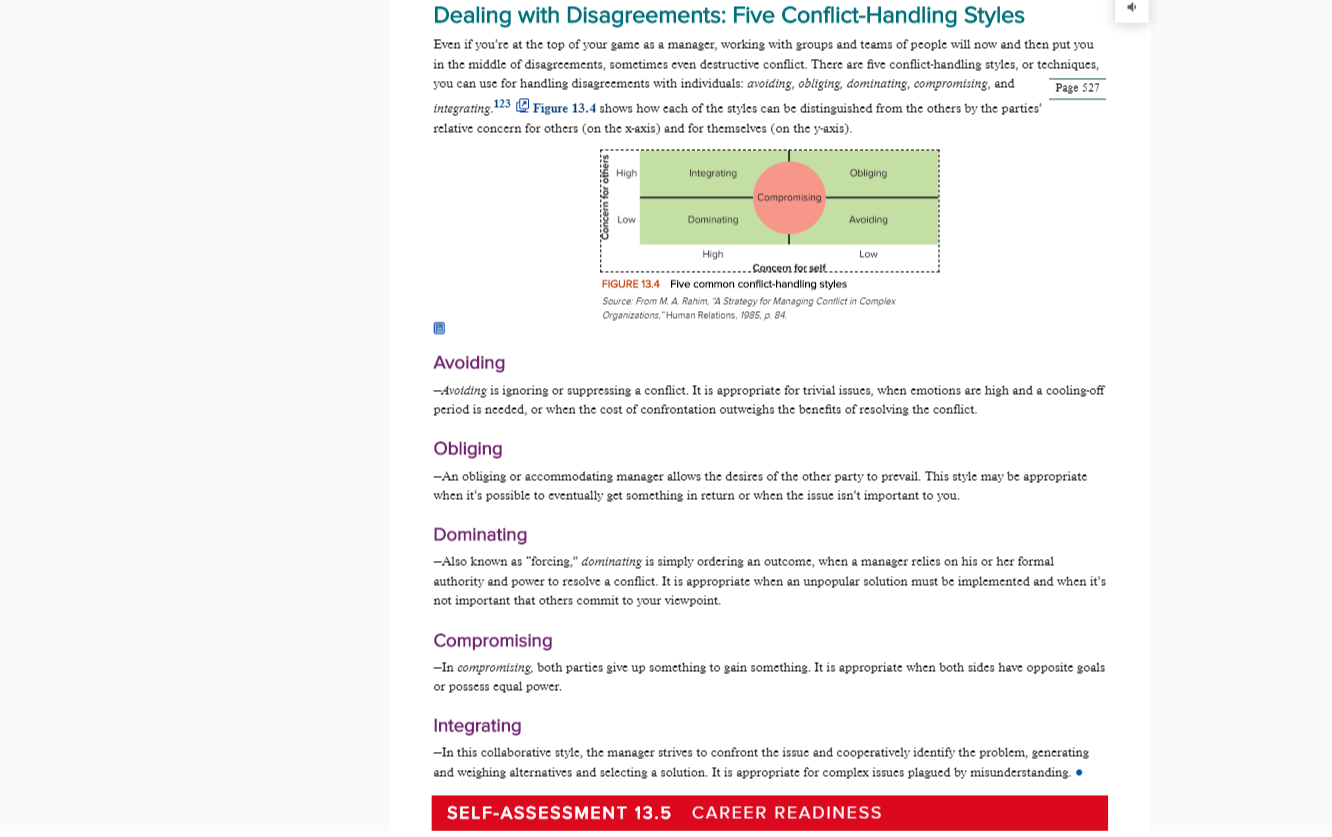
Dealing with Disagreements: Five Conflict-Handling Styles Even if you're at the top of your game as a manager, working with groups and teams of people will now and then put you in the middle of disagreements, sometimes even destructive conflict. There are five conflict-handling styles, or techniques, you can use for handling disagreements with individuals: avoiding, obliging, dominating, compromising, and Page 527 integrating 123 Figure 13.4 shows how each of the styles can be distinguished from the others by the parties' relative concern for others (on the x-axis) and for themselves (on the y-axis). Integrating Obliging Concern for others Compromising Dominating Avoiding High Low ... Sconcern for selt .... FIGURE 13.4 Five common conflict-handling styles Source: From M. A. Rahim, "A Strategy for Managing Contlict in Complex Organizations, "Human Relations, 1985, p. 84. Avoiding -Avoiding is ignoring or suppressing a conflict. It is appropriate for trivial issues, when emotions are high and a cooling-off period is needed, or when the cost of confrontation outweighs the benefits of resolving the conflict. Obliging -An obliging or accommodating manager allows the desires of the other party to prevail. This style may be appropriate when it's possible to eventually get something in return or when the issue isn't important to you. Dominating -Also known as "forcing," dominating is simply ordering an outcome, when a manager relies on his or her formal authority and power to resolve a conflict. It is appropriate when an unpopular solution must be implemented and when it's not important that others commit to your viewpoint. Compromising - In compromising, both parties give up something to gain something. It is appropriate when both sides have opposite goals or possess equal power. Integrating - In this collaborative style, the manager strives to confront the issue and cooperatively identify the problem, generating and weighing alternatives and selecting a solution. It is appropriate for complex issues plagued by misunderstanding.. SELF-ASSESSMENT 13.5 CAREER READINESS

