







Question: help please Data Lifecycle Management: A Big Challenge for Big Data Over 90 percent of the world's data was generated in the last two years.
help please 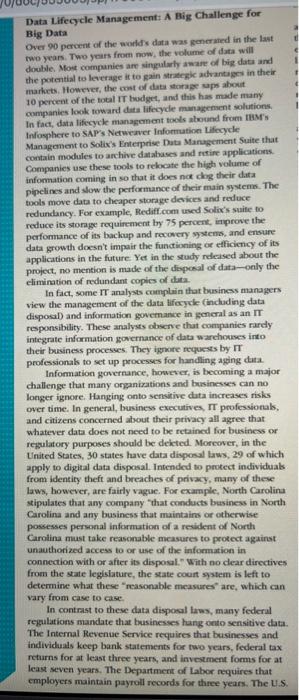
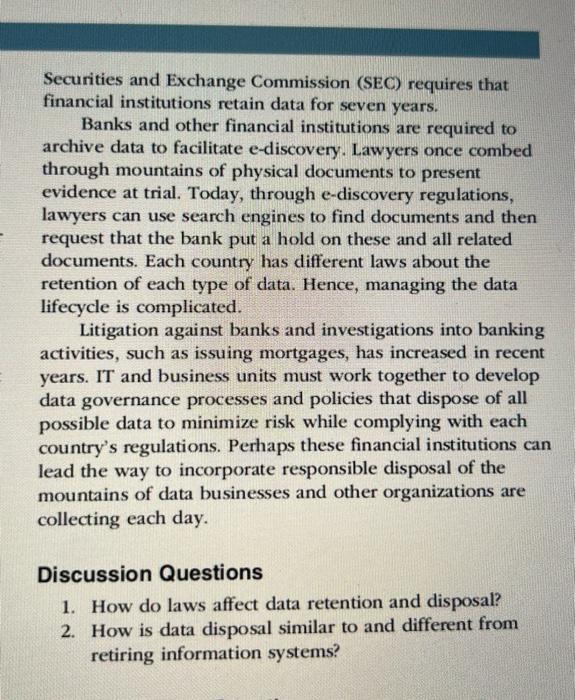
Data Lifecycle Management: A Big Challenge for Big Data Over 90 percent of the world's data was generated in the last two years. Two years from now, the volume of data will double. Most companies are singularly aware of big data and the potential to leverage it to gain strategic advantages in their markets. However, the cost of data storage saps about 10 percent of the total IT budget, and this has made many companies look toward data lifecycle management solutions. In fact, data lifecycle management tools abound from IBM's Infosphere to SAP's Netweaver Information Lifecycle Management to Solix's Enterprise Data Management Suite that contain modules to archive databases and retire applications. Companies use these tools to relocate the high volume of information coming in so that it does not clog their data pipelines and slow the performance of their main systems. The tools move data to cheaper storage devices and reduce redundancy. For example, Rediff.com used Solix's suite to reduce its storage requirement by 75 percent, improve the performance of its backup and recovery systems, and ensure data growth doesn't impair the functioning or efficiency of its applications in the future. Yet in the study released about the project, no mention is made of the disposal of data-only the elimination of redundant copies of data. In fact, some IT analysts complain that business managers view the management of the data lifecycle (including data disposal) and information governance in general as an IT responsibility. These analysts observe that companies rarely integrate information governance of data warehouses into their business processes. They ignore requests by IT professionals to set up processes for handling aging data. Information governance, however, is becoming a major challenge that many organizations and businesses can no longer ignore. Hanging onto sensitive data increases risks over time. In general, business executives, IT professionals, and citizens concerned about their privacy all agree that whatever data does not need to be retained for business or regulatory purposes should be deleted. Moreover, in the United States, 30 states have data disposal laws, 29 of which apply to digital data disposal. Intended to protect individuals from identity theft and breaches of privacy, many of these laws, however, are fairly vague. For example, North Carolina stipulates that any company that conducts business in North Carolina and any business that maintains or otherwise possesses personal information of a resident of North Carolina must take reasonable measures to protect against unauthorized access to or use of the information in connection with or after its disposal." With no clear directives from the state legislature, the state court system is left to determine what these "reasonable measures" are, which can vary from case to case. In contrast to these data disposal laws, many federal regulations mandate that businesses hang onto sensitive data. The Internal Revenue Service requires that businesses and individuals keep bank statements for two years, federal tax returns for at least three years, and investment forms for at least seven years. The Department of Labor requires that employers maintain payroll records for three years. The U.S. Securities and Exchange Commission (SEC) requires that financial institutions retain data for seven years. Banks and other financial institutions are required to archive data to facilitate e-discovery. Lawyers once combed through mountains of physical documents to present evidence at trial. Today, through e-discovery regulations, lawyers can use search engines to find documents and then request that the bank put a hold on these and all related documents. Each country has different laws about the retention of each type of data. Hence, managing the data lifecycle is complicated. Litigation against banks and investigations into banking activities, such as issuing mortgages, has increased in recent years. IT and business units must work together to develop data governance processes and policies that dispose of all possible data to minimize risk while complying with each country's regulations. Perhaps these financial institutions can lead the way to incorporate responsible disposal of the mountains of data businesses and other organizations are collecting each day. Discussion Questions 1. How do laws affect data retention and disposal? 2. How is data disposal similar to and different from retiring information systems Step by Step Solution
There are 3 Steps involved in it
1 Expert Approved Answer
Step: 1 Unlock

Question Has Been Solved by an Expert!
Get step-by-step solutions from verified subject matter experts
Step: 2 Unlock
Step: 3 Unlock
 Study Help