



Question: help please E-books, an online book retailer, has two operating departmentscorporate sales and consumer salesand two support departmentshuman resources and information systems. (Click the icon
 help please
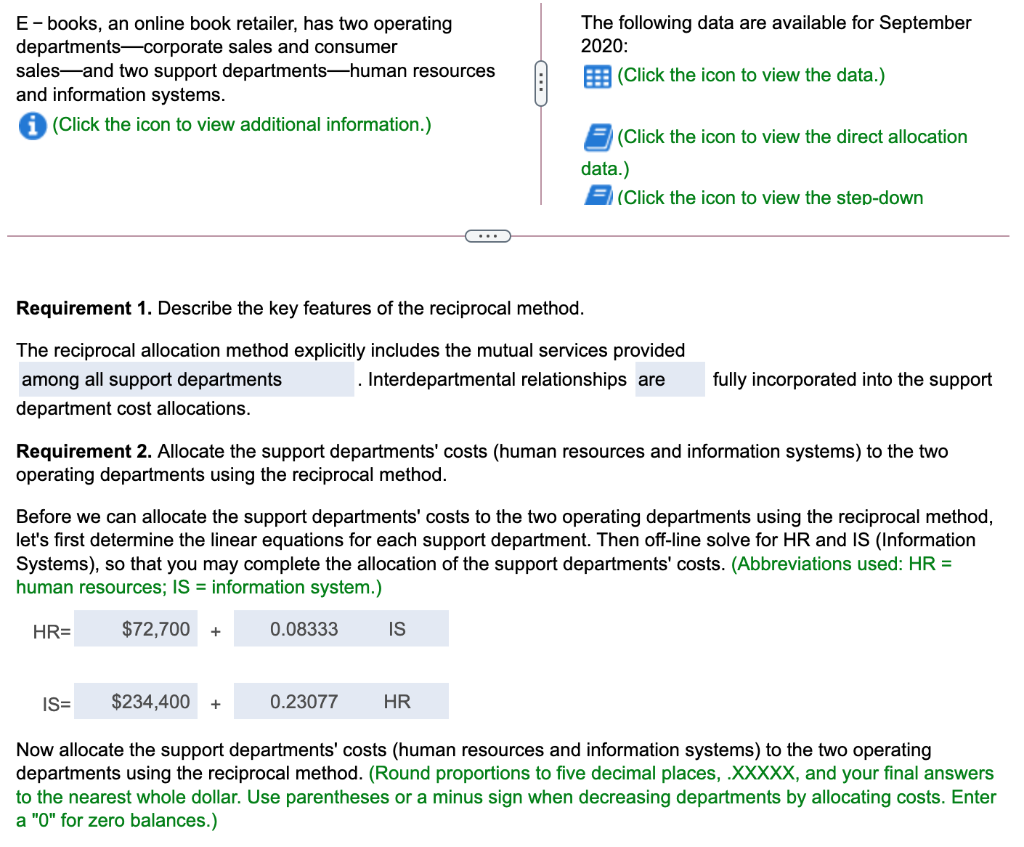
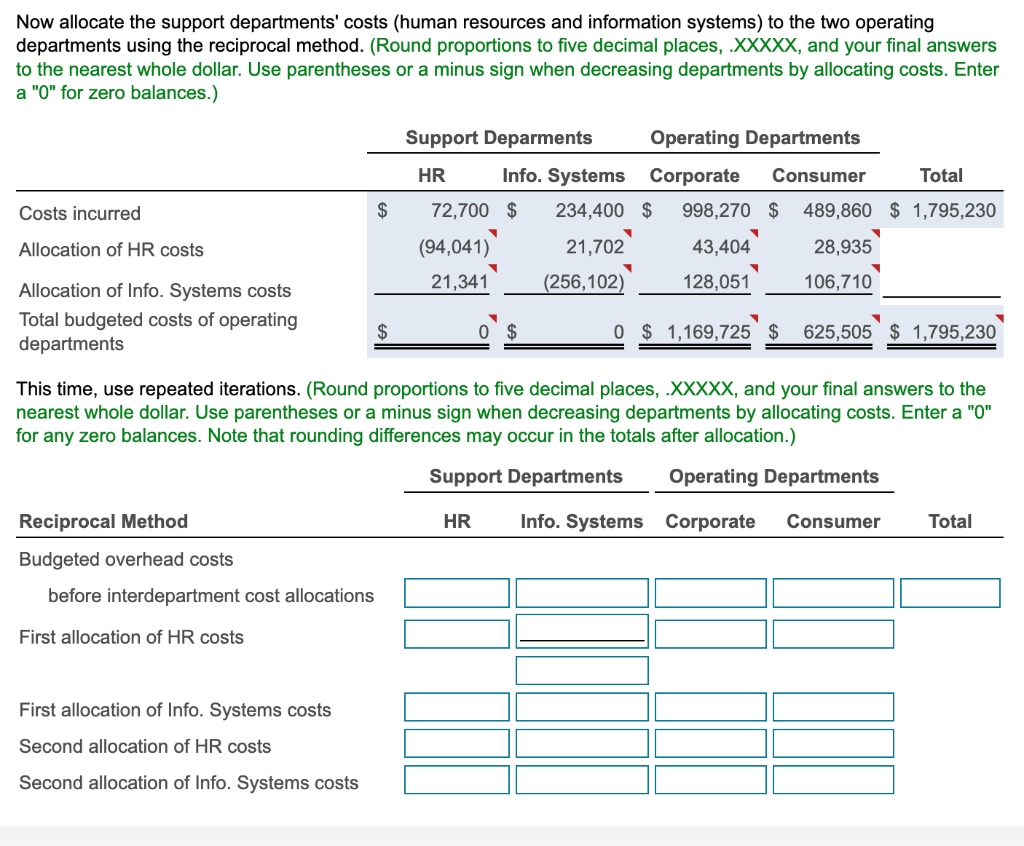
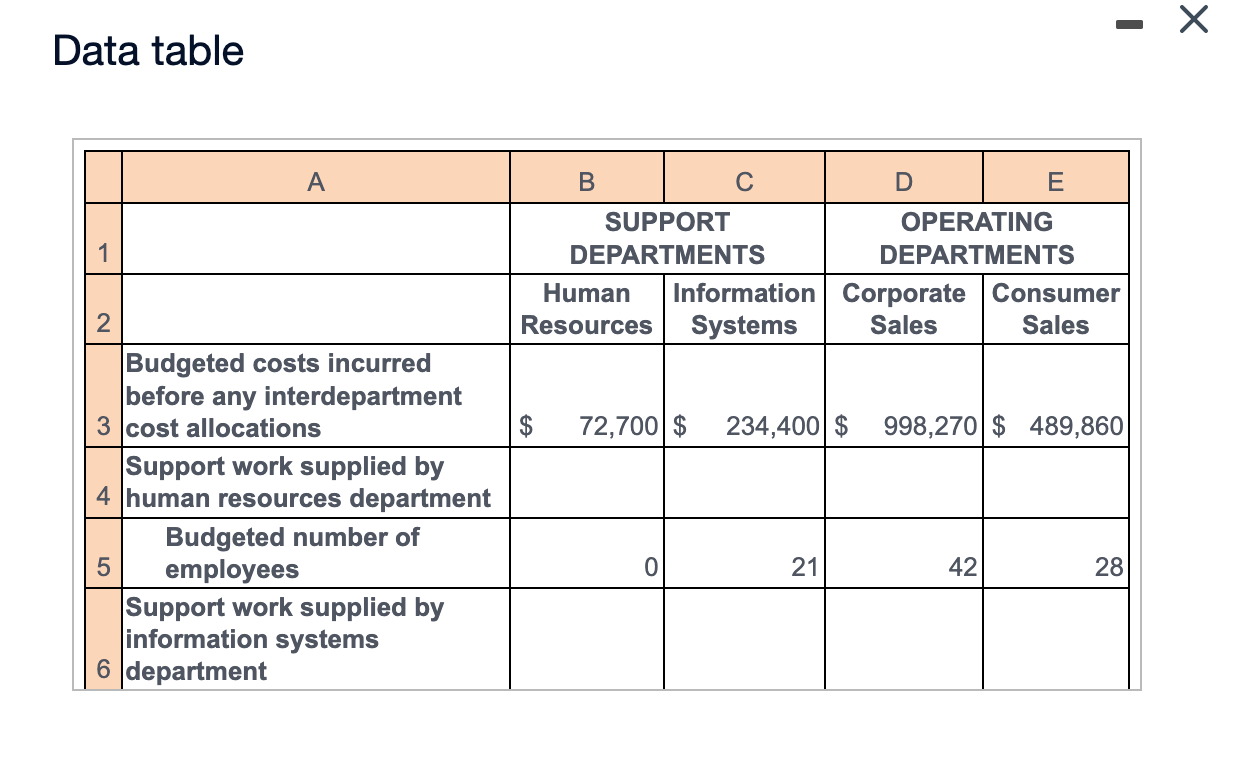
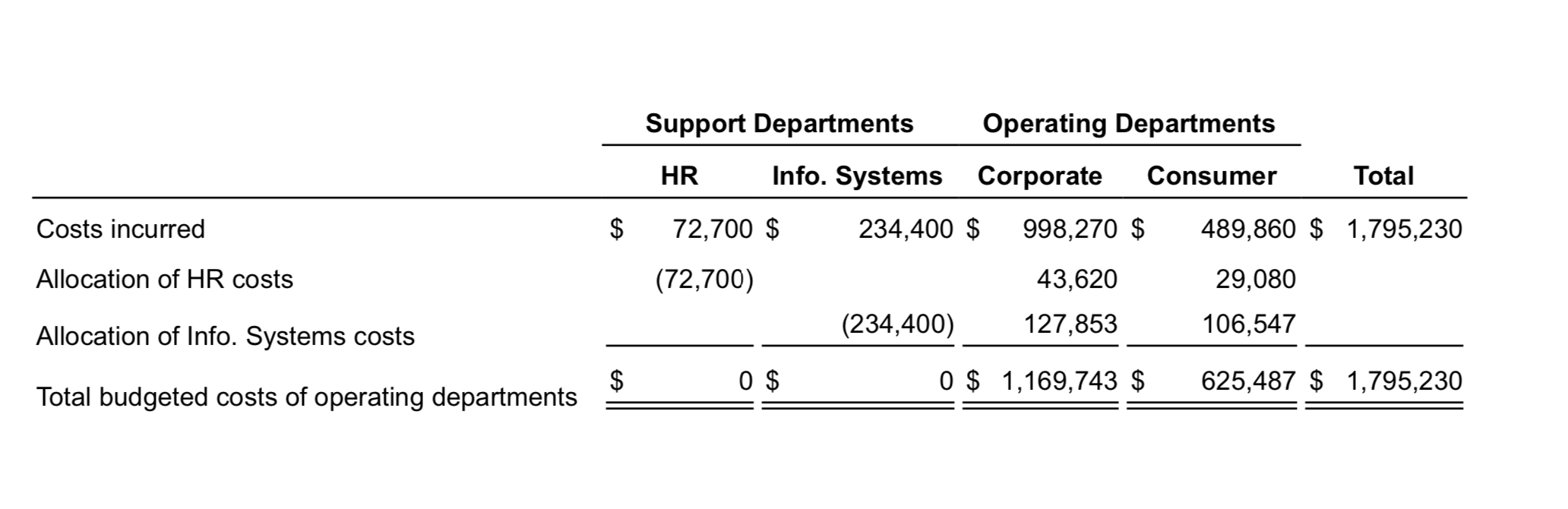
E-books, an online book retailer, has two operating departmentscorporate sales and consumer salesand two support departmentshuman resources and information systems. (Click the icon to view additional information.) The following data are available for September 2020: (Click the icon to view the data.) .. (Click the icon to view the direct allocation data.) (Click the icon to view the step-down Requirement 1. Describe the key features of the reciprocal method. The reciprocal allocation method explicitly includes the mutual services provided among all support departments . Interdepartmental relationships are department cost allocations. fully incorporated into the support Requirement 2. Allocate the support departments' costs (human resources and information systems) to the two operating departments using the reciprocal method. Before we can allocate the support departments' costs to the two operating departments using the reciprocal method, let's first determine the linear equations for each support department. Then off-line solve for HR and IS (Information Systems), so that you may complete the allocation of the support departments' costs. (Abbreviations used: HR = human resources; IS = information system.) HR= $72,700 + 0.08333 IS IS= $234,400 + 0.23077 HR Now allocate the support departments' costs (human resources and information systems) to the two operating departments using the reciprocal method. (Round proportions to five decimal places, .XXXXX, and your final answers to the nearest whole dollar. Use parentheses or a minus sign when decreasing departments by allocating costs. Enter a "0" for zero balances.) Now allocate the support departments' costs (human resources and information systems) to the two operating departments using the reciprocal method. (Round proportions to five decimal places, XXXXX, and your final answers to the nearest whole dollar. Use parentheses or a minus sign when decreasing departments by allocating costs. Enter a "0" for zero balances.) Costs incurred $ Support Deparments Operating Departments HR Info. Systems Corporate Consumer Total 72,700 $ 234,400 $ 998,270 $ 489,860 $ 1,795,230 (94,041) 21,702 43,404 28,935 21,341 (256,102) 128,051 106,710 Allocation of HR costs Allocation of Info. Systems costs Total budgeted costs of operating departments $ $ 0 $ 1,169,725 $ 625,505 $ 1,795,230 This time, use repeated iterations. (Round proportions to five decimal places, .XXXXX, and your final answers to the nearest whole dollar. Use parentheses or a minus sign when decreasing departments by allocating costs. Enter a "0" for any zero balances. Note that rounding differences may occur in the totals after allocation.) Support Departments Operating Departments Reciprocal Method HR Info. Systems Corporate Consumer Total Budgeted overhead costs before interdepartment cost allocations First allocation of HR costs First allocation of Info. Systems costs Second allocation of HR costs Second allocation of Info. Systems costs - Data table A B D E 1 SUPPORT OPERATING DEPARTMENTS DEPARTMENTS Human Information Corporate Consumer Resources Systems Sales Sales $ 72,700 $ 234,400 $ 998,270 $ 489,860 2 Budgeted costs incurred before any interdepartment 3 cost allocations Support work supplied by 4 human resources department Budgeted number of 5 employees Support work supplied by information systems 6 department 0 21 42 28 Support Departments Operating Departments HR Info. Systems Corporate Consumer Total Costs incurred $ 72,700 $ 234,400 $ 998,270 $ 489,860 $ 1,795,230 Allocation of HR costs (72,700) 43,620 29,080 106,547 Allocation of Info. Systems costs (234,400) 127,853 $ 0 $ 0 $ 1,169,743 $ 625,487 $ 1,795,230 Total budgeted costs of operating departments
Step by Step Solution
There are 3 Steps involved in it

Get step-by-step solutions from verified subject matter experts