







Question: Help please Every variable has three major items associated with it: the value stored in the variable, the number of bytes reserved for the variable,
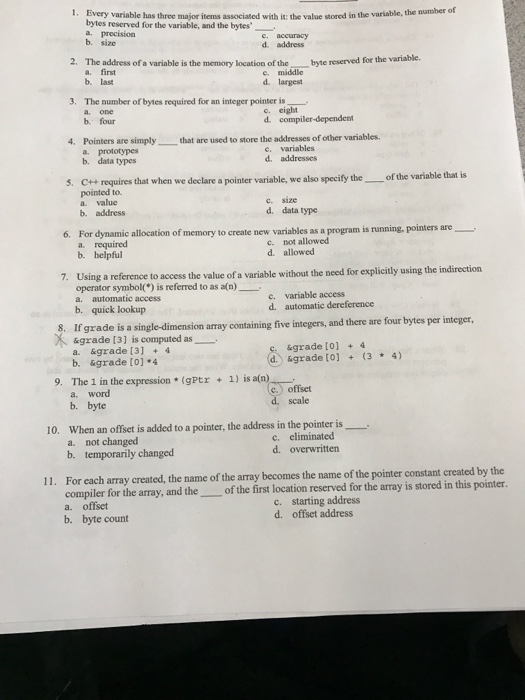
Every variable has three major items associated with it: the value stored in the variable, the number of bytes reserved for the variable, and the bytes'--. a. precision b. size 1. c. accuracy d. address 2. The address of a variable is the memory location of the byte reserved for the variable. a. first b. last middle d. largest 3. The number of bytes required for an integer pointer is a. one b. four c. eight d. compi 4. Pointers are simplythat are used to store the addresses of other variables. e. variables d. addresses a. prototypes b. data types 5. C++ requires that when we declare a pointer variable, we also specify the__ of the pointed to. c. size d. data type a. value b. address For dynamic allocation of memory to create new variables as a program is running, po a. required b. helpful inters are 6. c. not allowed d. allowed Using a reference to access the value of a variable without the need for explicitly using the indirection operator symbol() is referred to as a(n) a. automatic access b. quick lookup 7. c. variable access d. automatic dereference is a single-dimension array containing five integers, and there are four bytes per integer, s. If grade X &grade [3] is computed as c. &grade [0] 4 d. &grade to](3 4) 4 a. grade [3 b. grade [0] 4 1) is a(n) The 1 in the expression * (gptr a. word b. byte 9. + c.) offset d. scale 10. When an offset is added to a pointer, the address in the pointer is c. eliminated a. not changed b. temporarily changed d. overwritten For each array created, the name of the array becomes the compiler for the array, and the a. offset b. byte count name of the pointer constant created by the 11. location reserved for the array is stored in this pointer. c. starting address d. offset address of the first
Step by Step Solution
There are 3 Steps involved in it

Get step-by-step solutions from verified subject matter experts
 Study Help